
How to Keep Outdoor Cats Warm in Winter
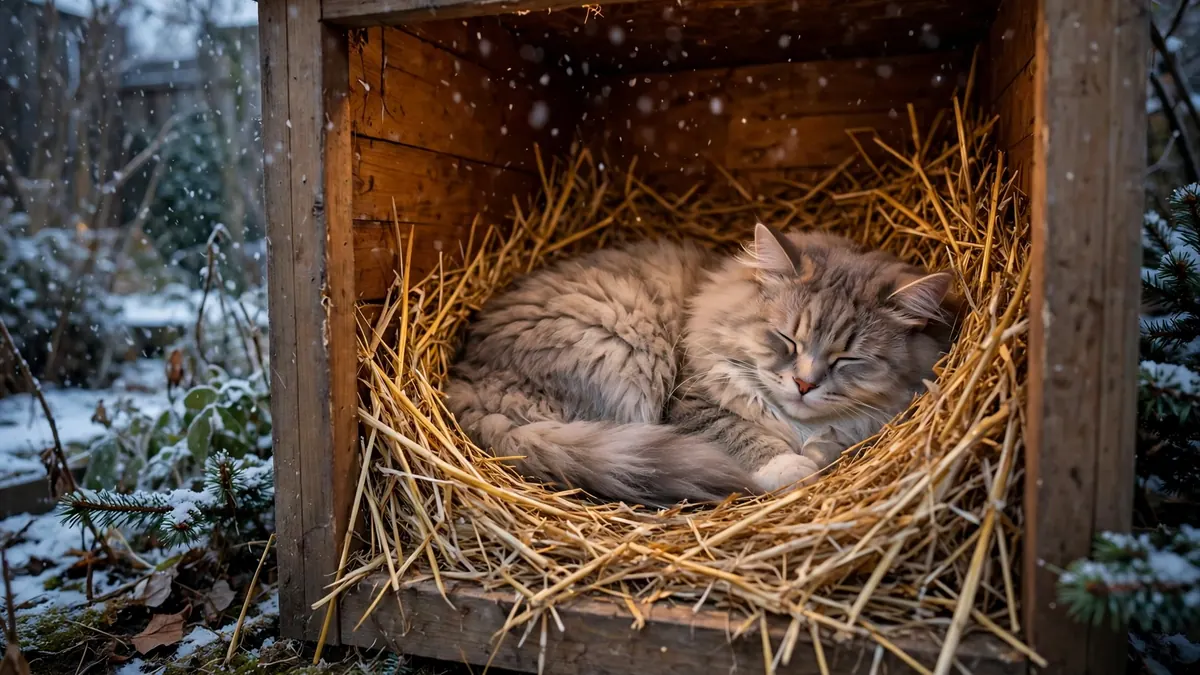
A healthy adult cat with a dry, windproof place to sleep can come through hard winter weather surprisingly well. A cat without one is in genuine trouble once temperatures drop below freezing: body heat leaks away faster than food can replace it, water turns to ice, and ears, tails and toes are exposed to frostbite. Almost everything that protects an outdoor cat in winter comes down to three things, a small dry shelter, unfrozen water, and extra calories.
This guide covers both kinds of outdoor cat. If yours is a pet who lives partly or mostly outside, you have an option colony caretakers do not: bringing the cat in when weather turns dangerous. If you feed community cats, the unowned, often unsocialised cats who live outdoors full-time, your job is different: support them in the territory they know rather than trying to move them. The shelter, water and feeding advice applies to both.
The Short Answer
Give the cat a small, raised, windproof shelter packed with straw, not hay, not blankets, with one small entrance, set out of the wind. Feed more than usual, on a predictable schedule, and keep water drinkable with a deep plastic or heated bowl checked twice a day. Bang on your car bonnet before starting it, keep antifreeze and de-icing salt away from anywhere cats walk, and bring pet cats, kittens, seniors and struggling cats indoors as temperatures fall towards freezing.
Key Takeaways
- Small shelters stay warmer than big ones, a cat heats a small space with its own body. Bigger is not better.
- Straw is the only bedding for an outdoor shelter. Hay, blankets, towels and newspaper soak up moisture and can freeze against the cat.
- Deep, thick plastic bowls in a sunny spot buy time against freezing; a heated bowl solves it.
- Staying warm burns calories, so winter portions go up, not down.
- Antifreeze is lethal to cats in tiny amounts and tastes sweet to them. Clean up every spill; never use salt or chemical de-icers where cats walk.
Disclosure: this guide mentions product types, heated bowls, outdoor heating pads, ready-made shelters, and we may earn a commission if you buy through links on this page. We describe what to look for; we have not tested specific models.
Two Kinds of Outdoor Cats
A pet cat who goes outdoors is socialised, has a home base, and can usually be brought inside when conditions demand it. For that cat, everything here is a back-up layer: useful on cold days, essential if the cat is ever shut out overnight, and no substitute for a warm house in a cold snap.
A community cat, feral, stray or barn cat, lives outside by circumstance or by nature. Alley Cat Allies, the organisation that sets the standard for community cat care, is clear: healthy adult community cats are adapted to their territory and should be supported there, not rounded up. Taking a feral cat to a shelter is not a rescue; many shelters lack non-lethal policies for unsocialised cats, and the cat may be killed. What helps is shelter, reliable food and water, and check-ins after storms. If you are new to looking after cats, our new cat owner starter kit covers the wider basics of food, litter and vet care.
The Shelter: Small, Dry and Off the Ground
Shelter is the most important winter intervention, and the design rule is counterintuitive: the best shelter is barely bigger than the cat. Alley Cat Allies’ guidance for a good size is about 2 feet by 3 feet and 18 inches high, enough for cats to huddle, small enough that body heat actually warms the air inside. A big, roomy shelter stays as cold as the night outside it.
You can build one from two nested plastic storage bins with rigid foam insulation between them, or from a thick-walled foam cooler inside a bin, with a single entrance hole cut through the layers. Ready-made insulated cat houses exist if building is not for you. Whichever route you take, the non-negotiables are the same:
- One small entrance. No more than 6 to 8 inches wide, big enough for a cat, too small for most predators and dogs, and small enough to keep wind and snow out. A loose flap adds protection, as long as it cannot freeze shut.
- Raised off the ground. Set the shelter on a wooden pallet, bricks or boards. A floor touching frozen ground conducts heat straight out and lets meltwater seep in.
- Insulated walls. Foam board lining inside walls and roof stops body heat escaping through thin plastic.
- Weatherproof and weighted. A sloped or secured lid sheds rain and snow; in storm-prone spots, weigh a lightweight shelter down with bricks so it cannot blow over with a cat inside.
For a colony, several smaller shelters beat one large one: friendly cats huddle three to five to a shelter, while cats who do not get along refuse to share, and the lowest-ranking cat ends up sleeping in the wind.
Placement: Out of the Wind, Into the Sun
Where the shelter sits matters almost as much as how it is built. Face the entrance away from the prevailing wind, wind chill strips heat far faster than still air, and angle it against a wall, fence or hedge. A spot that catches daytime sun warms the shelter and the ground in front of it. Keep it somewhere quiet and discreet, in the territory the cats already use; a shelter placed where cats do not go will be ignored.
If you have a garage, shed or barn, giving cats access during severe weather is the simplest shelter upgrade of all, Alley Cat Allies recommends it, with one strict condition: remove or lock away antifreeze and other chemicals first. After heavy snow, dig out shelter entrances: cats can be snowed into a shelter as easily as out of one.
Bedding: Straw, Never Hay or Blankets
If you remember one rule from this guide, make it this one: straw, not hay. The two look similar and are not interchangeable. Straw, the dry, hollow stalks left from harvested grain, repels moisture, so it stays dry and insulating, and cats burrow into it so it traps their body heat around them. Hay is animal feed: it absorbs moisture, goes soggy and mouldy, and a damp bed actively pulls heat from the cat sleeping in it. Blankets, towels and newspaper fail the same way; as Alley Cat Allies puts it, blankets absorb moisture like a sponge. A frozen blanket is worse than no blanket at all.
Pack the straw in loosely to about a quarter to halfway up the shelter, so the cat can tunnel in and be covered. You can line the shelter with a mylar emergency blanket under the straw, it reflects radiant heat back, but cover it completely, because cats dislike bare mylar’s crinkle and may avoid the shelter. Check bedding after rain and storms and replace any that is damp or soiled; keep spare straw stored dry.
Electric heat belongs in shelters only for pet cats, near a safe outdoor outlet, with equipment made for the job: a low-wattage, outdoor-rated heated pad designed for animals, with a chew-resistant cord you inspect regularly. GreatPetCare’s veterinary guidance makes the same point: keep a layer between cat and element, and check cords for wear, a damaged cord is an electrocution risk. Never run household heating pads, heat lamps or space heaters in a colony shelter: unsupervised mains electricity in a straw-filled box is a fire risk that outweighs the cold. For colony cats, dry straw done properly is the heating system.
Water: Beating the Freeze
A cat copes with a missed meal far better than with no water. Dehydration is a real winter risk precisely because water is the first thing to freeze, and Alley Cat Allies recommends fresh water twice a day in extremely cold weather. The physics is on your side if you choose the bowl well:
- Deep, not wide. A deep bowl exposes less surface to the air and freezes more slowly than a wide, shallow one. Set it in the sunniest sheltered spot you have.
- Thick plastic or rubber, never metal. The ASPCA’s winter guidance is blunt: use plastic bowls rather than metal, because at low temperatures a cat’s tongue can stick and freeze to metal. Thick plastic also flexes, so ice pops out without cracking the bowl.
- Refill with warm water, on a schedule. Warm water buys an hour or two; hot water adds nothing and risks a scalded mouth. Twice-daily refills beat any trick.
- For light frosts, a floating ball. A ping-pong ball on the surface keeps water moving slightly and stops a full skin of ice forming, a caretaker trick for marginal nights. Well below freezing, no trick wins for long.
- The reliable fix: a heated bowl. A thermostatically controlled, safety-listed heated bowl keeps water liquid around the clock. Alley Cat Allies includes a pinch of sugar in its older winter tips, as a way to slow freezing slightly and add a little energy; treat it as a marginal extra, bowl choice, sun and refills do the real work.
Keep water bowls at the feeding station, not inside the shelter, a spilled bowl turns the bedding into a wet, freezing mattress.
Food: More Calories, Served on Schedule
Staying warm burns energy, so winter feeding means larger portions, not the same scoop, Alley Cat Allies advises increasing portions through severe cold rather than letting leftovers freeze in the dish.
Wet and dry food behave differently in the cold. Wet food costs the cat least energy to digest, so more energy goes on staying warm, but it freezes fast, sometimes before a shy cat dares to eat. Serve it at set mealtimes and remove what is left before it turns to ice. Dry food will not freeze, making it the dependable backbone of winter feeding: put out extra, kept dry in a simple covered feeding station that also keeps cats’ feet off frozen ground while they eat. A little foam insulation under a plastic dish slows freezing of both food and water.
Whatever the menu, consistency is the strategy: feed at the same times daily and community cats learn the schedule, arriving while food is unfrozen instead of wandering in the cold. Before a major storm, put out extra food and water in case snow keeps you away for a day or two.
Cold-Snap Extras: Cars, Paws and Poison
Bang the bonnet. A recently driven car is one of the warmest spots on a winter street, and cats crawl up under the bonnet to sleep against the engine; starting it can injure or kill them. Both the ASPCA and Alley Cat Allies give the same advice: bang loudly on the bonnet, check underneath and between the tyres, and give any hidden cat a few seconds to escape.
Antifreeze is the winter poison. Most antifreeze is made with ethylene glycol, and the ASPCA warns that it is lethal to cats even in tiny doses, its sweet taste actively attracts animals to spills and puddles. Wipe up every spill immediately, store containers out of reach, and never let cats drink from driveway puddles near parked cars. If you buy antifreeze, choose a propylene glycol product: Alley Cat Allies notes it is less toxic, though still toxic, so the clean-up rule does not change. If you suspect a cat has licked antifreeze, treat it as an emergency: contact your vet or the ASPCA Animal Poison Control Center (888-426-4435) immediately.
Mind the salt. Salt and chemical de-icers irritate cats’ paw pads and can poison a cat who licks them clean afterwards. Alley Cat Allies does not recommend salt or chemical melting products near cat colonies at all; sand gives grip without the chemistry. Even products sold as pet-safe deserve caution, because cats can still drink from meltwater puddles. For pet cats, wipe paws, legs and belly with a damp towel as they come in, as the ASPCA advises, so nothing is licked off later. If a cold snap brings a pet cat indoors, sweep for hazards first, the season’s plants come in too, and while poinsettias are only mildly toxic to cats, garage antifreeze is not mild at all.
When It’s Too Cold: Bring Them In
There is no single danger temperature, coat, age, health, wind and wet all shift the line, but the guidance converges. The Humane Society of the United States recommends limiting pet cats’ outdoor time once temperatures drop below 45°F (7°C), and below freezing, 32°F (0°C), the risk of hypothermia and frostbite climbs sharply for any cat without proper shelter. A wet cat loses heat far faster than a dry one, so a rainy 40°F night can be worse than a still, dry 25°F one.
Some cats should never be expected to tough out a cold snap, whatever the thermometer says:
- Kittens, who cannot regulate their body temperature well and chill quickly.
- Senior cats, whose circulation and muscle mass are reduced.
- Sick, injured, pregnant or underweight cats, who have no reserves to burn.
- Short-haired and hairless cats, and any pet cat who normally lives indoors, an indoor cat put outside in winter has neither the coat nor the habits for it.
For a pet cat, “indoors” need not mean the living room: a box of straw in a garage, barn or porch corner breaks the wind and lifts the cat out of the worst of it. For a healthy adult community cat the calculation reverses, capture stress, and the risk of a shelter system that may kill an unsocialised cat, usually outweigh the benefit, so Alley Cat Allies advises leaving community cats in their territory and upgrading their shelter instead. The exceptions are the vulnerable list above: a kitten, or a visibly ill or injured cat, needs a vet or an experienced local rescue contacted, not a warmer box.
Learn the emergency signs, because a cat in trouble needs a vet, not more straw. Hypothermia shows as shivering (which may lessen as it worsens), lethargy, weakness, stiff movements, slow shallow breathing, and ears, paws or a tail tip that feel cold and look pale or blue-tinged. Frostbite attacks the thin-skinned extremities first, ear tips, toes, tail tip, where skin looks pale, grey or bluish and feels cold and firm; swelling and blistering can follow on thawing. If you can handle the cat safely, bring it into the warm and get veterinary help straight away. Our holiday safety guide for cats covers the indoor hazards that arrive with the season.
The Winter Checklist
- Shelter built or bought: small (about 2 × 3 ft), insulated, one 6 to 8 inch entrance with a free-moving flap.
- Raised on a pallet or boards, entrance facing away from the wind, in a quiet spot that gets some sun.
- Bedding is straw, packed loosely a quarter to halfway up, never hay, blankets or towels.
- Spare straw stored dry for refreshes after storms; entrances dug out after snowfall.
- Deep plastic or rubber water bowl (never metal) in a sunny spot, refilled warm twice a day, or a heated bowl, plugged in and checked.
- Portions increased; wet food at set mealtimes with frozen leftovers removed; extra dry food always available under cover.
- Antifreeze stored away and every spill wiped up; no salt or chemical de-icer near shelters and feeding stations; sand used for grip instead.
- Bonnet banged and tyres checked before every winter drive.
- A warm fallback space, garage, shed or barn, chemicals removed, ready for pet cats, kittens, seniors and any cat who is struggling.
- Hypothermia and frostbite signs known, and your vet’s number saved.
Frequently Asked Questions
How cold is too cold for an outdoor cat?
There is no exact number, because wind, wet and the cat’s age and health matter as much as the thermometer. As working guidance: limit pet cats’ time outdoors below 45°F (7°C), as the Humane Society recommends, and treat anything below freezing (32°F / 0°C) as dangerous for a cat without a dry, insulated shelter. Kittens, seniors and sick or thin cats are at risk well above freezing and should spend cold snaps in at least a garage.
Why is straw better than a blanket in an outdoor shelter?
Moisture. Straw’s hollow stalks repel water, so it stays dry and keeps insulating, and a cat can burrow in and trap its own body heat. Blankets, towels and hay absorb moisture like a sponge; on a freezing night the damp fabric chills, can freeze stiff, and draws heat away from the cat instead of holding it in. Outdoors, dry always beats soft.
Can I put a heating pad in an outdoor cat shelter?
For a pet cat’s shelter near a safe outdoor outlet, yes, with conditions: use a low-wattage pad made for animals and rated for outdoor use, keep a layer between the cat and the element, make sure the cat can move off it, and inspect the cord regularly. For colony shelters without safe, supervised power, skip electric heat entirely; insulated walls and deep straw heat those safely on body warmth alone.
Should I bring a feral cat indoors during a cold snap?
For a healthy adult community cat, usually no. Feral cats are adapted to their territory, capture causes real stress, and a shelter can be fatal for an unsocialised cat, which is why Alley Cat Allies advises supporting community cats where they live: improve the shelter, add straw, feed extra, keep water flowing. Kittens and visibly sick or injured cats are the exception; those need a vet or an experienced local rescue, contacted promptly.
My cat’s water keeps freezing. What actually works?
In order of reliability: a safety-listed heated bowl; then the low-tech stack, a deep, thick plastic or rubber bowl (never metal), set in full sun, started with warm water and refilled twice a day at set times. A floating ping-pong ball delays a skin of ice on marginal nights, and Alley Cat Allies’ older winter tips even include a pinch of sugar in the water, but in a hard freeze every trick eventually loses. Refills and heat are the honest answer.
What if I think a cat has licked antifreeze?
Act immediately, do not wait for symptoms. Antifreeze made with ethylene glycol is lethal to cats in very small amounts, and treatment works only if it starts early, before kidney damage sets in. Keep the cat away from the source, and call your veterinarian or the ASPCA Animal Poison Control Center (888-426-4435) right away for instructions. Afterwards, clean up the spill so no other animal finds it.
Winter care for outdoor cats is not complicated, but it is unforgiving of good intentions done halfway: a beautiful big shelter full of blankets fails where a small foam box full of straw succeeds. Get the shelter small and dry, keep water liquid and portions generous, and check in after every storm, that rhythm is what brings outdoor cats through to spring.