
11 Signs Your Cat Loves You (And What Each One Really Means)
Cats do not love loudly. There is no tail wagging, no jumping up at the door, no face full of kisses. A cat shows love the way a cat does everything else: quietly, on its own terms, and in small moments that are easy to miss. A slow blink across the room.
A forehead pressed into your hand. A warm weight settling on your feet at night. Each one on its own can mean something else, but together, repeated over weeks, they add up to a clear answer.
The short answer is yes. Your cat almost certainly loves you, or at least trusts you deeply and has chosen you as its safe person.
The 11 signs below show up on every serious list, from Cats Protection to International Cat Care. Each one comes with the honest version of what it means. That includes the two famous traps: purring does not always mean happiness, and a cat showing its belly is not asking for a belly rub. Our guide to cat tail language covers the other half of the conversation, what the tail says while the rest of the cat is talking.
Key Takeaways
- 11 signs make the list: slow blinking, head bunting, purring near you, sleeping on or near you, following you around, showing the belly, meowing just for you, initiating play, licking or grooming you, bringing you gifts, and grooming themselves around you.
- No single sign proves love. A pattern of several signs, repeated over time, is the reliable evidence.
- Purring only counts as a love sign in a relaxed context. Cats also purr when they are stressed, ill, or in pain.
- A belly display is trust, not an invitation. Most cats will grab or bite a hand that goes for the belly.
- Adult cats rarely meow at each other. A meow aimed at you is a communication system your cat built for you alone.
- The gift motive is debated. Teaching you to hunt and caching prey in a safe place are the two leading explanations from behaviorists.
The 11 Signs
| Sign | What it looks like | What it usually means |
|---|---|---|
| Slow blinking | Soft gaze, eyes closing slowly and opening again | Trust and relaxed positive feeling |
| Head bunting | Forehead or cheek pressed and rubbed on you | You are marked as safe and familiar |
| Purring near you | Low rumble while settled beside you | Contentment, if the body is loose and relaxed |
| Sleeping on or near you | Curled on your lap, feet, or pillow | You are the safe place to sleep |
| Following you around | Room to room, including the bathroom | You are its chosen company |
| Showing the belly | Rolling over, belly exposed, paws loose | Trust and vulnerability, not a rub request |
| Meowing just for you | A specific meow used only with you | A private language built for one person |
| Initiating play | Bringing a toy, pouncing your feet, chirping | You are its chosen play partner |
| Licking or grooming you | Licks on your hand, face, or hair | Social grooming, group bonding |
| Bringing you gifts | Toys, socks, or prey left for you | You are part of its social circle |
| Grooming around you | Calm self grooming in your presence | Safe enough to drop its guard |
1. Slow Blinking at You
The slow blink is the clearest friendly signal a cat has, and it is the only one with a proper experiment behind it. A relaxed cat looks at you, lets its eyes narrow, closes them slowly, and opens them again. In a 2020 study published in Scientific Reports, researchers at the Universities of Sussex and Portsmouth found that cats slow blinked back more often and were more likely to approach a person who slow blinked at them first.
The paper itself is careful: it calls the slow blink sequence an indicator of positive emotion in cats, not a measure of love. That caution matters, and it is also why the sign is worth trusting. It is a real signal, tested in a lab, and it means your cat feels relaxed and safe with you.
You can answer it. Look at your cat softly, close your eyes slowly, hold them shut for a second, and open them again. Do not stare. A hard direct stare is a threat in cat language, and Cats Protection warns against it. The slow blink works because it is the opposite of a stare: it says you are so unthreatening that you can close your eyes.
If your cat blinks back, you have just had a conversation. If it looks away or walks off, that is not rejection. Some cats blink at people they feel comfortable around and some use it to signal friendly intentions when they feel vulnerable. Either way, the message is friendly.
2. Head Bunting You
When your cat bumps its forehead against your chin, your hand, or your leg, or rubs its cheek along your face, it is doing something called bunting. Cats have scent glands on their forehead, cheeks, and chin, and rubbing them on you deposits their scent.
Cats Protection calls head bumps the cat version of a hug, and Dr. Zazie Todd, animal behaviorist and author of Purr: The Science of Making Your Cat Happy, puts it more plainly: bunting means the cat sees you as one of its clan. International Cat Care adds that bunting often happens in the core area of a cat’s territory and is tied to comfort, reassurance, and friendly social interaction.
This is one of the strongest signs on the list because a cat only bunts what it feels safe with. It does not bunt strangers, and it does not bunt furniture it fears. If your cat offers a bunt, lower yourself to its level and let it rub against your hand.
A gentle stroke on the cheek in return is the right reply. Do not grab the head or push it away. The scent your cat leaves on you is a claim, and it is a compliment: you smell like home now.
3. Purring Near You
Purring is the sound everyone reaches for first, and it is the sign that needs the most care. A cat that purrs while kneading on your lap, muscles loose, eyes half closed, is content. That is the classic picture, and it is real.
Purring and kneading go back to kittenhood, when kittens knead their mother to help milk flow, and an adult cat that kneads you is reaching for that same early comfort. Veterinary behaviorist Dr. Vanessa Spano describes purring with kneading as a throwback to kittenhood that shows a cat feels loved and safe.
But purring is not always happiness. Cats also purr at the vet, while recovering from injury, and when they are frightened or in pain. The love signal is the context, not the sound. A purr with a loose body, a soft face, slow blinks, or kneading means contentment.
A purr with a tense body, flattened ears, hiding, or fast breathing means something is wrong, and that cat needs a vet, not a cuddle. Read the whole cat, never just the noise. Our guide on why cats make biscuits covers the kneading half of this sign in full.
4. Sleeping On or Near You
A sleeping cat is a defenseless cat, and cats know it. They choose their sleeping spots the way a person chooses a safe neighborhood: somewhere warm, somewhere high or hidden, somewhere nothing can sneak up on them.
When your cat chooses your lap, your feet, your pillow, or the spot on the bed right beside you, it is choosing you over every other safe place in the house. That is a large statement from an animal that spends half its life asleep.
Notice the pattern rather than the single night. A cat that sleeps on you every night has made a decision. A cat that sleeps near you, on the arm of the sofa while you watch television, is doing the same thing at a polite distance.
Even a cat that sleeps in the same room but not on you is keeping you inside its safe zone. The warmth matters too. Cats run warmer than people and seek heat, so a lap is partly a radiator. But there are warm spots all over a house, and your cat picked the one that smells like you.
5. Following You Around
The cat that appears in the kitchen two seconds after you do, waits outside the bathroom door, and trails you from room to room is not lost. It is keeping company.
Following is listed as an affection sign on every ranking page, and it is easy to see why: a cat that wanted nothing to do with you would stay where it was. Yours has decided that wherever you are is the interesting place to be.
Be honest with yourself about the motive, because it is usually mixed. Some following is about food, some is about routine, and some is about a door that might open. That does not cancel the affection. A cat follows the person it trusts to be near, and the food motive and the love motive are the same walk.
The sign is strongest when the following has no payoff: the cat that follows you to a room with no food, no toy, and no view, and simply sits down near you, is there for you.
6. Showing You Their Belly
A cat that rolls onto its back in front of you, belly exposed, paws loose, is showing you its most vulnerable part. The belly is where the organs are, and a cat does not expose it to anything it fears.
Cats Protection lists showing the tummy as one of its five ways cats show love. It is a display of trust, and it is also the most misunderstood sign on this list.
Showing the belly is not an invitation to rub the belly. That is the trap. Many cats will grab, kick, or bite a hand that goes for the exposed stomach, and owners then decide the cat was lying. It was not lying.
It was saying I trust you enough to show you this, and the correct response is to admire it from a distance, or at most offer a brief stroke on the cheek. The belly roll is a conversation, not a request. Treat it as one and the cat will keep offering it.
7. Meowing Just for You
Here is a fact that surprises most owners: adult cats barely meow at each other. Kittens meow at their mothers, and then the meow mostly disappears from cat to cat communication. The meow you hear is a tool your cat built for talking to people.
Cats learn which sounds get results from their particular human, and they refine them over weeks and months. Many owners can tell the feed me meow from the let me out meow after a few months of living together.
That makes a meow aimed at you something special: a private language, invented for one person. Some cats develop a distinct voice for a specific person in the household and stay silent for everyone else.
A greeting meow when you walk in, a chirp when you appear, a particular trill reserved for you, these are all the same behavior. Your cat has trained you as much as you have trained it, and the training only works because the cat chose you as the student.
8. Initiating Play
A cat that brings you a toy, drops it at your feet, pounces on your toes under the blanket, or chirps at you from across the room is asking you to play.
Play is how cats practice hunting, burn energy, and bond, and a cat that initiates play with a person has decided that person is safe to be silly around. That is a bigger compliment than it sounds. Play requires a cat to drop its guard, expose its belly in a pounce, and trust that the game will stay a game.
Answer the invitation when you can. A few minutes with a wand toy or a tossed toy mouse is one of the fastest ways to deepen the bond, and it is also the cheapest. If your cat brings you the same toy every evening, that is a routine it built around you, and routines are how cats say this is ours.
The sign is weaker on its own than the others, a bored cat also wants play, but as part of the pattern it counts. A cat that plays with you and then settles beside you is a cat that likes your company twice over.
9. Licking or Grooming You
A lick on your hand, a rough tongue on your chin, a cat that grooms your hair while you sit still: this is allogrooming, the social grooming cats direct at members of their own group.
Cats that live together groom each other, usually around the head and neck, the spots a cat cannot easily reach itself. When your cat grooms you, it is treating you as a member of its group, and it is doing you a service it would only do for family.
It is also a practical act. Grooming spreads scent, and a cat that licks you is adding its scent to yours, the same message as the head bunt in a wetter form. Some cats groom their owners when they are relaxed and happy, some do it when they want attention, and a few overdo it when they are anxious.
The context tells you which. A calm cat, loose and slow blinking, that leans in and licks your hand once or twice is bonding. Accept it graciously, even if the sandpaper tongue is startling the first time.
10. Bringing You Gifts
The dead mouse on the doorstep, the toy mouse on your pillow, the sock dragged from the laundry basket to your bed: the famous gift. This is the sign with the most honest disagreement behind it, and this guide will not pretend otherwise. One popular theory says cats treat their humans like clumsy kittens who need to be taught to hunt or fed.
Another says the cat is simply moving prey to a safe place to eat or store it, and your home is the safest place it knows. A third says it is social sharing with a member of the group. Behaviorists do not agree, and the research does not settle it.
What is not in doubt is the selectivity. If a cat consistently delivers toys or trophies to one person and not to anyone else in the household, it is treating that person as part of its social circle. The gift goes to the chosen person, at their spot, often announced with a distinctive yowl. That is the meaningful part.
Do not scold the cat for a gift, even a dead one. Calmly collect it without drama, or you will teach the cat that offering things is risky, and the offerings will stop. The cat was not being rude. It was including you.
11. Grooming Themselves Around You
The quietest sign on the list is also one of the most telling. Grooming is a vulnerable activity. A cat that is washing itself cannot watch for danger at the same time, so cats only groom when they feel safe enough to drop their guard.
A cat that settles near you, curls a paw over its face, and grooms itself thoroughly in your presence is saying something simple: I am safe here, with you.
Watch for the quality of the grooming. A relaxed cat grooms slowly and completely, working through its coat in a calm rhythm, sometimes pausing to blink at you. A stressed cat grooms in short frantic bursts, or over grooms one spot until the fur thins. The first is a love sign. The second is a stress sign, and it belongs in a different guide.
The difference is the body around the grooming: loose and heavy with sleep in the first case, tense and twitchy in the second. When your cat grooms itself beside you and then falls asleep, that is the whole answer in one scene.
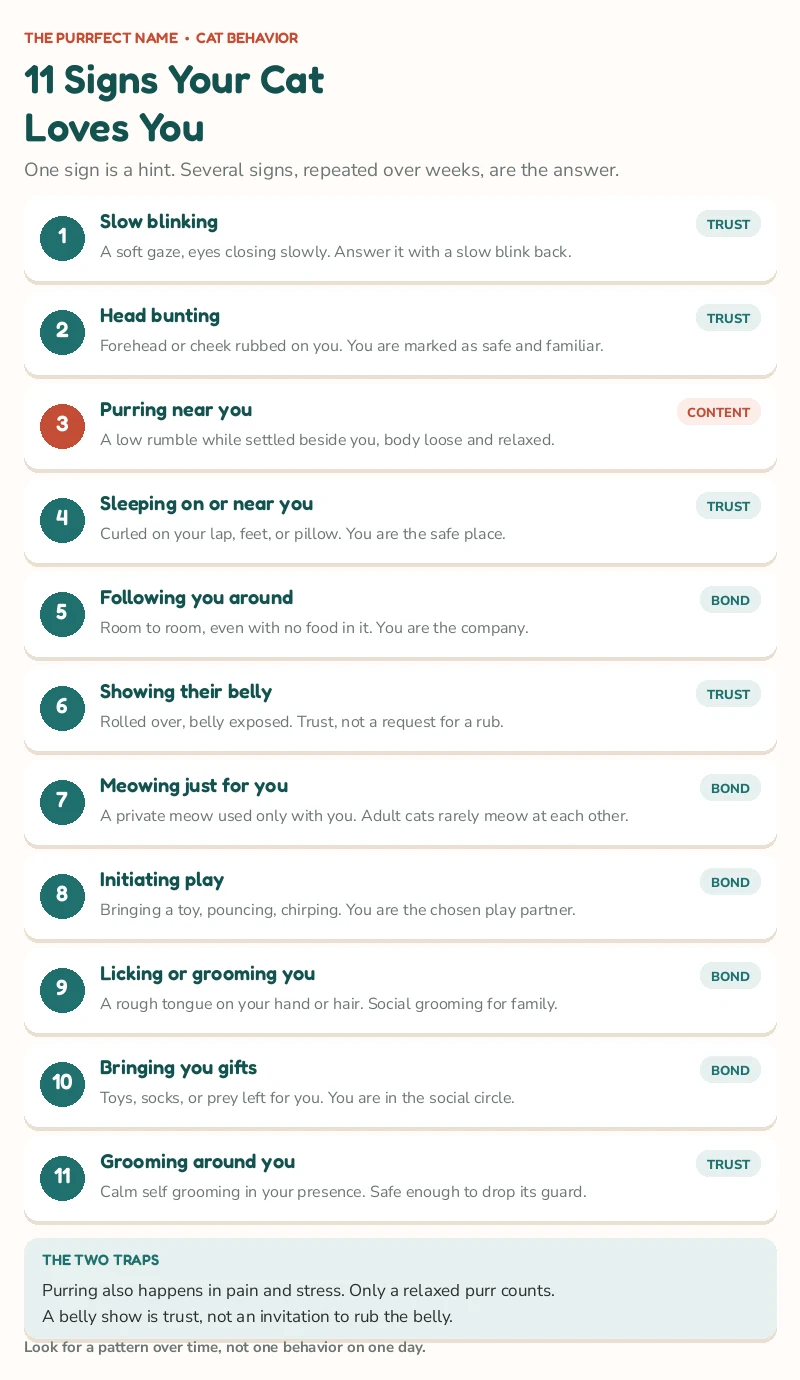
What Love Looks Like Over Time
No single sign on this list proves anything. A cat can slow blink at a stranger, follow a person for food, or purr at the vet. The evidence is the pattern: several signs, from different parts of the list, repeated over weeks, aimed at you more than at anyone else.
A cat that slow blinks, bunts, sleeps on your feet, and grooms itself beside you is not performing four unrelated behaviors. It is telling you the same thing four ways.
It is also worth saying what love is not. Cats do not love the way people do, and they do not owe you the signs on this list. A shy cat, a senior cat, a cat that was not handled much as a kitten, or a cat that simply prefers a quiet corner may love you deeply and show it in only one or two ways, or in ways this list does not cover.
The 2019 attachment study from Oregon State University found that cats form attachment bonds with their people in patterns similar to those seen in dogs and human infants, but attachment in a cat looks like proximity and calm, not like enthusiasm. If your cat chooses to be in the same room as you, day after day, that is the bond. The rest is decoration.
How to Earn More of It
You cannot demand the signs on this list, but you can make them more likely. Slow blink back when your cat blinks at you. Let the cat come to you instead of chasing it. Keep your hand low and let it sniff before you touch. Stroke the cheeks and chin, the spots cats like, and stop before the cat asks you to stop. Play for a few minutes a day. Keep the routine steady, because cats trust what is predictable.
And respect the no: a cat that walks away is not rejecting you, it is regulating itself, and a cat whose no is respected will say yes more often next time. Our guide to cat sleeping positions shows what your cat’s chosen sleeping spot says about how safe it feels with you.
Frequently Asked Questions
Does my cat love me if it never sits on my lap?
Yes, very likely. Lap sitting is one sign out of 11, and many affectionate cats prefer to sit near you rather than on you. A cat that sleeps in the same room, follows you, slow blinks, or bunts your hand is showing love in its own way. Shy cats and senior cats often show affection at a distance.
Why does my cat bite me after showing its belly?
Because the belly display was trust, not an invitation. A cat that rolls over is showing vulnerability, and most cats will grab or bite a hand that goes for the stomach. Admire the belly from a distance and stroke the cheek instead.
Does purring always mean my cat is happy?
No. Cats purr when they are content, and also when they are stressed, ill, or in pain. A purr counts as a love sign only in a relaxed context: loose body, soft face, slow blinks, or kneading. A purr with a tense body, hiding, or fast breathing is a reason to call the vet.
Why does my cat bring me dead mice?
Behaviorists debate the motive. The two leading explanations are that the cat is treating you like a kitten that needs to be taught to hunt, or that it is moving prey to a safe place, and your home is the safest place it knows. Either way, the gift goes to a person the cat counts as part of its social circle. Do not scold the cat for it.
Can I slow blink at my cat?
Yes, and it works. A 2020 study in Scientific Reports found that cats were more likely to slow blink back and approach a person who slow blinked at them first. Look softly, close your eyes slowly, hold them shut for a second, and open them again. Never stare hard at a cat, which reads as a threat.