
10 Signs Your Cat Misses You
Come home after a day out and your cat will tell you exactly how it felt about your absence. It may be waiting by the door, talking more than usual, following you into every room, or sleeping on the shirt you left on the bed.
Cats have a reputation for not caring, and it is wrong. Research has shown that most cats form real attachments to their people, and their behavior when you return is the clearest evidence of it.
One honest note before the list. The science behind it is a 2019 study at Oregon State University, published in Current Biology. Researchers used a Secure Base Test, the same kind of test used with human infants and dogs. Of 70 kittens, 64.3% were securely attached to their owners, and of 38 adult cats, 65.8% were. That study measured attachment behavior during a short separation and reunion.
It did not measure “missing someone”, and this article does not pretend it did. The ten signs below are behaviors owners see again and again when a cat is reunited with a person it is attached to, and they are presented as exactly that.
One line matters more than the list. Missing you is normal. Struggling while you are away is not the same thing, and the last section explains how to tell them apart and when to call your vet.
The information here is general information only and is not veterinary advice. If your cat stops eating, toilets outside the box, over-grooms to bald patches, or becomes destructive while you are away, contact your vet. Those signs can be health problems first and feelings problems second.
Key Takeaways
- Most cats form real attachments to their people: in a 2019 study, about 65% of cats tested were securely attached to their owners.
- A cat that waits by the door, follows you, meows more, and gets clingy when you return is showing you it missed you.
- Your scent is comforting to a cat, which is why it sleeps on your clothes or your side of the bed while you are gone.
- Head butting, rubbing, and a tail held high at the door are friendly reunion greetings, not random behavior.
- A toy or a caught gift brought to you is a social gesture, and it is one of the clearest signs on this list.
- Purring on sight is a good sign, but purring alone is not proof of happiness, because cats also purr when stressed or in pain.
- Missing you is normal. Destructive behavior, toileting outside the box, and not eating while you are away are signs of separation problems and need a vet.
The 10 Signs, One by One
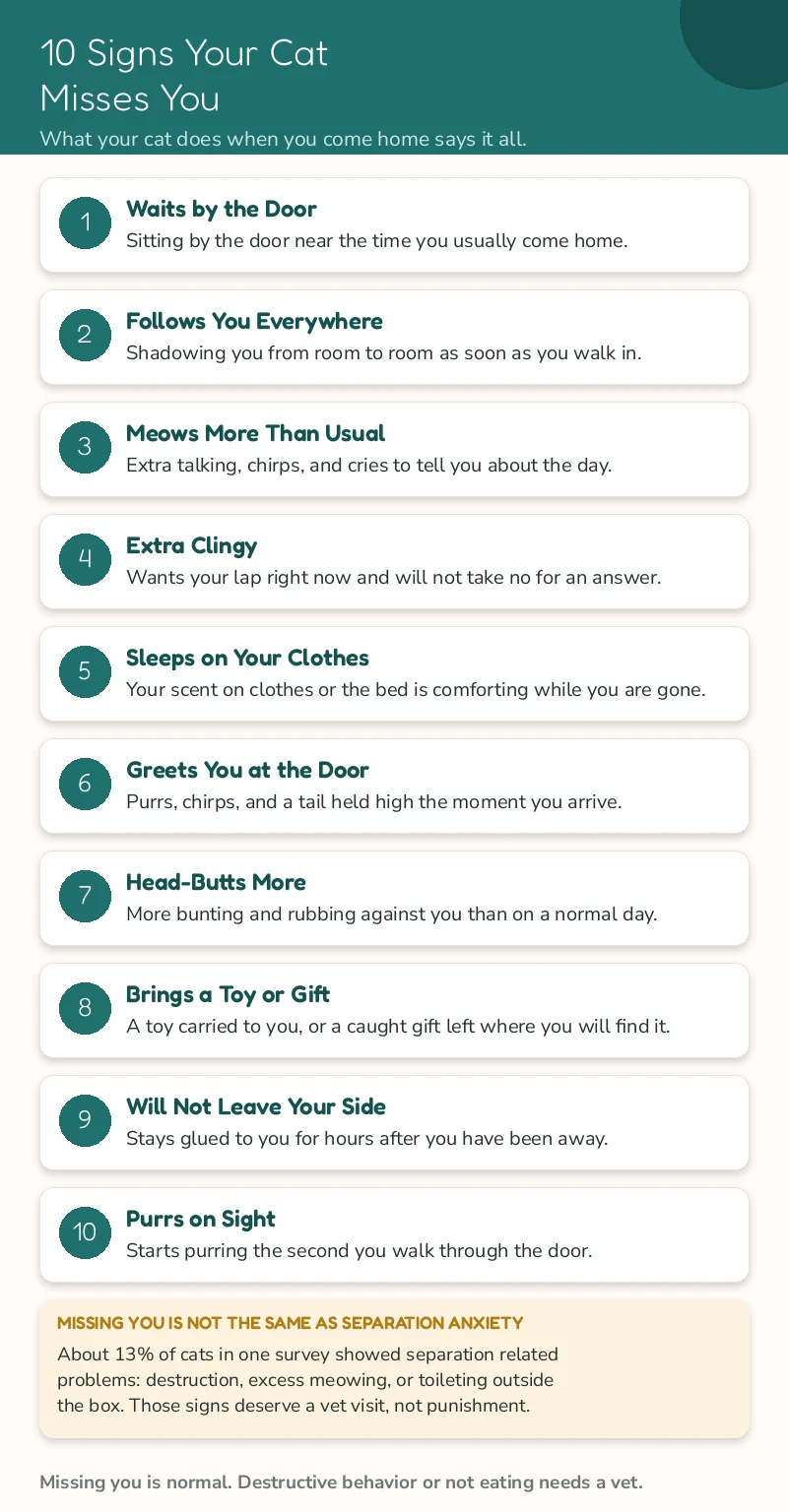
1. Waits by the Door
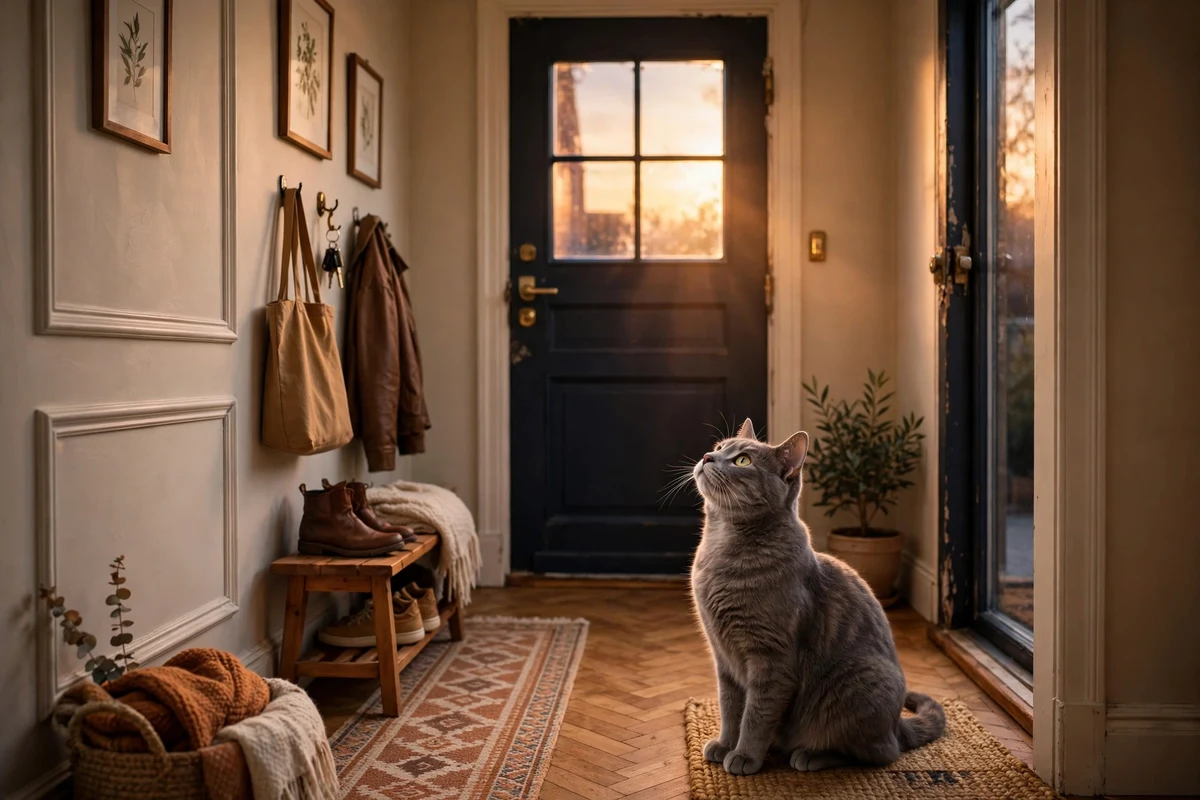
Some cats take up a post by the door in the hour before you usually come home, and they are there when the key turns.
Cats live by routine, not by clocks, but they learn the sequence of a day: the light changing, the sounds of the street, the quiet of the house before you arrive. A cat that waits is a cat that has learned your pattern and cares about the part of it that is you.
Not every cat does this, and that does not mean the others care less. Some cats wait on a windowsill, some on the stairs, and some simply appear from another room the moment they hear the door. The sign is the readiness, not the exact spot.
2. Follows You Everywhere
Walk in the door and your cat becomes your shadow: into the kitchen, into the bathroom, up the stairs, back down again. This is the reunion version of a behavior cats show all the time, but after an absence it is more intense, and it lasts longer.
The cat is checking that you are really back, and making sure you do not disappear again. Our guide to why cats follow their owners explains the everyday reasons cats trail behind you, from curiosity to food to simple company.
Give it an hour. Most cats do a thorough check, settle beside you, and go back to normal. A cat that is still glued to you the next morning may be telling you the absence was harder for it than you thought, and the last section of this article is for that cat.
3. Meows More Than Usual
A cat that is normally quiet may turn into a chatterbox the moment you walk in: meows, chirps, trills, and cries, all aimed at you. Adult cats rarely meow at each other. Meowing is a language they mostly keep for people, which makes a burst of it on your return a direct message.
It is your cat telling you about its day, complaining about your absence, and asking for attention, all at once. Our guide to why cats meow walks through the sounds cats use when they want something from you.
There is a difference between reunion chatter and distress. Reunion meowing settles within a few minutes of your return, once the cat has been greeted and fed. Meowing that goes on for hours, or that starts the moment you pick up your keys to leave, is a different sign, and it belongs in the separation anxiety section below.
4. Becomes Extra Clingy and Wants Your Lap
Some cats come back from your absence with one demand: your lap, right now. A cat that usually sits beside you may climb straight onto you, knead your legs, and refuse to be moved.
In the Oregon State study, the cats that were insecurely attached were the ones that clung hardest on reunion and were hardest to soothe. Clinginess is not a flaw in a cat. It is a measure of how much the cat leans on you, and a cat that leans hard will show it after time apart.
Let the cat have the lap. A few minutes of close contact after an absence costs you nothing and settles the cat faster than anything else. Push the cat away and it will usually come back twice as determined, because the thing it wants most is the thing you just refused.
5. Sleeps on Your Clothes or Bed
Come home and find your cat curled up on the shirt you left on the chair, or on your side of the bed, and you have found one of the most honest signs on this list.
Cats live in a world of smell, and your scent is the most familiar and reassuring smell in their home. Sleeping on your clothes is a cat staying close to you while you are gone, in the only way it can.
This is also why the sign survives the trip. A cat does not sleep on a stranger’s clothes. It sleeps on yours because your scent means safety, routine, and the person who feeds it. If you are going away for a few days, leaving a worn shirt on the cat’s bed is one of the simplest comforts you can offer, and it genuinely helps.
6. Greets You at the Door with Purrs, Chirps, or a Raised Tail
The full greeting is hard to miss: your cat trots over the moment you step inside, tail held high, sometimes with a little quiver at the tip, chirping or trilling, and purring before you have even put your bag down.
Research and owner reports agree on one detail: the greeting gets more intense the longer you have been gone. A cat that greets you this way is not just happy to see you. It is relieved.
Read the whole cat, not just the purr. A tail held high with a soft body and forward ears is a friendly greeting. A purr on its own is not proof of happiness, because cats also purr when they are stressed or in pain. Put the two together, purring plus a tail held high plus a cat that came to find you, and the meaning is clear.
7. Head-Butts and Rubs Against You More Than Usual
Head butting, or bunting, is a cat pressing its head and cheeks against you, and it is one of the most affectionate things a cat does. Cats have scent glands on their cheeks and forehead, and bunting marks you with their scent while picking up yours.
It is a greeting, a claim, and a hello all at once. After an absence, many cats bunt harder and longer than usual, as if they are re-marking you after your time away.
Answer it the way a cat would. Stay still, let the cat rub, and give it a slow blink in return. A cat that bunts you and gets a calm, warm response will bunt you again tomorrow, and that is a bond being maintained in the only language the cat has.
8. Brings You a Toy or Another Gift
A cat that carries a toy to you and drops it at your feet, or meows until you notice it, is offering you something. It is a social gesture, and it is often the first thing a cat does after a reunion. The same instinct shows up in a less welcome form when a cat brings home a caught animal and leaves it where you will find it.
That is not a criticism of your hunting skills, whatever the jokes say. It is a cat bringing its catch back to the group, which is what cats do with the things they value. Our guide to why cats bring you dead animals explains the hunting and social reasons behind the gift, and why it is never spite.
Thank the cat, even for the toy. Pick it up, say something warm, and play with it for a minute. The cat brought you something because you matter to it, and the fastest way to keep that habit is to show that the gift was noticed.
9. Refuses to Leave Your Side
Some cats take shadowing to its limit: they will not leave your side for hours after you have been away, following you from room to room, sleeping pressed against you, and waking the moment you move.
This is the stronger end of sign 2, and it is the sign most likely to mean the absence was hard for the cat. A cat that does this after a weekend away is normal. A cat that does this after you went to the shop is a cat that may be struggling with being alone at all.
Watch the pattern over a week. If the clinging fades within an evening, the cat missed you and has now caught up. If it does not fade, or if it comes with the signs in the next section, the cat needs more help than a cuddle, and the vet section below is where to start.
10. Starts Purring as Soon as It Sees You
The simplest sign on the list is also the sweetest: your cat starts purring the second it sees you, before you have touched it, sometimes before you have spoken. Purring on sight, after a long absence, is a cat expressing relief and contentment at the reunion, and it is one of the behaviors researchers found increased after longer separations.
Keep the caveat from sign 6 in mind. Purring is not always happiness. A cat can purr when it is stressed, in pain, or frightened.
What makes this sign meaningful is the timing: purring that starts at the sight of you, together with a cat that came to find you, a tail held high, and a body that relaxes as you get closer. That combination is a cat that missed you, and is glad you are home.
Missing You vs Separation Anxiety
Missing you is normal. Separation anxiety is a real problem, and the two look alike until you know what to look for. In a 2020 questionnaire study published in PLoS ONE, researchers asked 130 owners about 223 cats, and 13.45% of the cats, 30 out of 223, met at least one of the study’s criteria for separation-related problems.
Among those 30 cats, the most common signs were destructive behavior in 20 cats, excessive vocalization in 19, and urinating in inappropriate places in 18. The study’s authors note that the questionnaire still needs validation by direct observation, so treat the numbers as a guide, not a diagnosis.
The signs that point toward a problem rather than normal missing are the ones that happen while you are gone, not when you return.
A cat that destroys furniture, scratches at doors, urinates on your bed or clothes, over-grooms to bald patches, or refuses to eat or drink while you are away is not being naughty. It is distressed, and it needs help. The same applies to a cat that starts crying the moment you pick up your keys, or that is still agitated hours after you return.
If that sounds like your cat, start with your vet, and ask about a vet behaviorist if the problem is severe. Do not punish the behavior. Punishment does not teach a cat to feel safe alone, and it makes the anxiety worse.
What helps is a routine that does not change, play before you leave, a food puzzle or a worn shirt left behind, and departures that stay boring: no long goodbyes, no fuss on return, just a calm house that the cat can predict.
For a normal cat, a few small habits make absences easier. Keep feeding and play on the same clock, even on weekends. Play for ten minutes before you leave, so the cat is tired and content. Leave a worn shirt on the cat’s bed.
If you are away for more than a day, have someone the cat knows visit daily, rather than leaving the cat alone with a full bowl. And when you come home, greet the cat, then carry on as normal. The calmest reunion is the one the cat can predict.
Frequently Asked Questions
Do cats really miss their owners?
Yes, in the sense that matters. Most cats form attachments to their people, and in a 2019 study about 65% of cats tested were securely attached to their owners, a rate similar to dogs and human infants.
A cat that waits by the door, greets you with a tail held high, and follows you around after an absence is showing you that attachment in action. What the study did not measure is longing in the human sense, so the honest answer is that cats miss you in a cat way, through attachment and routine, not through the same thoughts a person has.
How long can I leave my cat alone?
Most healthy adult cats cope with a normal working day alone, as long as they have food, fresh water, a clean litter box, and something to do. Overnight alone is usually fine for a healthy adult cat with the same setup.
Beyond 24 hours, have someone visit daily to feed, clean the box, and spend time with the cat. Kittens, senior cats, and cats with medical problems should not be left alone for a full day without a check.
Is it separation anxiety or just boredom?
The difference is timing and distress. A bored cat plays, explores, and sleeps, and greets you calmly.
A cat with separation problems shows distress while you are gone: destruction, toileting outside the box, over-grooming, or not eating, and it may start crying as soon as you leave. If you are not sure, a camera will tell you more in one day than a week of guessing. Show the footage to your vet.
Will getting a second cat help?
Sometimes, and sometimes it makes things worse. A second cat can help a cat that is lonely, but it can also add stress to a cat that is anxious about territory or resources. Never get a second cat as a quick fix for separation problems. Talk to your vet first, and introduce any new cat slowly, with separate food, water, litter boxes, and resting spots.
Why does my cat ignore me when I come home?
Some cats need a few minutes. A cat that walks away when you return may be overstimulated, or it may simply be a cat that shows affection on its own schedule. Give it space and let it come to you.
A cat that ignores you for a day and then returns to normal is fine. A cat that hides, stops eating, or avoids you for days after every absence is a cat to talk to your vet about.
The Bottom Line
Your cat noticed you were gone. It waited by the door, it slept on your shirt, it followed you into the kitchen, and it purred the moment it saw you. That is not a small thing. It is the sound of an animal that has chosen you as its person, and is glad you came back.
Enjoy the greeting, give the cat its lap time, and keep the routine steady so the next goodbye is easier. And if the signs go past missing you into real distress, do not wait. A vet visit now is kinder than a year of quiet suffering while you are out.