
8 Things Cats Do That Science Cannot Fully Explain
Your cat stares at a blank wall for five minutes. It walks across the room and settles on the one person who is ill. It wakes up and paces just before the ground shakes. It is easy to conclude that cats have a sixth sense science cannot touch. Some of what cats do is genuinely strange. Some of it only looks strange because cats sense a world humans cannot.
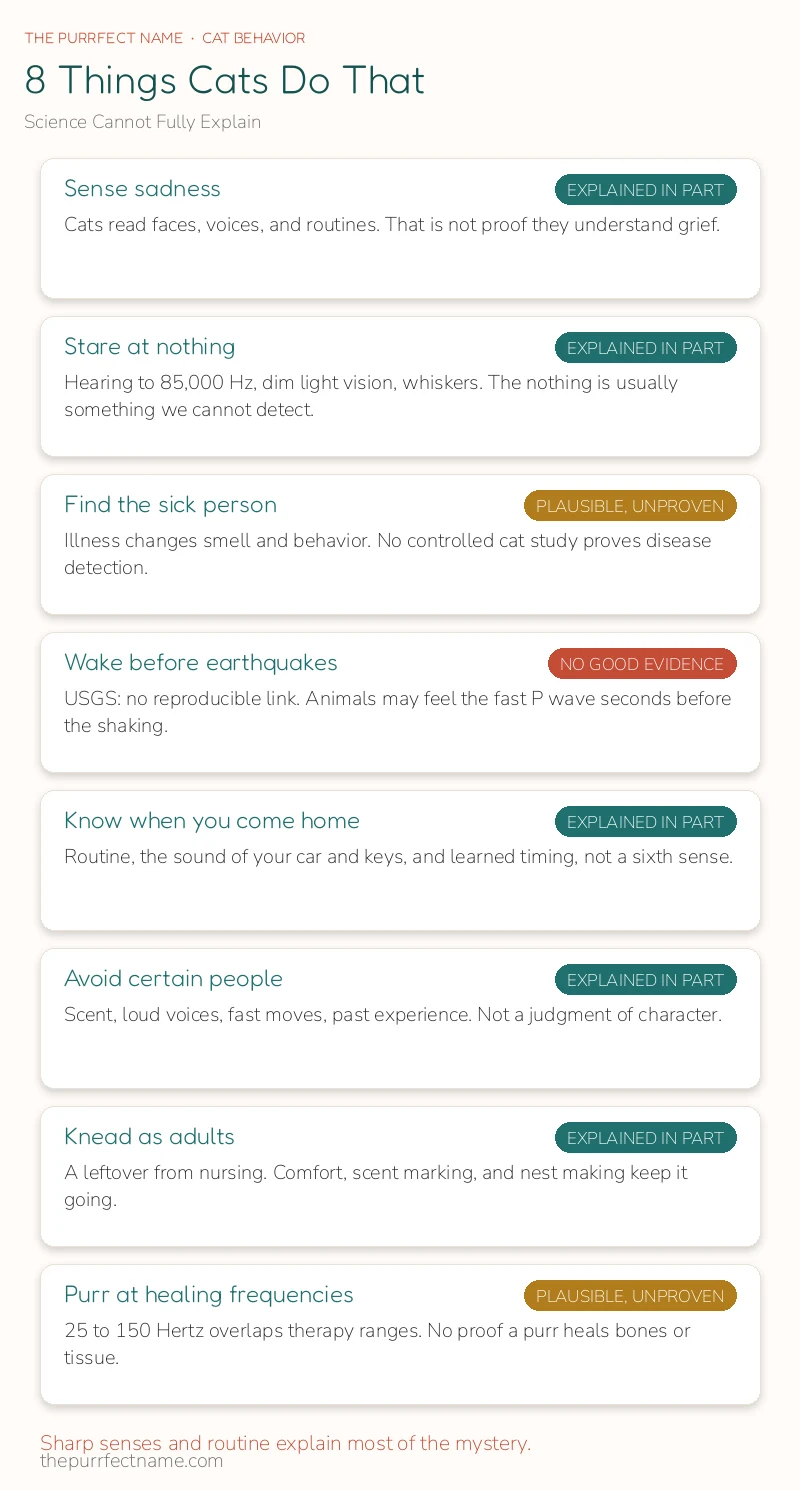
The short answer is that all 8 of these behaviors have a partial explanation, and none of them is proof of magic. A few are explained well: cats hear and see things we cannot, they read our faces and routines, and kneading is a leftover from kittenhood. A few are plausible but unproven, including illness detection and healing purrs. And one, predicting earthquakes, has no good evidence at all. Each section below carries a plain verdict, so you can see exactly where the science stops.
The information here is general information only and is not veterinary advice. A cat’s behavior is never a medical diagnosis for you or for the cat. If your cat’s behavior changes suddenly, contact your vet.
Key Takeaways
- Verdict summary: 5 of the 8 are explained in part, 2 are plausible but unproven, and 1 has no good evidence.
- Earthquake prediction has no good evidence. The honest version is that animals may feel the fast P wave seconds before the strong shaking, after the quake has already started.
- A purr at 25 to 150 Hertz overlaps the frequency range used in vibrational therapy, but there is no proof a cat’s purr heals human bones or tissue.
- Cats read human faces, voices, and routines well. That is real, and it explains most of the “mind reading” moments.
- Illness detection in cats is plausible but unproven, and a cat is never a diagnosis.
1. Cats Sense Sadness and Come Closer: Explained in Part
Verdict: explained in part. When you are sad, you move less, speak more softly, cry, and break your routine. Cats notice all of that. In a 2015 study at Oakland University, Jennifer Vonk and Moriah Galvan showed cats their owners’ smiling and frowning faces paired with matching vocal tones. The cats spent significantly more time looking at the matching pairs, happy face with happy voice, angry face with angry voice, which suggests they recognize the emotional match.
Cats also showed more positive behaviors, such as purring, rubbing, or sitting in the owner’s lap, when the human was smiling.
What that does not prove is that cats understand sadness the way humans do. A cat that comes closer when you cry may be responding to a change in your voice, your smell, and your stillness, not to an idea of grief.
Researcher Kristyn Vitale’s work on attachment found that about 65 percent of cats are securely attached to their owners, and securely attached cats use their owner as a safe base, checking in when something changes. So your cat probably does know something is different, and probably does come closer because you are its safe place. That is real comfort, and it does not need telepathy to count.
2. Cats Stare at Nothing for Minutes: Explained in Part
Verdict: explained in part. The “nothing” is usually something you cannot detect. Cats hear frequencies from about 48 Hz to 85,000 Hz, while humans top out near 20,000 Hz. That means your cat can hear the high whine of aging electronics, a mouse behind a wall, or a pipe ticking two rooms away. Their ears rotate up to 180 degrees to pinpoint a sound.
Their vision works in light about 6 times dimmer than humans need, thanks to a reflective layer behind the retina called the tapetum lucidum, and their whiskers sense air currents far too small for human skin to feel.
So a cat staring at a blank wall may be tracking dust in a sunbeam, listening to an insect in the wall, or watching a shadow move outside a window you cannot see from your angle.
If staring comes with other changes, such as pressing the head against a wall, pacing, confusion, or vision problems, that is different and worth a vet visit. Ordinary staring at “nothing” is usually just a cat using senses you do not have. If your cat’s staring habit worries you, our guide to why cats stare at you covers the everyday reasons cats lock their gaze on something.
3. Cats Always Find the Sick Person in a Room: Plausible But Unproven
Verdict: plausible but unproven. Illness changes a person: body temperature rises with fever, sweat and breath change as body chemistry shifts, movement slows, and voice and routine change. Cats have about 200 million odor sensitive cells in their noses, against about 5 million in humans, plus a vomeronasal organ in the roof of the mouth that analyzes chemical signals. It is plausible that a cat can smell those changes and notice the behavior changes, and many owners report cats becoming more attentive or protective around a sick person.
Plausible is not proven. There are no controlled studies showing pet cats can detect human disease, and the disease detection evidence that does exist comes mostly from trained dogs, not cats.
A cat settling on the ill person in the room may also be choosing the warmest, stillest, most available lap, which is usually the sick person’s. So enjoy the comfort, but never treat it as a diagnosis. A cat cannot tell you that you are ill, and it certainly cannot tell you what is wrong. If you feel unwell, see a doctor. If your cat starts behaving strangely around a sick person and also changes its own habits, see a vet.
4. Cats Wake Up Right Before Earthquakes: No Good Evidence
Verdict: no good evidence. This is the claim that falls apart hardest under checking. The US Geological Survey states plainly that no reproducible link has ever been proven between animal behavior and an impending earthquake, and that no one has ever predicted a major earthquake in the strict scientific sense. Reports of animals acting strangely hours or days before a quake are anecdotal and inconsistent, and controlled studies do not find a reliable pattern.
What is real is much smaller and less useful as a warning. An earthquake sends out a fast, small P wave first, then a slower, stronger S wave that does the shaking people feel. Very few humans notice the P wave, but animals with keener senses may feel it seconds before the S wave arrives. That is a reaction to a quake that has already started, not a prediction of one coming.
A 2020 study from the Max Planck Institute of Animal Behavior did find farm animals in Italy becoming more active before earthquakes of magnitude 3.8 or greater when housed together, but not when out to pasture, and the researchers themselves note that a definitive link is still not proved. So if your cat wakes up and paces seconds before the ground shakes, it felt the first wave before you did. If it paces on a calm Tuesday, it is not forecasting anything.
5. Cats Know When You Are Coming Home: Explained in Part
Verdict: explained in part. Your cat is not reading your mind. It is reading your routine. Cats learn the sound of your car, your footsteps, your keys, and the time of day you usually return. They recognize their owner’s voice and smell, and they remember the patterns tied to feeding, play, and your departure and return. When the routine runs on time, the cat is often waiting by the door before you open it, because it heard the cues that come minutes before you arrive.
The test is what happens when the routine breaks. Come home at a random hour, in a different car, and most cats will not be waiting. They will be asleep on the sofa, and they will greet you when they hear you, not before. That is not a failure of the cat. It is proof that the trick is learning and sharp senses, not a sixth sense. Cats are excellent students of their people, and after months of the same schedule, they know it better than you do.
6. Cats Avoid Certain People for No Reason: Explained in Part
Verdict: explained in part. The reason is usually there, just not visible to you. Cats read people through scent, voice, movement, and past experience. A person who moves fast, talks loudly, leans over the cat, reaches straight for its head, or smells of another cat or dog will often get avoided. A person who sits still, speaks softly, and lets the cat approach will often get chosen. Past experience counts too: a cat that was grabbed by a stranger as a kitten may avoid strangers for life.
What cats do not do, as far as any evidence shows, is judge character. There is no study showing cats can tell a good person from a bad person. The cat that avoids your visitor is not detecting a bad soul. It is detecting loud shoes, strong perfume, direct eye contact, or the smell of the visitor’s own dog. If you want a shy cat to like a guest, the advice is simple: have the guest sit down, ignore the cat, and let the cat decide.
7. Cats Knead Even as Adults: Explained in Part
Verdict: explained in part. Kneading starts at birth. Newborn kittens press their paws against their mother’s belly while nursing to stimulate milk flow, and the rhythm becomes tied to warmth, food, and safety. Many cats keep the habit for life, kneading blankets, laps, and soft cushions, often while purring. Wild cats also knead grasses and leaves to flatten a resting spot, and cats have scent glands in their paw pads, so each push leaves a trace of scent behind.
Why adults keep doing it is not fully settled. The leading explanations are comfort, self soothing, scent marking, and nest making, and different cats may knead for different reasons. One popular explanation, that kneading releases dopamine and oxytocin in the cat’s brain, is theoretical: a vet reviewer at Figo Pet Insurance notes that those pathways have not been definitively mapped in cats and are extrapolated from other mammals.
Also, kneading does not prove a cat was weaned too early, and some adult cats never knead at all, which is also normal. Our full guide to why cats knead covers the reasons and when kneading is worth a vet check.
8. Cats Purr at Healing Frequencies: Plausible But Unproven
Verdict: plausible but unproven. The frequency part is real. Cats purr at about 25 to 150 Hertz, and that range overlaps the frequencies used in vibrational therapy, which has been studied for bone density and tissue healing. Cats also purr when they are hurt or frightened, not only when they are happy, which led to the theory that purring may help cats heal themselves.
The healing part is where the evidence stops. No controlled study proves that a cat’s purr heals human bones, lowers human blood pressure, or speeds human recovery, and no study proves it heals the cat either. Our guide to why cats purr covers the real reasons cats purr, including why they purr when they are hurt.
The overlap of frequency ranges is interesting, but an overlap is not a treatment. A purring cat on your lap may genuinely calm you down, lower your stress, and make you feel better, and that is a real benefit. It is not the same as healing tissue, and any article that says a purr fixes bones is selling a story, not science. Keep the purr, enjoy the calm, and see a doctor for the broken bone.
What Science Can and Cannot Say About Cats
The pattern across all 8 items is the same. Cats have senses far sharper than ours, they learn routines and read people with great skill, and they carry behaviors from kittenhood into adulthood. Those three facts explain most of the mystery, without any need for a sixth sense. Where the explanation runs out, the honest answer is that we do not know yet, and that is a better answer than a made up one.
If your cat does something strange, start with the senses: what can it hear, smell, or see that you cannot? Then check the routine: what changed today? Then check the cat: is it eating, playing, and using the litter box normally? If the answer to that last question is no, the mystery is over and the vet visit is due.
Frequently Asked Questions
Can cats really predict earthquakes?
No, not in any reliable way. The USGS says no reproducible link has been proven. Animals may feel the fast P wave seconds before the strong shaking, but the quake has already started by then, so that is detection, not prediction.
Does a cat’s purr heal humans?
There is no proof of that. Cats purr at 25 to 150 Hertz, which overlaps the range used in vibrational therapy, but no controlled study shows a cat’s purr heals human bones or tissue. A purring cat can still calm you and lower your stress.
Can cats sense when you are sad?
Cats can tell something has changed. A 2015 study found cats distinguish happy and angry faces and voices, and they react to changes in movement, voice, and routine. That is not proof they understand sadness the way humans do.
Can cats detect illness in people?
It is plausible but unproven. Illness changes body odor and behavior, and cats have the nose to notice, but no controlled study proves pet cats detect human disease. A cat is never a diagnosis.
Why does my cat stare at nothing?
It is almost never nothing. Your cat can hear sounds up to about 85,000 Hz, see in dim light, and feel air currents with its whiskers, so it is usually tracking something you cannot detect, such as an insect, a sound behind a wall, or dust in a sunbeam.
Why do adult cats still knead?
Kneading starts as a nursing behavior and stays tied to comfort, safety, and warmth. Adults knead to self soothe, mark scent from glands in their paws, and prepare a resting spot. Some adults never knead, which is also normal.