18 Things Cats Wish You Knew
If your cat could write you a letter, it would not be long. It would be a list of small things: change my water, clean my box, let me hide sometimes, play with me, and please stop feeding me things that poison me.
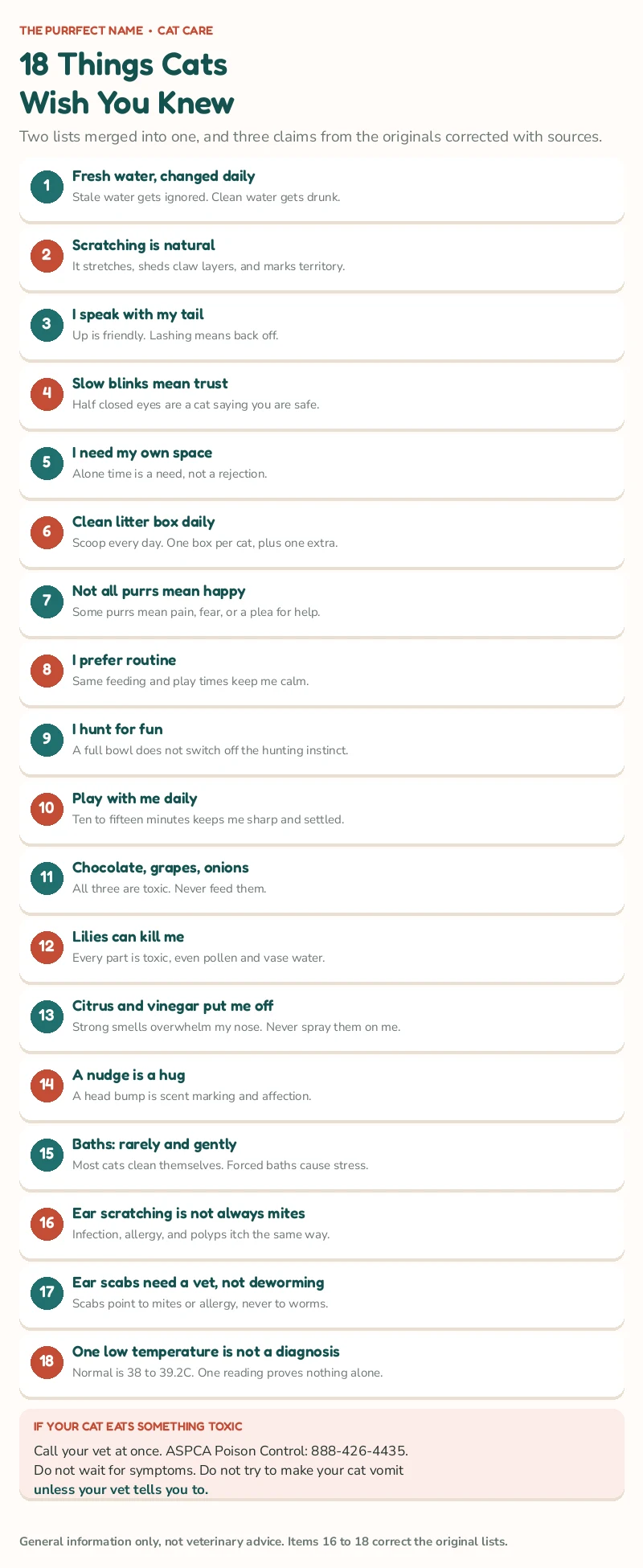
Two popular lists of exactly that kind have been shared thousands of times online. This list brings them together into one list of eighteen. Every claim here is checked, and the three that were wrong are corrected.
Three claims in the original lists do not survive a check against veterinary sources. A body temperature below 37.7C does not by itself mean a cat is sick. Scratching ears with the back legs does not always mean ear mites. And peeling, hair loss, or scabs behind the ears is not a sign it is time for deworming.
Those three are corrected in the list below, with the sources. One piece of bad advice, putting citrus or vinegar on a charger to stop chewing, is dropped entirely. The rest of the list is verified and kept.
The information here is general information only and is not veterinary advice. If your cat eats something toxic, stops eating, hides constantly, or shows any of the warning signs in the health section below, contact your vet. Do not wait for symptoms, and do not try to diagnose your cat from a list.
Key Takeaways
- Daily care is the bulk of the list: fresh water, a clean litter box, a scratching post, routine, space, and play.
- Your cat talks to you constantly, with its tail, its eyes, its purr, and its head. Learn the signals and you will argue less.
- Chocolate, grapes, and onions are toxic. Lilies can kill a cat. Keep both out of the house entirely.
- Three claims from the original lists are corrected here: temperature, ear mites, and ear scabs.
- The bad advice to put citrus or vinegar on a charger is dropped. Use cord covers instead.
Daily Care: 6 Things
1. Fresh Water, Changed Daily
Cats have a low thirst drive, an adaptation from desert dwelling ancestors, and many cats will ignore a stale bowl for hours. Change the water daily, wash the bowl, and keep more than one water station around the house. Put at least one bowl away from the food bowl, because many cats prefer not to drink where they eat.
A running water fountain helps too, because cats are drawn to moving water and drink more from it. If your cat suddenly drinks far more than usual, or stops drinking, that is a change worth mentioning to your vet, because drinking changes can be an early sign of kidney trouble or diabetes.
2. Scratching Is Natural, So Give Me a Post
Scratching is not bad behaviour. It stretches the muscles, sheds the outer layers of the claws, and marks territory with scent glands in the paws. A cat that scratches your sofa is a cat with nowhere better to scratch.
Give it a tall, stable, vertical post that lets it stretch to full height, covered in sisal or rough carpet, and put it where the cat already scratches, not in a corner nobody visits. Some cats also like a horizontal cardboard scratcher. Offer both and let the cat choose. Never declaw a cat to stop scratching. Declawing removes the last bone of each toe, and it can cause lasting pain and behaviour problems.
3. I Speak With My Tail
Your cat’s tail is one of the clearest windows into how it feels. A tail held high usually means a confident, friendly cat. A puffed tail means fear. A fast side to side swish is irritation, not happiness the way a dog’s wag is. But tails do not speak in simple code, and the same position can mean different things depending on the ears, the eyes, the posture, and what just happened.
Our guide to cat tail language covers every position, one by one, including the ones sources disagree on. Learn the tail and you will stop misreading your cat’s mood, and you will stop petting a cat that has been telling you to stop for minutes.
4. Slow Blinks Mean Trust
A slow blink, half closed eyes held for a beat and then opened again, is one of the clearest friendly signals a cat has. It is sometimes called a cat kiss, and the name is not just cute.
In a 2020 study at the University of Sussex, published in Scientific Reports, cats were more likely to slow blink back at owners who slow blinked at them first, and more likely to approach a stranger who slow blinked than one who kept a neutral face. When your cat slow blinks at you, blink back slowly, hold your eyes closed for a second, and open them again. Do it once and wait. Many cats will answer, and some will come closer. It costs nothing and it is the closest thing to a conversation cats offer.
5. I Need My Own Space Sometimes
A cat that walks away from you is not rejecting you. It is taking alone time, and alone time is a need, not an insult. Cats are both predator and prey animals, and they need a place where nothing can approach them and nobody will pick them up.
Give your cat a room, a shelf, or a box it can retreat to, and let it choose when to come out. Never pull a cat out of hiding, and never block its way back in. A cat that knows it can leave is a cat that stays, and a cat that is followed into its hiding place learns that nowhere is safe.
6. Clean My Litter Box Daily
A cat’s sense of smell is far sharper than yours, and a box that smells dirty to you smells far worse to the cat that has to step into it. Scoop at least once a day, and keep one box per cat plus one extra. Use unscented litter, since strong fragrances bother a sensitive nose, and wash the box when you change the litter.
In a multi cat home, spread the boxes around the house rather than lining them up in one room, so no cat can guard them all. Most cats will put up with a dirty box for a while, then quietly start using a corner of a room instead. That is not revenge. It is a cat choosing the cleaner option in front of it.
How I Talk to You: 5 Things
7. Not All Purrs Mean I Am Happy
Purring usually means contentment, and it is the sound owners love most. But not all purrs mean happy. Cats also purr when they are in pain, frightened, or unwell, as a form of self soothing, the same way a person might hum to calm themselves down. The purr is the same sound in both cases, which is why the rest of the cat matters more than the noise. A cat that purrs while relaxed, loose, and half asleep is content.
A cat that purrs while tense, hiding, not eating, or guarding a part of its body may be in pain, and that combination needs a vet, not a cuddle. Learn your cat’s normal purr and the body that goes with it, and a new purr in a new context will stand out.
8. I Prefer Routine
Cats rely on familiarity, routine, and a sense of control to feel comfortable. That is the sentence every major source on cat stress agrees on. Feeding times, waking and sleeping times, work patterns, playtime, and even cleaning routines all matter.
A new job that changes when you leave and come home, a holiday that changes who feeds the cat, or a new baby that changes when the house is quiet, all break the pattern the cat has learned to trust. Keep the anchors steady even when the rest of life changes: feed at the same times, play at the same times, and keep the cat’s quiet hours quiet. Routine is the cheapest reassurance a cat can get, and it costs nothing but consistency.
9. I Hunt for Fun, Not Because I Am Hungry
A full bowl does not switch off the hunting instinct. Cats hunt even when they are well fed, because hunting is driven by instinct and opportunity, not by an empty stomach. The stalk, crouch, pounce, grab, and bite sequence fires whenever a small moving thing appears, and it fires whether or not the cat has just eaten.
That is why your cat chases a toy mouse after dinner, and why it brings home real prey with a full bowl in the kitchen. Do not feed the cat more to stop it hunting. It will not work. Play with it instead, with a wand toy that lets it stalk, chase, pounce, and catch, and the hunting instinct gets its outlet without a dead mouse on the doormat.
10. Play With Me Daily
Play is hunting practice, and without it boredom turns into destructive scratching, night time zoomies, or tension with other pets. Aim for 10 to 15 minutes of focused play once or twice a day, with a wand toy or a toy the cat can catch, and end every session with a catch and a small treat so the hunt finishes the way a real one would.
Short, frequent sessions beat one long session, because they match a cat’s natural pattern of several small hunts through the day. Rotate the toys weekly so they stay interesting, and keep hands and feet out of the game, so the cat learns that people are not prey.
11. A Nudge Is a Hug
When your cat presses its head against your leg, your hand, or your face, it is not being pushy. It is headbutting, also called bunting, and it is one of the highest compliments a cat can give. Cats have scent glands on their cheeks, chin, and forehead. When a cat bunts you, it deposits facial pheromones onto you, mixing its scent with yours and creating a shared colony scent that marks you as familiar, safe, and part of its social group.
Answer it gently: a slow blink back, a scratch under the chin, or simply staying still and letting the cat finish. Kneading is another comfort signal in the same family, and our guide to why cats make biscuits explains why cats keep a kittenhood behaviour for their whole lives.
Food and Safety: 3 Things
12. Never Feed Me Chocolate, Grapes, or Onions
Three familiar foods are genuinely dangerous to cats, and all three are worth knowing by name. Chocolate contains theobromine and caffeine, which cats metabolise very slowly. Dark chocolate and cocoa are more dangerous than milk chocolate, but no chocolate is safe for a cat. Grapes and raisins can cause kidney failure, and the amount that causes harm is unpredictable, so any amount should be treated as an emergency.
Onions, garlic, chives, and leeks all damage red blood cells and can cause anaemia, in any form, raw, cooked, or powdered, including the onion and garlic powder hidden in sauces, stocks, and ready meals. Our full guide to what cats can eat covers the safe list, the caution list, and the never feed list, with the three rules that keep sharing food safe: plain, small, and occasional.
If your cat eats any of the three toxic foods, call your vet at once. Do not wait for symptoms, and do not try to make your cat vomit unless your vet tells you to.
13. Lilies Can Kill Me
True lilies and daylilies are among the most dangerous plants a cat can meet. Every part of the plant is toxic, including the petals, the leaves, the stem, the pollen, and even the water in the vase, and a cat can be poisoned simply by brushing against the pollen and grooming it off later.
Lilies cause acute kidney failure in cats, and there is no antidote, so treatment must start fast. A cat that has brushed against a lily needs vet advice at once, even without symptoms, because poisoned cats can look fine for 12 to 24 hours.
Do not keep lilies in a house with a cat, not even in a room the cat does not use. Pollen travels, and cats explore. If someone sends you lilies, give them away or throw them out. A bouquet is not worth a cat.
14. Citrus and Vinegar Put Me Off, So Use Them Carefully
Cats dislike the smell of oranges, vinegar, and citrus in general. The sharp smell overwhelms a nose that is far more sensitive than yours, and it can put a cat off a spot, a surface, or a room.
That dislike is real, and it can be useful as a deterrent on a surface you want the cat to avoid, used away from the cat and allowed to dry. What the original list got wrong was the advice that followed: put a little citrus or vinegar on a charger to stop the cat chewing it.
That advice is dropped here, because liquid on a charger is an electrical and fire risk, and no source recommends it. Keep cables out of reach instead, run them behind furniture, and use cord covers. And never spray citrus or vinegar on a cat, on its bedding, or in its litter box. A deterrent that the cat cannot escape is not a deterrent. It is a stressor.
Health: 4 Things to Get Right
15. Baths: Rarely and Gently, Never Forced
Most cats clean themselves, and most never need a bath at all. Their tongues, their grooming routine, and their fastidious habits do the job better than a bath ever will. Many cats also dislike water and air blown in their face, which is why a forced bath is one of the most stressful things an owner can do to a cat.
A bath is only needed when the cat has got into something it cannot clean off itself, such as oil, paint, or a sticky substance, or when a vet has prescribed a medicated wash for a skin condition. When a bath is needed, use lukewarm water, a cat safe shampoo, a quiet room, and a calm voice, and keep it short. Dry the cat gently and keep it warm afterwards.
Never use human shampoo, and never hold a cat under running water or blow air into its face to dry it. If your cat hates baths, that is normal. It does not need to learn to love them.
16. Ear Scratching Is Not Always Mites
This is the first correction. The original list said that scratching ears with the back legs means ear mites. That is not necessarily true. Ear mites are one cause, and they are the most frequent cause in kittens and in cats that have just joined the household.
But the same sign, scratching at an ear with a hind foot, shaking the head, rubbing the ear on furniture, comes from bacterial or yeast ear infection, from allergies to food or inhaled substances, from a polyp in a young cat, and from a foreign body in the ear. In adult cats with an ear that keeps coming back, allergy is often the cause.
Dark brown to black debris that looks like coffee grounds points toward mites, but even that is not proof, because yeast and bacterial infection can produce dark debris too. The only safe answer to an itchy ear is to get the ear looked at, not to guess. Nothing goes into the ear before someone has looked at the eardrum.
17. Ear Scabs Need a Vet, Not Deworming
This is the second correction, and it is the most important one in this list, because the original claim was not just wrong, it was the wrong treatment. The original list said that peeling, hair loss, or scabs behind the ears means it is time for deworming. No source links ear scabs to worms. None. Ear scabs point to ear mites or allergy, and to the scratching those cause.
A cat with itchy ears scratches with its back feet until the skin behind the ear breaks, and the scabs are the result of that scratching, not a sign of worms. Deworming does not treat ear scabs, and a cat given wormer for an ear problem will still have an ear problem, plus a dose of medicine it did not need.
If you see peeling, hair loss, or scabs behind your cat’s ears, book a vet visit. The vet will look in the ear, check for mites, infection, and allergy, and treat the cause that is actually there.
18. One Low Temperature Is Not a Diagnosis
This is the third correction. The original list said that if a cat’s body temperature drops below 37.7C, the cat is sick. That is oversimplified. A cat’s normal body temperature is 38 to 39.2C, which is higher than a person’s, and 37.7C is the bottom of some published normal ranges, not a sickness threshold on its own. A single reading is not a diagnosis.
Temperature varies with age, with kittens and senior cats running differently from healthy adults, with the time of day, with whether the cat has just been resting somewhere warm, and with how the temperature was measured. A cat can also be ill with a perfectly normal temperature. What matters is the reading together with the cat: a low reading plus lethargy, hiding, not eating, or weakness is a reason to call the vet at once.
A single low reading on a cat that is eating, playing, and behaving normally is a reason to take the reading again and watch the cat, not a reason to panic. Do not try to take a cat’s temperature unless your vet has shown you how, because a wrong technique gives a wrong reading and a stressed cat.
What to Do First
If you only change three things after reading this list, change these. First, change the water daily and scoop the box daily. Those two take five minutes and they are the wishes your cat notices fastest. Second, learn the tail and the slow blink, and answer both.
A cat that is understood is a cat that trusts you, and trust is the whole relationship. Third, take the toxic foods and the lilies out of the house. Everything else on this list makes life better for your cat. Those two can save its life.
Frequently Asked Questions
Why is this list longer than the ones I have seen online?
Because two popular lists cover the same ground: things a cat would tell its owner. One list of eighteen, with the errors corrected, gives you the full answer in one place.
Is it true that a cat’s temperature below 37.7C means it is sick?
Not on its own. Normal cat temperature is 38 to 39.2C, and a single reading is not a diagnosis. Temperature varies with age, time of day, and how it was measured.
A low reading plus lethargy, hiding, or not eating is a reason to call the vet. A single low reading on a cat that is eating and behaving normally is a reason to take the reading again and watch the cat.
My cat scratches its ears a lot. Does it have ear mites?
Maybe, but not necessarily. Ear mites are the most frequent cause in kittens, but the same sign comes from bacterial or yeast infection, allergy, a polyp, or a foreign body. Get the ear looked at by a vet rather than guessing, and do not put anything into the ear before the eardrum has been checked.
Can I put vinegar on cables to stop my cat chewing them?
No. Liquid on a charger is an electrical and fire risk, and no source recommends it. Keep cables out of reach, run them behind furniture, and use cord covers. Never spray citrus or vinegar on a cat.
The Bottom Line
Your cat has been trying to tell you these eighteen things all along, with its tail, its eyes, its purr, and its head. It wants fresh water, a clean box, a post to scratch, a routine it can rely on, space when it needs it, and play every day.
It wants you to know that not every purr means happy, that it hunts for fun, and that a nudge is a hug. It wants you to keep chocolate, grapes, onions, and lilies out of its reach, and to use citrus and vinegar carefully, never on a charger and never on the cat.
And it wants you to know three things the original lists got wrong: one low temperature is not a diagnosis, ear scratching is not always mites, and ear scabs need a vet, not deworming. Listen to the list and your cat will notice. A cat that is understood is a cat that greets you at the door, sleeps on your lap, and slow blinks at you across the room.