
8 Things Your Cat Needs But Never Asks For
Your cat will never sit you down and explain what it needs. It will not ask for more play, cleaner water, or a taller shelf. It will show you instead, in small ways that are easy to miss: sleeping more, hiding more, grooming too much, or quietly giving up on the things it used to enjoy. By the time a need becomes obvious, the cat has usually been doing without it for a while.
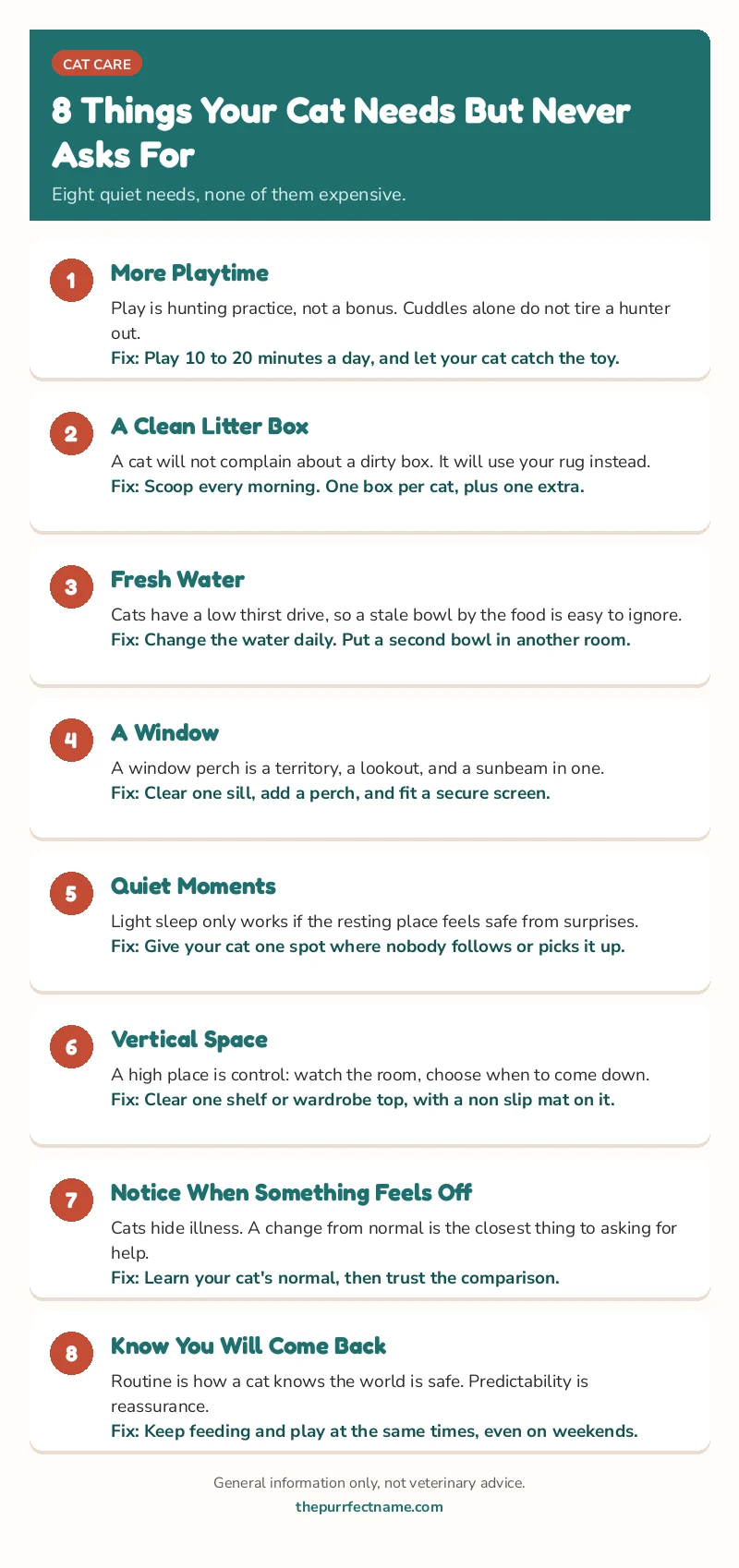
The eight needs below are not luxuries. They are the basics that behavior and veterinary guidance keeps coming back to: play that finishes like a hunt, a clean place to toilet, fresh water, a view of the world, quiet, height, attention to change, and the simple reassurance that you come back. Most of them cost little or nothing. All of them are things a cat cannot provide for itself in a house.
The information here is general information only and is not veterinary advice. If your cat stops eating, hides constantly, grooms until its fur thins, or changes its toileting habits, contact your vet. Those changes can be health problems first and unmet needs second.
Key Takeaways
- Play is hunting practice, not a bonus. Short daily sessions that end in a catch keep a cat fitter and calmer than cuddles alone.
- Scoop the litter box at least once a day, and keep one box per cat plus one extra.
- Fresh water in a clean bowl, away from the food and the litter box, matters more than most owners think.
- A window with a perch is a television, a lookout, and a sunbeam in one, and it costs nothing.
- Cats need quiet moments without being startled, especially in busy households.
- Vertical space gives a cat control: a high place to watch from is a safe place.
- Notice when something feels off. A change in appetite, grooming, hiding, or toileting is the closest thing to a cat asking for help.
- Coming home on a predictable routine is reassurance a cat can count on, and cats count on routine.
The 8 Needs, One by One
1. More Playtime, Not Just Cuddles
Cuddles are for you. Play is for the cat. A cat is a small hunter living in a house, and play is how it practices the sequence it was built for: stalk, chase, pounce, and catch. Without that outlet, the energy goes somewhere else, usually into curtains at midnight, ambushed ankles, or tension with another pet.
Behavior guides are consistent on this point: even 10 to 20 minutes of focused play a day makes a visible difference, and a session that ends with the cat catching the toy and getting a small treat finishes the hunt the way a real one would finish.
Do this today. Put a wand toy in a drawer by the sofa, play for 10 minutes before dinner, and let your cat win. Two short sessions beat one long one, and a regular slot beats a random burst whenever you remember.
2. A Clean Litter Box, Every Single Day
A cat will not complain about a dirty box. It will use it until it cannot stand it, and then it will use your rug instead. Litter box problems are one of the most common reasons cats are surrendered to shelters, and most of them start with a box that was not scooped.
The standard guidance is simple: scoop at least once a day, keep one box per cat plus one extra, use unscented litter, and place the box somewhere quiet and easy to reach. Covered boxes can trap smells and make a cat feel cornered, so most cats prefer a large open box.
Do this today. Scoop every morning before you do anything else, and set a weekly reminder to empty and wash the box. It takes two minutes, and it is the single highest value habit in this whole list.
3. Fresh Water, Not From a Stale Bowl
Cats are famously fussy about water, and the fussiness has a reason. In the wild a cat’s ancestors got most of their water from prey, so domestic cats have a low thirst drive and often drink too little. A stale bowl by the food dish is the least tempting option in the house, which is why so many cats prefer a dripping tap, a glass left on a table, or a puddle outside.
Fresh water in a clean bowl, placed away from the food and the litter box, is a small change that supports kidneys and overall health for years. Some cats drink more from a fountain, because moving water reads as fresher to them.
Do this today. Change the water daily, wash the bowl properly, and put a second bowl in another room. If your cat ignores every bowl you offer, try a fountain and watch what happens over a week.
4. A Window to Watch the World From
A window perch is the closest thing an indoor cat has to a territory. Birds, leaves, passing people, and changing light give a cat the novelty its brain is built to track, and a sunny sill gives it warmth at the same time.
It is also a safe lookout: high, warm, and far from the noise of the floor. Our guide to indoor versus outdoor cats makes the same point from the other side, that indoor life only works when the house replaces what the outdoors would have provided, and a window is the cheapest replacement there is.
Do this today. Clear one windowsill, put a folded blanket or a proper perch on it, and make sure the window has a secure screen. A cat that can watch the world from a warm sill is a cat that is much less likely to be bored.
5. Quiet Moments Without Being Startled
Cats sleep 12 to 16 hours a day, and much of that time is light dozing from which they can wake in a second. That light sleep is not laziness. It is a prey animal resting while staying ready, and it only works if the resting place feels safe. A cat that is startled out of rest again and again, by loud voices, sudden grabs, or children chasing it for a cuddle, starts resting in harder to reach places or stops resting properly at all.
Our guide to cat sleeping positions shows how to tell light rest from deep sleep, so you can see when your cat is resting and leave it alone.
Do this today. Give your cat one spot in the house where nobody follows it, picks it up, or bothers it. A high shelf, a quiet room, or a covered bed all work. The rule is simple: when the cat is in its spot, it is off duty.
6. Vertical Space to Climb and Feel Safe
Cats think in three dimensions. A high place is not a luxury for a cat, it is control: from up high a cat can watch the room, choose when to come down, and avoid dogs, children, and other cats without a confrontation.
Feline environmental guidelines from the AAFP and ISFM put vertical space at the center of a healthy indoor home, and indoor cats with good climbing options show fewer behavior problems than cats kept at floor level. A tall tree, a cleared shelf, or a sturdy wardrobe top all count, as long as the cat can get up and down safely.
Do this today. Clear one shelf or the top of one wardrobe, and put a non-slip mat on it. In a multi-cat home, give each cat its own high spot, so nobody has to argue over the only good seat in the house.
7. You to Notice When Something Feels Off
This is the need cats ask for least and need most. A cat hides illness by instinct, so the first signs are almost always small: eating a little less, grooming a little more, hiding a little longer, sleeping in a new place, or using the litter box differently. None of those on its own proves anything, but a change from your cat’s normal pattern is the closest thing to a cat asking for help.
Cats also change how they sound when something is wrong, and our guide to why cats meow covers the meows that most often mean a request or a complaint, so you can hear the change when it happens.
Do this today. Learn your cat’s normal: how much it eats, where it sleeps, how often it uses the box, and how chatty it is. Then trust the comparison. A cat that is suddenly different from its own normal for more than a day or two deserves a vet call, not a wait and see.
8. To Know You Will Always Come Back Home
Cats are creatures of routine, and routine is how they know the world is safe. The same feeding time, the same play slot, the same person walking through the door in the evening: these are not small things to a cat, they are the structure its whole day hangs on.
A cat that is left alone for long stretches, or whose routine changes constantly, cannot settle, and unsettled cats show it in the same ways stressed cats always do: overgrooming, hiding, restlessness at night, or toileting outside the box. You do not need to be home all day. You need to be predictable.
Do this today. Keep feeding and play at roughly the same times every day, even on weekends. If you go away, keep the same sitter, the same food, and the same routine, and leave something that smells like you where the cat sleeps. Coming back matters, but coming back on time matters more.
What to Do This Week
Do not try to fix all eight at once. Pick three and do them this week: scoop the box every morning, play for 10 minutes before dinner, and clear one windowsill. Next week, add fresh water in a second room and one high spot the cat can claim. The week after that, learn your cat’s normal so you can spot a change early. Small, steady changes are the ones a cat actually notices, because a cat notices routine more than it notices effort.
Frequently Asked Questions
How much play does a cat need every day?
Most behavior guides suggest at least one or two short focused sessions, about 10 to 20 minutes in total, with a wand toy or something that moves like prey. Kittens and young adults usually want more. Older cats want less but still benefit from a gentle daily session.
Why does my cat prefer the tap to its water bowl?
Moving water reads as fresher to a cat, and a bowl next to the food smells of food, which cats prefer to avoid. Try a fountain, or move the bowl away from the food, and change the water daily.
Is it cruel to keep a cat indoors if it wants to go out?
Not if the indoor life is enriched. An indoor cat with play, climbing space, window views, and quiet company can be healthy and content. The cruelty is in boredom and neglect, not in walls.
How do I know if my cat is stressed?
Look for changes from its normal: hiding more, eating less, grooming until fur thins, sleeping in new places, or toileting outside the box. One change for a day is usually nothing. Several changes, or one change that lasts, deserves a vet call.
The Bottom Line
Your cat will never hand you a list. It will hand you small signals instead, and the eight needs in this article are what those signals are usually asking for. Play, a clean box, fresh water, a window, quiet, height, attention, and a predictable return: none of them is hard, and together they are most of what a good life with a cat is made of. Start with one today, and your cat will tell you the rest, in the only way it can, by choosing to be near you.