
9 Weird Cat Behaviours Explained
Every cat owner has watched their cat do something strange and thought the same thing: what was that?
A cat kneads your lap like dough, chatters its teeth at a bird through the window, sprints around the house at 3 a.m., or squeezes into a box half its size and falls asleep. None of it is random. Every one of these behaviours has a reason, and most of them are older than the house your cat lives in.
This article explains nine of them, one by one, with the honest version where the popular version is wrong. Two of the nine already have their own full guides on this site: kneading and the flehmen response. They are summarised here so the list is complete, and the full guides are linked where they exist.
One of the nine, bringing home dead animals, has its own honest answer too, and our guide to why cats bring you dead animals gives it in full, including what to do with the animal and how to cut the numbers down.
The information here is general information only and is not veterinary advice. If a behaviour on this list appears suddenly, changes sharply, or comes with hiding, eating less, or toileting changes, contact your vet. A new behaviour is worth more attention than a strange old one.
Key Takeaways
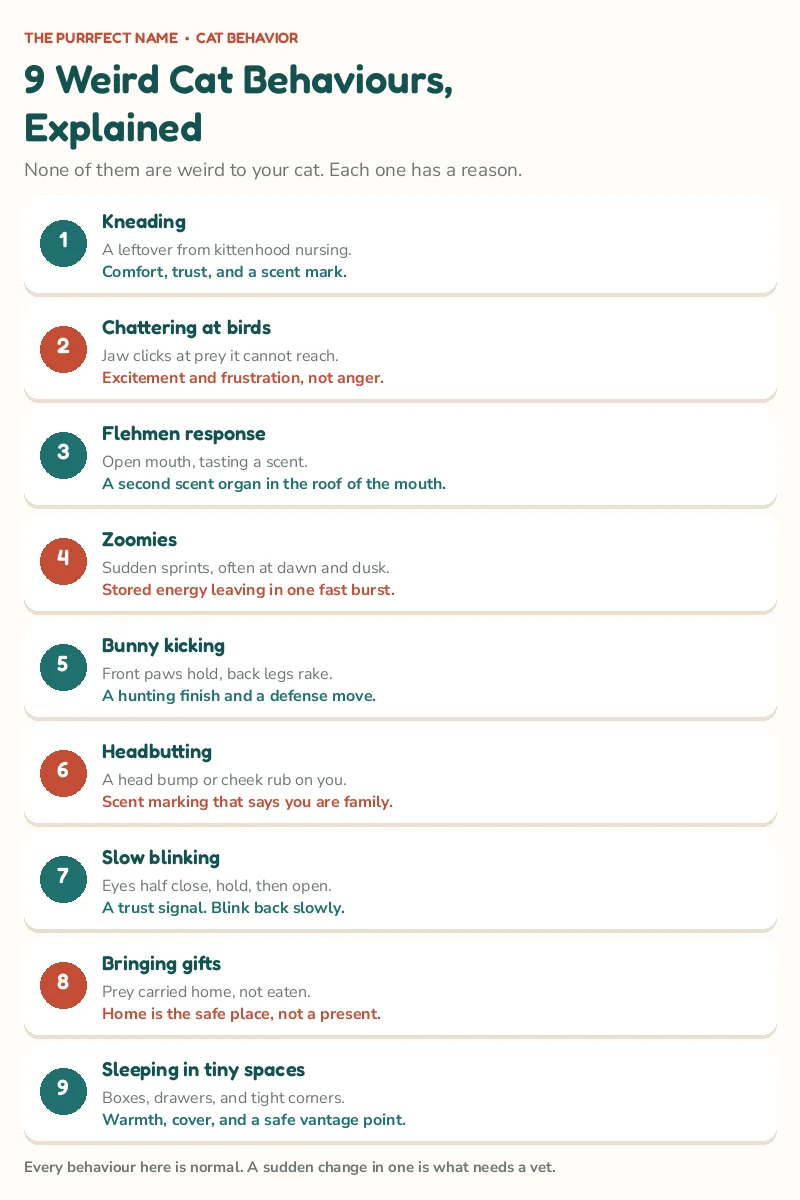
- Kneading is a leftover from kittenhood nursing, kept for comfort, trust, and scent marking.
- Chattering at birds is probably excitement and frustration, but no explanation is proven.
- The flehmen response is a cat tasting a scent with a second scent organ in the roof of its mouth.
- Zoomies are short bursts of stored energy, most common at dawn and dusk.
- Bunny kicking is a real hunting finish and a defence move, not a cute dance.
- Headbutting deposits scent from glands on the cheeks and forehead. It marks you as family.
- A slow blink is a trust signal. Blink back slowly and many cats will answer.
- Bringing home prey is probably not a gift. Home is the safest place to carry a catch.
- Sleeping in tiny spaces gives warmth, cover, and a safe vantage point.
The 9 Behaviours, One by One
1. Kneading
Your cat pushes its front paws into a blanket, a pillow, or your lap, left, right, left, right, like a baker working dough. That is kneading, and cat owners call it making biscuits. It starts in kittenhood, when kittens press their mother’s belly while nursing to help the milk flow. Many cats keep doing it for their whole lives, usually when they feel safe, comfortable, and relaxed.
There is no single proven reason why every adult cat kneads. The overlapping explanations tell the story: comfort and relaxation, the feeling of nursing, preparing a resting spot, stretching, and leaving scent from glands in the paw pads. A cat that kneads your lap has chosen you because it trusts you.
Our full guide to why cats make biscuits covers all six reasons, the companions that come with kneading like purring and drool, and the three myths that are wrong, including the claim that kneading proves a cat was weaned too early.
Do not punish kneading. If the claws hurt, put a thick folded blanket between paws and skin and redirect the cat to the blanket. A cat that is punished for kneading learns that your lap is not safe, and the trust that made it knead there takes a knock.
2. Chattering at Birds
A cat sits at the window, eyes locked on a bird, and its jaw starts clicking in a rapid chatter, sometimes with a chirp mixed in.
It looks like the cat is trying to talk to the bird, and in a way it is trying, but nobody knows exactly what the sound is for. This is one of the behaviours where the honest answer is that the research is not settled, and any article that states one reason as fact is overreaching.
The leading explanations are frustration and excitement. The cat can see prey it cannot reach, and the chattering is the tension of a hunt that cannot start. A second explanation is that the rapid jaw movements mimic the killing bite a cat uses on small prey, a kind of rehearsal with no prey in reach. A third, from a study of wild margays in Brazil, is that cats may copy the calls of their prey to lure them closer.
None of these has been conclusively proven, and more than one may be true at once. The chatter is also sometimes linked to the vomeronasal organ, the second scent organ covered in the next section, because the cat may be moving air across it to get more information about what it sees but cannot smell.
What is certain is that chattering is normal, it is not a sign of illness, and it does not need fixing. It means your cat is locked onto something it wants to hunt. Give it a play session with a wand toy afterwards and let the hunting sequence finish with a catch.
3. The Flehmen Response
A cat sniffs something, then hangs its mouth open with a curled lip, looking as if it has just tasted something disgusting. It has not. It is doing the flehmen response, and it is the opposite of distaste: the cat liked the smell so much it wanted a closer look.
The open mouth lets scent reach the vomeronasal organ, also called Jacobson organ, a second scent organ in the roof of the mouth behind the front teeth. The nose is good at ordinary smells. The vomeronasal organ is tuned to chemical signals such as pheromones, the scent messages other animals leave behind.
By curling its lip and drawing air across it, the cat analyses a scent in far more detail than sniffing alone allows. You will see it most after a cat sniffs another cat’s markings, a new object in the house, or a smell on your clothes from outside.
The flehmen response is normal in cats, horses, and many other animals. It lasts a few seconds and the cat goes back to what it was doing. A cat that holds its mouth open and pants for a long time, especially in heat or after exercise, is a different matter and needs a vet, because that is not flehmen. It is overheating or breathing trouble.
4. Zoomies
One minute your cat is asleep on the sofa. The next it is tearing down the hallway, skidding around corners, leaping onto furniture, and doing the sideways crab run with a bottlebrush tail. That sudden sprint is the zoomies, and the proper name is frenetic random activity periods, usually shortened to FRAPs.
Zoomies are short bursts of running, jumping, and pouncing that release stored energy in one fast rush. Cats sleep 12 to 16 hours a day, and that long rest stores up a lot of energy. Cats are also crepuscular, which means their natural peaks of activity fall at dawn and dusk, the hours when their wild prey is most active. That is why the sprint so often lands at 3 a.m. or just before dinner.
The hunting instinct has nowhere to go in a quiet house, so it comes out as a race down the hallway instead. Our full guide to why cats get the zoomies at night covers the causes, the post litter box sprint, and the pre bed routine that moves the burst earlier in the evening.
Zoomies are normal in most cases, and you should not try to stop them entirely. What matters is the pattern. A cat that has always zoomed after dinner and settles quickly is doing its usual thing.
A cat that has never zoomed before and suddenly sprints every night, or a cat that used to zoom and suddenly stops, is a cat whose pattern has changed, and that change is worth mentioning to your vet.
5. Bunny Kicking
A cat grabs a toy, or your forearm, with its front paws, hauls it to its belly, and rakes it with rapid back leg kicks. It looks playful and cartoonish, which is where the name comes from, but it is a serious piece of predatory hardware, and the cute name hides what the move actually is.
In a real hunt, a cat that has caught prey larger or more dangerous than a mouse cannot rely on a single killing bite. By clutching the animal to its body and raking with the powerful back claws, the cat can wound and subdue prey that might otherwise twist free and bite or scratch back. The same move is a defence weapon.
A cat grabbed by a larger predator or a rival can kick hard enough to do real damage while protecting its head and neck, and the primordial pouch, the loose skin on the belly, helps shield its organs while it does it. Kittens learn the move play fighting their littermates, and adult cats rehearse it on toys, especially long kicker toys.
Read the context before you react. Play kicking is directed at toys, with a loose body and ears forward. Defensive or overstimulated kicking is directed at you, usually your hand or arm, and it comes with tension: flattened ears, a lashing tail, dilated pupils, and often a bite. The golden rule is simple: never let hands or feet become the prey.
If your cat kicks your arm, go still, do not pull away, wait for the grip to loosen, and then redirect the cat to a kicker toy. If kicking at people happens often, or appears suddenly during petting, it can mean overstimulation, a sensitive area, or pain, and a vet check is sensible.
6. Headbutting
A cat presses its head against your leg, your hand, or your face, sometimes with enough force to surprise you, then rubs its cheek along you. This is headbutting, also called bunting, and it is one of the highest compliments a cat can give.
Cats have scent glands on their cheeks, chin, and forehead. When a cat bunts you, it deposits facial pheromones onto you, mixing its scent with yours and creating a shared colony scent. That scent marks you as familiar, safe, and part of its social group.
It is the same behaviour cats use with each other in a bonded group, and the same reason a cat rubs against furniture, door frames, and the corners of boxes. A cat that headbutts you is not asking for food. It is saying you belong to it, in the nicest way a cat knows how.
Answer it gently. A slow blink back, a scratch under the chin, or simply staying still and letting the cat finish is enough. Do not push the cat away or grab its head, and do not confuse a headbutt with an invitation to pick the cat up. The cat asked for a greeting, not to be lifted.
7. Slow Blinking
A cat looks at you, half closes its eyes, holds them shut for a beat, and opens them again. It is sometimes called a cat kiss, and the name is not just cute.
In a 2020 study at the University of Sussex, published in Scientific Reports, cats were more likely to slow blink back at owners who slow blinked at them first, and more likely to approach a stranger who slow blinked than one who kept a neutral face.
A slow blink is one of the clearest friendly signals a cat has. It means the cat feels safe enough to close its eyes in your presence, which is a real statement from an animal that is both predator and prey.
The researchers even changed their own control condition during pilot trials, because a direct unbroken stare from a stranger seemed to unsettle the cats. That contrast is the whole lesson: a stare is a challenge, and a slow blink is the opposite.
Do this when your cat slow blinks at you. Blink back slowly, hold your eyes closed for a second, and open them again. Do it once and wait. Many cats will answer, and some will come closer. It costs nothing, and it is the closest thing to a conversation cats offer.
8. Bringing Gifts
You open the back door and there is a dead mouse on the doormat. Or your cat walks in, drops a bird at your feet, and looks up at you proudly. The popular story is that your cat is giving you a gift, or trying to teach you to hunt because it thinks you are hopeless at it. Both stories are appealing, and both are probably wrong.
Here is the honest version. Mother cats do bring prey to their kittens in stages, dead first, then injured, then live, and let them practise on it. That is a real, well documented teaching sequence. The leap is applying it to a spayed adult cat and a fully grown human.
No study has shown that cats think of their owners as incompetent kittens, and plenty of the cats who bring prey home are males, who play no part in raising kittens. Cats Protection says plainly that cats are not giving gifts or teaching hunting skills. The better supported explanation is simpler: cats carry prey to the place they feel safest, and your home is that place.
A cat that catches a mouse in the open is holding a meal that a fox, a dog, or a bigger cat could take off it, so it carries the catch to a secure, enclosed core area before eating. For your cat, that place is your living room. The prey arrives not because it is for you, but because you live in the safest room your cat knows.
A 2013 KittyCam study found that cats brought home 23 percent of the animals they caught, ate 28 percent, and left 49 percent where they caught them, which fits a cat that often abandons the catch once the carry home is done.
Do not punish your cat for bringing prey home. Punishment does not stop hunting, because hunting is instinct, not disobedience, and it only teaches the cat to hide the next catch.
What does cut the numbers down is a high meat diet, which cut prey brought home by 36 percent in a 2021 Exeter trial, and daily play, which cut it by 25 percent in the same trial. Keeping the cat indoors, in a catio, or on a harness cuts it to almost nothing.
9. Sleeping in Tiny Spaces
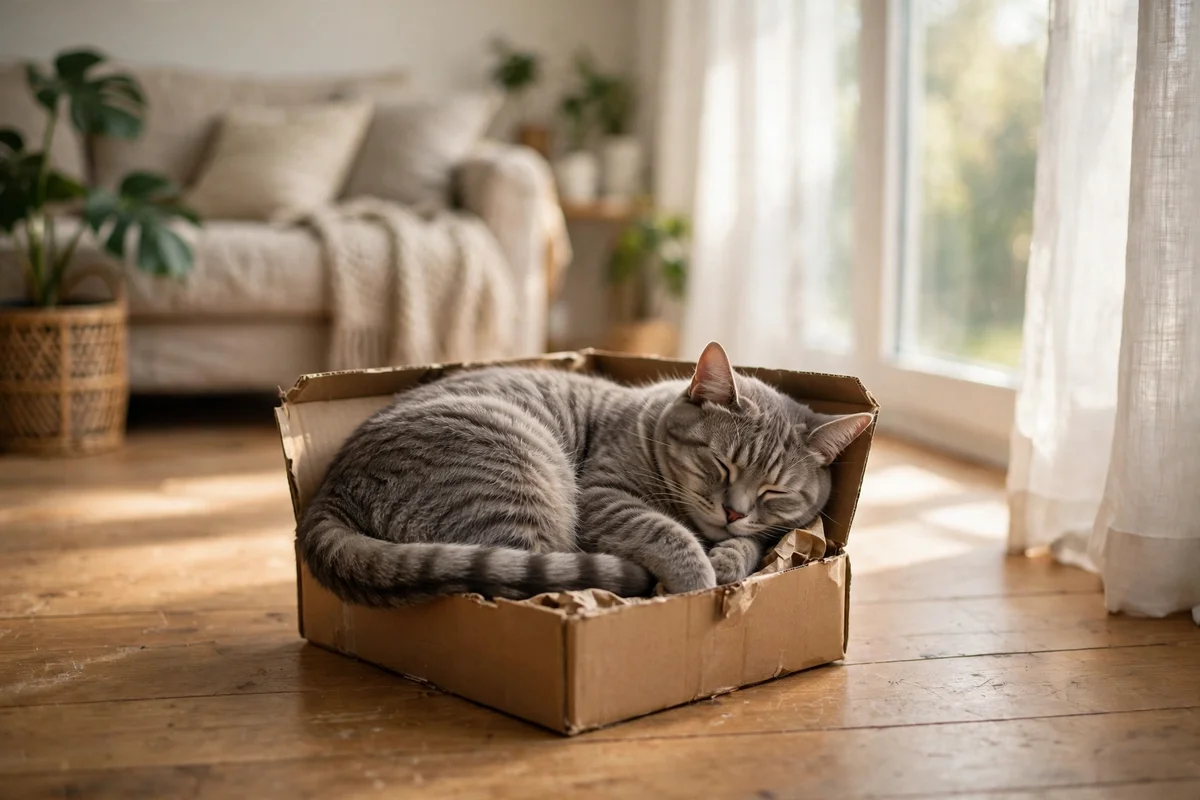
A cat will walk past an expensive cat bed, past the sofa, past a sunny windowsill, and squeeze itself into a cardboard box, a drawer, a laundry basket, or the gap behind the sofa, then fall asleep. It looks absurd. It is also perfectly sensible, once you know what a small space gives a cat.
Three things, all at once. First, security. A small enclosed space is a den. Nothing can approach from behind or from the side, and the cat can watch the room from a hidden vantage point.
A 2014 study at Utrecht University found that shelter cats given a hiding box adapted to their new environment faster and showed lower stress levels than cats without one. Second, warmth. A cat’s normal body temperature is 38 to 39.2C, higher than a person’s, and cardboard is an excellent insulator.
Curling up in a snug box traps body heat and makes a warm microclimate the cat does not have to spend energy maintaining. Third, privacy. A cat that wants to sleep deeply does not want to be watched, touched, or stepped over, and a box is a room with a door that only the cat can open.
Leave a box or two around the house, especially in quiet corners, and let the cat choose. The exception is sudden, constant hiding. If a normally social cat starts spending all day under the bed and will not come out, that is a change in pattern, not a sleeping preference, and it deserves a vet call.
When a Weird Behaviour Is a Worry
Every behaviour on this list is normal on its own. What turns a normal behaviour into a worry is change.
A cat that has kneaded gently for years and suddenly kneads constantly, a cat that has never chattered and suddenly stares and chatters at nothing, a cat that zoomed every evening and suddenly stops, or a cat that slept in boxes and suddenly hides under the bed all day, is a cat telling you something has changed. The behaviour is the signal, not the problem.
Pair the behaviour with the rest of the cat before you decide. Relaxed ears, a loose body, slow blinks, and normal eating and toileting all point to a normal cat doing normal things. Flattened ears, a tense body, dilated pupils, hiding, eating less, drinking more, or toileting outside the box all point the other way.
If the change lasts more than a day or two, or comes with any of those other signs, stop reading articles and call your vet. A behaviour change can be a health problem first and a behaviour problem second.
Frequently Asked Questions
Why does my cat do so many weird things?
Because your cat is a small predator living in a human house, and its behaviour was shaped for hunting, hiding, and surviving, not for living rooms. Kneading, chattering, bunny kicking, and bringing prey home are all hunting or kittenhood behaviours running in a home where there is nothing to hunt and no mother to nurse from. They look weird to people because people do not hunt mice for a living.
Is my cat trying to tell me something when it brings me a dead animal?
Probably not in the way people mean. The best supported explanation is that your cat is carrying prey to the safest place it knows, which is your home, and often abandons it once the carry is done.
It is not a gift in the human sense, and there is no good evidence it is trying to teach you to hunt. Do not punish it. Use play, food, and indoor time to cut the numbers down.
Why does my cat chatter at birds but never at toys?
Because the chatter seems tied to real, unreachable prey. A toy is something the cat can catch, so the hunting sequence can finish. A bird behind glass is prey the cat can see but never reach, and the chatter is the tension of a hunt that cannot start. That is also why a play session after window watching helps: it lets the sequence finish with a catch.
Should I stop my cat from bunny kicking me?
Yes, but not by punishing the cat. Bunny kicking is normal, and it belongs on toys, not on people. Keep a long kicker toy nearby during play, keep hands and feet out of the game, and go still if the cat grabs your arm. A cat that kicks people often may be overstimulated or in pain, so a vet check is sensible if it starts suddenly.
The Bottom Line
None of the nine behaviours on this list means your cat is broken, angry, or strange. They mean your cat is a cat.
Kneading is comfort, chattering is a hunt that cannot start, flehmen is a closer smell, zoomies are energy leaving in a rush, bunny kicking is a hunting finish, headbutting is a scented greeting, a slow blink is trust, a dead mouse on the doormat is a hunt carried home, and a box is a warm safe den. Learn to read them and your cat stops looking weird. It starts looking like what it is: a small hunter that chose your house as its territory, and you as its family.