
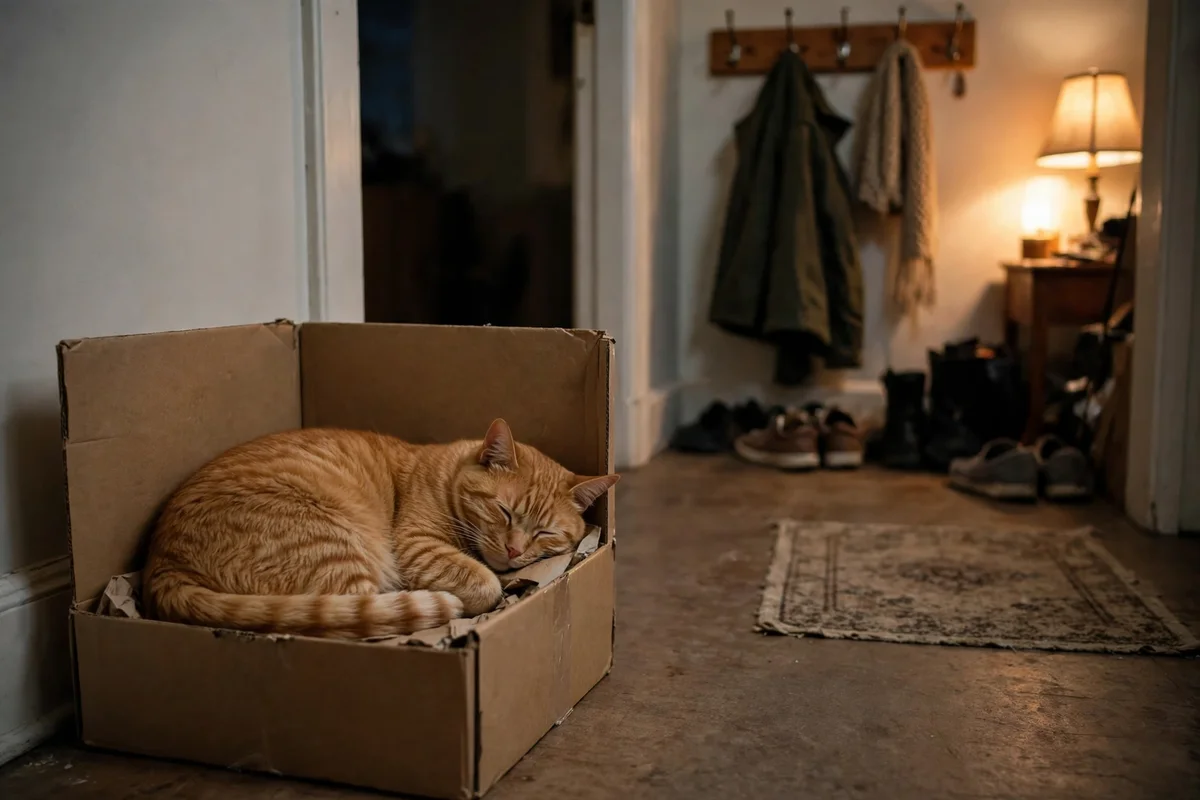
Why Do Cats Love Boxes?
Cats love boxes because one cardboard box answers four needs at once: safety, warmth, comforting pressure, and play. A box gives a cat walls at its back and one entrance to watch, it traps body heat, and it makes a perfect hiding place to pounce from. That is why a cat will walk past an expensive bed and climb into the box it arrived in. The behaviour looks funny, and it is funny, but it is also one of the best studied quirks in cat behaviour, with real experiments behind it.
The information here is general information only and is not veterinary advice. If your cat starts hiding far more than usual, or hiding comes with eating less or signs of pain, contact your vet.
Key Takeaways
- Cats love boxes because a box gives safety, warmth, pressure, and play, all at once.
- Cats are both predator and prey, so a box with walls and one entrance lets them watch the room without being watched.
- A cat’s body runs at 100.5 to 102.5 degrees Fahrenheit, and its comfort zone is about 86 to 97 degrees, far warmer than most homes.
- The snug squeeze is part of the appeal. Whole body contact pressure is calming, which is why the too small box often beats the roomy one.
- A Utrecht University study found that shelter cats given a hiding box settled faster than cats without one.
- Cats will even sit in a square drawn on the floor, and in an illusory square that is not really there.
- Most box sitting is normal and healthy. Hiding that never stops, or hiding with appetite loss or withdrawal, is worth a vet conversation.
The Short Answer: One Box, Four Needs at Once
Buy a cat a bed and it sleeps in the box the bed came in. Almost every cat owner has lived that joke. A cat bed answers one need, softness. A cardboard box answers four needs at the same time, cheaply and on the cat’s own terms.
The four needs are safety, warmth, pressure, and play. Safety, because the walls hide the cat while the opening lets it watch the room. Warmth, because cardboard traps body heat. Pressure, because the walls press gently against the cat on every side, and that contact is calming. Play, because a box is a hiding place to pounce from and a new thing to explore.
There is no single reason cats love boxes: a cat asleep in a box is getting warmth, pressure, and safety all at once.
Safety First: The Fortress With One Door
The strongest reason cats love boxes is safety. A domestic cat is a predator, but it is also small enough to be prey, and it has kept the instincts of both roles. In the wild, small cats hunt from cover and rest in cover. A cardboard box does the same job in a living room.
A box gives a cat walls on three sides and one entrance to watch. Out in the open, a cat has to watch in every direction at once. Inside a box, it only has to watch one opening. The cat can see without being seen, which is exactly the position a small hunter wants.
That sense of control is the key. Cats are not good at resolving conflict, especially with other cats, so a safe retreat matters even in a calm home. A box on its side in a quiet corner gives the cat a choice: stay and watch, or duck out of sight. Having that choice is calming in itself.
Warmth: Your Living Room Is Cold to Your Cat
The second reason is warmth. A cat’s body temperature sits between 100.5 and 102.5 degrees Fahrenheit, warmer than a human body. A cat’s thermoneutral zone, the temperature range where its body does not have to work to stay comfortable, is about 86 to 97 degrees Fahrenheit, or 30 to 36 degrees Celsius, according to a 2006 report from the National Research Council.
Most homes sit far below that range. A living room at 68 or 70 degrees Fahrenheit feels comfortable to you and mildly chilly to your cat. That is why cats patrol sunbeams, sleep on laptops, and curl up on warm laundry. They are looking for heat, and the house is not giving them enough of it.
| Spot | What it gives the cat | Why the cat picks it |
|---|---|---|
| A cardboard box | Insulation, warmth, walls, and pressure | Four needs answered at once |
| A sunbeam | Direct warmth | Free heat, but it moves and fades |
| A laptop or radiator | Direct warmth | Hot surface, but no cover and no pressure |
| An open cat bed | Softness and some warmth | Comfortable, but no walls and no hiding place |
Cardboard is a good insulator because it is full of air. Corrugated cardboard has a wavy layer between flat sheets, and the air pockets slow heat down. When a cat curls up inside a box, its body warms the small pocket of air around it, and the cardboard walls slow that warmth from escaping.
The curl matters too. A cat asleep in a box folds into a tight ball, tucking its paws under and wrapping its tail around its body. That shape loses less heat than a stretched out cat. Our guide on cat sleeping positions explains what each resting shape usually means.
The Squeeze: Why the Too Small Box Wins
Every cat owner has seen it. A cat pours itself into a box that is plainly too small, with fur overflowing on every side, looking completely satisfied. It is not a mistake. The cat is choosing the squeeze on purpose, and the reason is touch.
The word is thigmotaxis: the drive to be in contact with surfaces. Cats are strongly thigmotactic. A cat wedged into a snug box feels gentle pressure on several sides at once, and that pressure appears to be genuinely calming. It is the same principle behind swaddling a baby, or behind the snug wraps used to calm anxious dogs. The cat is not shopping for space. It is shopping for contact, and the too small box beats the right sized box because the right sized box leaves gaps.
How a Cat Fits in a Box That Looks Too Small
Cats are built to fold. Their spines are unusually flexible, and their collar bones float free rather than locking into the shoulder the way ours do. But there is a limit. A cat with joint pain, a spinal problem, or poor balance may struggle to get in and out, and a box can become a trap rather than a refuge. For older or stiff cats, choose a larger box with a low cut entrance.
The Utrecht Study: What Actually Happened
The box habit is one of the few cat quirks science has tested properly. In 2014, researchers at Utrecht University ran a simple experiment, and its results are quoted on almost every page about cats and boxes. The details are worth knowing, because several of those pages get them wrong.
What the researchers did
The team, led by Claudia Vinke, studied 19 newly arrived cats at a Dutch animal shelter. The researchers split the cats at random into two groups. Ten cats got a hiding box in their cage. Nine cats did not. Then they watched both groups for 14 days, scoring stress with the Cat Stress Score, a standard scale based on posture and behaviour.
What they found
The difference showed up fast. On days 3 and 4, the cats with boxes had significantly lower stress scores than the cats without boxes, with a p value below 0.01. By day 14, both groups had reached the same low stress level. The difference was speed. The cats with boxes reached that recovered level around day 3, while the cats without boxes needed the full two weeks. A 2019 randomized controlled trial by Van der Leij and colleagues, published in PLOS ONE, backed the finding up.
What the study does not prove
Honesty matters here, because the Utrecht study is often inflated online. Some pages claim the boxed cats had lower cortisol, or recovered 3 to 4 days earlier, or cut their stress response in half. None of those numbers appear in the published study. The researchers measured behaviour with the Cat Stress Score, not cortisol levels, and their result is about the speed of recovery, not a percentage drop in stress. The study also involved only 19 cats in one shelter, in their first two weeks, so it is not proof that a box lowers stress for every cat in every situation.
The Hunter in the Box: Ambush, Play and Curiosity
Safety and warmth explain why cats rest in boxes. Play explains why they explode out of them. Cats are ambush hunters: they wait, hidden, and strike when something comes close. A box is the perfect ambush blind. The cat can see out, the prey cannot see in, and the walls hide the crouch until the pounce.
Watch a cat in a box with a toy nearby and you will see the hunting sequence in miniature. The cat crouches low, eyes fixed, tail tip twitching. Then it bursts out, grabs the toy, and drags it back into the box. The box turns an ordinary toy into a hunt, and that is why a box keeps a cat busy far longer than the same toy on an open floor.
Curiosity is the other half of play. Cats are drawn to new things, and a new box is a new thing. It smells different, it sounds different when scratched, and it has corners to investigate. That novelty is valuable for indoor cats, who live in a small and unchanging territory. Jumping in and out of boxes also keeps a cat moving, which helps fitness and coordination. Our guide on cat zoomies covers the other side of that energy, the sudden bursts of running and playing that often start from a box or a hiding place.
The Square That Was Not There
The strangest proof that boxes are about enclosure, not cardboard, came from a study of squares that did not exist. In 2017, owners started taping empty squares on the floor under the hashtag CatSquare, and cats sat inside them.
Animal cognition researcher Gabriella Smith at Hunter College, City University of New York, turned that joke into an experiment. In a study published in Applied Animal Behaviour Science in 2021, she asked owners to lay out three shapes on the floor over six days: a square taped on the floor, a Kanizsa square, and a control shape. A Kanizsa square is an optical illusion made from four Pac Man shapes arranged so the human brain sees a square that is not actually drawn.
The numbers were small, and Smith is open about that. About 500 owners signed up, 30 completed the six day sequence, and 9 cats chose at least one shape. The cats sat in the taped square 8 times, in the Kanizsa square 7 times, and in the control shape only once. They chose the square that was not there as often as the square that was.
How to Read One Box Session
Use the setting, the timing, and the body language together to tell what your cat is getting from the box right now.
- Setting: a box in a quiet corner usually means rest or retreat. A box in the middle of the action usually means ambush play. A box near a window or radiator usually means warmth.
- Timing: a cat that climbs into a box at bedtime is settling down to sleep. A cat that dives into a box when visitors arrive is usually hiding from the noise.
- Body language: loose body and slow blinks mean comfort. Wide eyes, flattened ears, and a lashing tail mean stress or fear.
- What happens next: a cat that sleeps in the box was resting. A cat that bursts out at a toy was hunting. A cat that stays in the box for hours and refuses food was not resting,
If the setting and the body language disagree, trust the body language. A cat sitting in a sunny box with flattened ears and wide eyes is not enjoying the sun. It is hiding, and the box happens to be where it hid. Our guide on what your cat is trying to tell you covers the sounds and signals that go with these postures.
Picking the Right Box
The right box depends on the cat’s size, age, and confidence.
| Cat | Best box | Why |
|---|---|---|
| Average adult cat | Shoebox to small delivery box, one entrance cut in the side | Snug enough for pressure, roomy enough to turn around |
| Large cat | Bigger delivery box, wide entrance | Too small becomes a struggle, not a squeeze |
| Kitten | Small box, low entrance, plus a blanket | Easy to climb into, warm, and safe to explore |
| Older or stiff cat | Large box, shallow low cut entrance, on the floor | Steps in rather than jumps |
| Nervous or new cat | Box on its side in a quiet corner | A private retreat the cat owns from day one |
| Multi cat home | One box per cat, in different rooms | Stops one cat guarding the only good box |
Cardboard is best. It insulates, it scratches well, and it is cheap to replace when it goes soggy or collapses. A box that has gone soft under a cat’s weight should be replaced, because a collapsing box can startle a cat. Placement matters as much as size. Put the box where the cat already likes to be, not where you wish it would be.
Building a Safe Box Playground
A box is the cheapest cat toy there is: make it safe first, then make it fun.
The box proofing checklist
- Remove all tape, labels, stickers, and plastic wrapping. Cats can swallow tape and plastic, and both can cause intestinal blockage.
- Pull out every staple and check for sharp edges or jagged cuts.
- Throw away loose string, rubber bands, and elastic. String is one of the most dangerous things a cat can swallow.
- Take out styrofoam peanuts and plastic air pillows. Both are choking hazards.
- Check what the box held before: a box that held chemicals or raw food should not become a cat toy.
- Make sure the box is empty and sturdy, and wipe the inside with a damp cloth.
Five box play ideas
- The tunnel: cut an entrance in each end of a long box and let the cat run through.
- The ambush box: cut a few paw sized holes in the sides. Poke a wand toy through and let the cat hunt it from inside.
- The treat hunt: hide a few treats inside the box under a scrunched paper ball, so the cat has to forage.
- The box fort: stack two or three boxes with entrances cut between them.
- The window box: put a box with a blanket near a window, for warmth, a view, and a hiding place in one spot.
Supervise the first few sessions, especially with kittens and cats that chew. Chewing cardboard is usually harmless, but a cat that swallows large pieces can develop an intestinal blockage, and that needs a vet. If your cat eats cardboard rather than chewing it, take the box away. If you are setting up a new cat’s space, our new cat owner starter kit covers the boxes, beds, and hiding places a new cat needs.
When Box Hiding Is a Worry
Most box sitting is ordinary behaviour, and the box itself is never the problem. The problem is when hiding changes, or when hiding comes with other changes. Talk to your vet if your cat suddenly hides far more than usual or stays in the box most of the day, if hiding comes with eating less, drinking more, vomiting, diarrhea, or a change in litter habits, if your cat overgrooms, loses weight, or seems sore, if it guards the box aggressively, or if it eats cardboard obsessively. One sign on its own may mean nothing, but two or three together are worth a conversation.
Hiding is one of the first signs that a cat is unwell or stressed. Our guide on why cats hide explains the full picture, from new furniture to illness, and when hiding needs a vet visit. Do not drag your cat out of the box. A frightened or unwell cat that is forced out loses its safe place and becomes more stressed, not less. Instead, watch the pattern for a day or two: how long the cat stays in, whether it eats and drinks, and whether it uses the litter box. If the hiding is new and lasts more than a day or two, or comes with any of the signs above, call your vet.
Frequently Asked Questions
Why does my cat sleep in a box instead of its bed?
A bed answers one need, softness. A box answers four: safety, warmth, pressure, and a place to hide. Try putting the bed inside the box.
Why does my cat sit in boxes that are too small?
The cat is choosing the squeeze on purpose. Whole body contact pressure is calming. As long as the cat can climb out easily, the overflow is the point, not a mistake.
Is it safe for my cat to play in cardboard boxes?
Yes, once the box is proofed. Remove tape, staples, string, rubber bands, plastic, and styrofoam. Take the box away if your cat eats cardboard rather than chewing it.
Do cats like boxes because they are stressed?
Sometimes, but not always. A stressed cat will seek a box to cope, and the Utrecht study showed that boxes help shelter cats settle faster. A relaxed cat will also use a box for warmth, pressure, and play.
Why does my cat sit in a square drawn on the floor?
Because the attraction is to enclosure itself, not to cardboard. In a 2021 study, cats sat inside taped squares and inside Kanizsa illusory squares as often as each other.