
Why Does My Cat Climb Me Like a Tree?
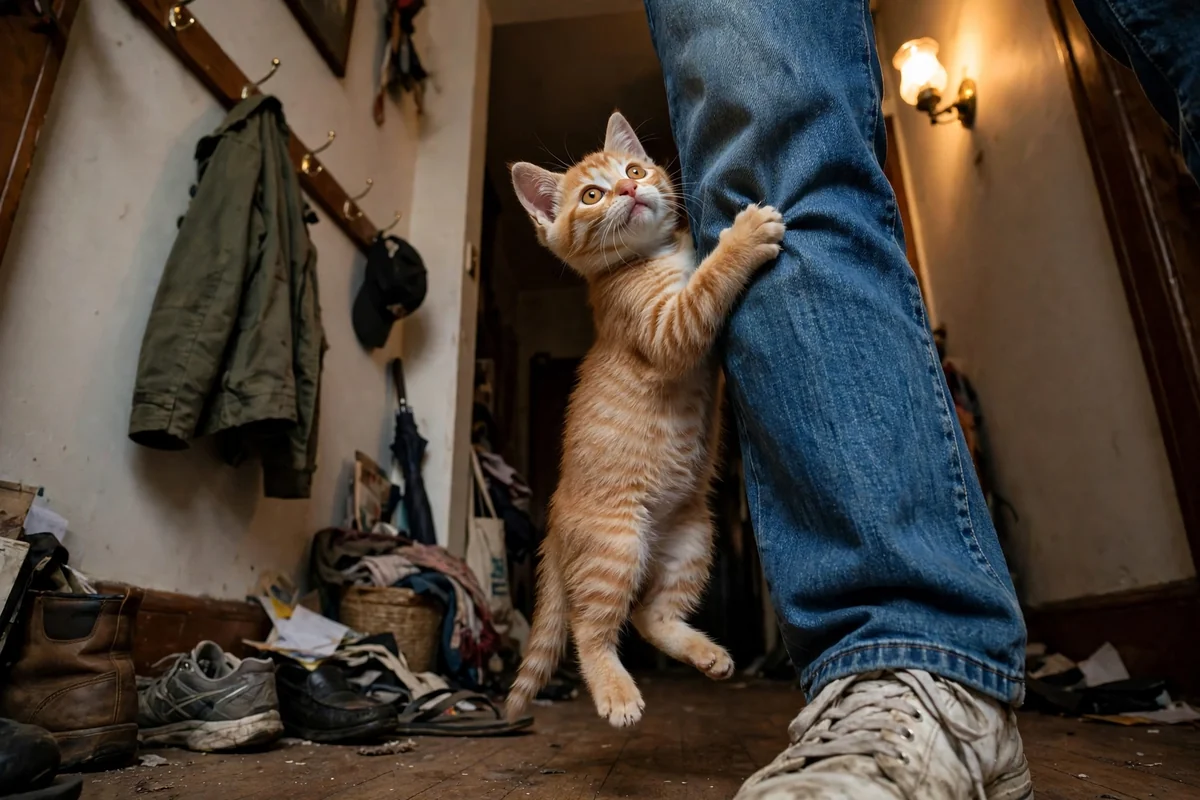
You are standing in the kitchen, and your kitten is halfway up your leg. Or you sit down to work, and your cat launches itself onto your shoulder like you are a tree branch. If your cat climbs you like a tree, it hurts, it startles you, and it leaves scratches. The honest answer is that your cat is doing what cats are built to do: climb to a high place. You are simply the tallest thing in the room, and the warmest, and the one that reacts every time.
This article explains the four different kinds of climbing, why cats do it, when it is normal and when it needs a vet, what to do in the moment, and a four step plan that moves the climbing from your leg to a cat tree.
The information here is general information only and is not veterinary advice. If your cat suddenly starts climbing or clinging far more than usual, or stops jumping and hiding, contact your vet.
Key Takeaways
- Your cat climbs you because height feels safe, and you are often the tallest object in the room.
- Kittens climb far more than adults. Most outgrow it as they grow heavier, but the habit stays if it was rewarded when they were small.
- Attention and boredom drive most climbing. A cat that wants food, play, or company learns fast that claws in a leg cannot be ignored.
- Leg climbing, shoulder riding, chest settling, and back jumping are four different behaviours with different causes.
- When the climbing happens tells you why. Mealtimes point to food, work time points to attention, and a sudden change after a move or a new pet points to stress.
- The fix is redirection, not punishment. Give your cat a tall stable tree, play daily, and reward the tree, not the climb.
- Never punish, shout at, or spray a climbing cat, and never declaw. Declawing removes the last bone of each toe.
- A sudden change in climbing or clinginess in an older cat deserves a vet check first, before you try to train it away.
The Short Answer: Why Does My Cat Climb Me Like a Tree?
Cats climb because they are climbers. Domestic cats descend from the African wildcat, and they share over 95 percent of their DNA with tigers. Wild cats climb trees to rest safely, to watch for prey, and to get away from danger. Your cat carries the same wiring. A high spot gives a better view and a safer rest place, and a standing person is often the tallest thing in the room.
That is the main reason, but it is rarely the only one. Warmth, affection, attention, boredom, and habit all play a part. A lap or a shoulder is warm, because cats run warmer than people, at around 100.5 to 102.5 degrees Fahrenheit. A climb that gets a reaction, even a shout, teaches the cat that climbing works. And a kitten that climbed your leg at eight weeks old and got picked up and cuddled has learned a lesson that can last for years.
4 Kinds of Climbing, and What Each One Means
Not all climbing is the same. Ranking pages lump it together, but leg climbing, shoulder riding, chest settling, and back jumping have different causes, and they need different fixes.
1. Leg climbing
This is the classic kitten move: front claws hooked into your jeans, back paws scrambling, all the way up to your knee or your hip. It is mostly a kitten and energy problem. Kittens are light, curious, and full of energy, and they are still learning what hurts people. They climb legs because legs are there, they move, and they are easy to grab. Most kittens outgrow it as they grow heavier and learn limits, but some adults keep doing it if the climb was rewarded when they were small.
2. Shoulder riding
A cat that climbs to your shoulder and settles there is after the view and the warmth. From your shoulder, a cat can see the whole room, and it is close to your face and your voice. Some cats learn this as kittens, when being carried on a shoulder meant safety. Others learn it because the shoulder gets them petted and talked to. Shoulder riding is the most affectionate kind of climbing, and also the one most likely to leave scratches on your neck.
3. Chest settling
A cat that climbs onto your chest when you lie down is looking for warmth, scent, and closeness. Your chest rises and falls with your breathing, it is warm, and it smells like you. Cats that settle on a chest often knead first, which comes from kittenhood, when kittens kneaded their mother to prompt milk flow. Kneading, purring, and slow blinking are trust signals. Our guide on why cats show their belly explains more of these trust signals, and why a belly on show is an invitation to look, not to touch.
4. Back jumping
A cat that jumps onto your back when you bend over is usually playing, or startled, or both. A bent back looks like a shelf, and a moving back looks like prey. This is the most startling kind, and the one most likely to cause a fall. It is also the easiest to prevent, because it only happens when you bend down at cat height. Stand up slowly, and keep a hand free to block the jump while you train the alternative.
Why Cats Climb: 6 Reasons
Most climbing comes down to one or more of these six reasons. Finding which ones apply to your cat is the first step to stopping it.
1. Height feels safe
This is the deepest reason. In the wild, a high branch is a safe place to rest and a good place to watch from. Cats form strong attachment bonds with their owners, shown in a 2019 study by Vitale and colleagues, and they also treat their owners as safe ground. When your cat climbs you, it is choosing the safest high place it can see. You are not furniture to your cat. You are the safe tree.
2. Kittens are built to climb
Kittens climb everything: curtains, shelves, your leg, your back. They are light enough to hang from a claw, curious enough to try anything, and energetic enough to keep going. Most stop as they grow bigger, because a 5 kilogram cat cannot hang from a trouser leg the way a 1 kilogram kitten can. If your adult cat still climbs your leg, it probably learned the habit as a kitten and never had a reason to stop.
3. Attention, and the fastest way to get it
A cat that wants your attention learns very fast what works. Meowing can be ignored. Sitting quietly can be ignored. Claws in a leg cannot be ignored. If petting, talking, or lifting follows the climb, the cat repeats it, because climbing is the most reliable button in the house. This is also why cats climb you when you sit down to work. Our guide on why cats sit on laptops covers the same attention logic: the thing you are looking at is the thing your cat wants to be on.
4. Boredom and unused energy
Indoor cats with little to climb or chase are the most likely to use their owner as the outlet. A cat that has no tall tree, no window perch, and no daily play still has a full tank of hunting energy, and your leg is the nearest moving target. Our guide on why cats get the zoomies explains the dawn and dusk energy burst that drives so much of this behaviour. A cat that climbs you at 6 in the morning is often a cat that has been asleep all night and is bursting with energy.
5. Warmth and affection
Cats run warmer than people, and they seek warm spots. A lap, a chest, and a shoulder are warm, and they smell like the person the cat trusts. Rubbing against you leaves scent from glands on the cheeks, paws, flanks, and the base of the tail, which marks you as familiar. Climbing for warmth and affection is not a problem to fix so much as a compliment to redirect. The cat wants to be close to you, just not with claws in your skin.
6. Stress, anxiety, or a new change
Some cats climb more when they are stressed. A move, a new pet, a new baby, building work, or a change in routine can all push a cat to cling to the one safe thing it knows: you. Stress climbing usually comes with other signs, such as hiding, eating less, over grooming, or toileting outside the tray. If the climbing started suddenly after a change, treat the stress first, and the climbing usually eases with it.
When It Happens Tells You Why: A Timing Diagnostic
No ranking page gives this diagnostic, but it is the fastest way to find the cause. Match the timing to the likely reason, then try the matching fix.
| When the climbing happens | What it likely means | Try first |
|---|---|---|
| At mealtimes, or near the kitchen | Food seeking | Feed on a fixed schedule, and do not feed from the table |
| When you sit down to work or watch television | Attention seeking | A short play session before you sit down, then ignore the climb |
| Early morning or late evening | Unused energy, the dawn and dusk burst | A play session before bed, and a morning play session |
| Only after a move, a new pet, or a new baby | Stress or insecurity | Keep routines fixed, give hiding places, and be patient |
| All day, every day, with no pattern | Boredom or a learned habit | A tall tree, daily play, and the four step plan below |
| Sudden onset in an older cat | Possible pain or illness | Vet check first, before any training |
Which Cats Climb Most?
Kittens climb most, and most outgrow it. Young adult cats climb more than seniors, because they have more energy. Indoor cats climb their owners more than outdoor cats, because they have fewer trees and fewer outlets. Some breeds are named as more likely climbers, including the Abyssinian, the Bengal, and the Ocicat, all active and athletic breeds, but any cat can be a climber if the habit was rewarded early.
Do not believe the dominance story. Several ranking pages repeat the idea that a climbing cat is trying to dominate you, or to be above you in a hierarchy. Cats do not run a dog style hierarchy, and high spots are about safety and habit, not rank. Your cat is not trying to be your boss. It is trying to be safe, warm, or noticed.
When Climbing Is a Warning Sign
Most climbing is normal. A few patterns deserve a vet visit before you try to train the behaviour away. The rule is simple: a sudden change in an older cat is a vet check first, and training second.
- A cat that suddenly starts climbing and clinging far more than usual, especially an older cat.
- A cat that suddenly stops jumping or climbing, hides in extreme spots, or cries when picked up. This can mean pain.
- Climbing paired with weight loss, drinking far more water, eating far less, or toileting outside the tray.
- Climbing paired with over grooming, bald patches, or constant hiding.
Sudden clinginess can be linked to health problems, including hyperthyroidism, kidney disease, arthritis, dental pain, and cognitive decline in older cats. This article cannot diagnose your cat, and it does not try to. If the behaviour changed suddenly, call your vet and describe the change. A vet check is cheap compared to months of training the wrong problem.
What to Do in the Moment
When claws are already in your leg, the goal is to get the cat off without a scratch and without teaching it that climbing gets a big reaction.
- Stay still. Do not shake your leg, pull away, or shout. Pulling away drags the claws through your skin, and shouting rewards the cat with attention.
- Go boring. Look away, stop talking, and let your body go limp. A boring tree is not worth climbing.
- Lift the cat gently from underneath, supporting its back paws, and place it on the floor or on its tree. Do not grab it by the scruff.
- Redirect at once. The moment all four paws are on the floor, offer a wand toy or point to the cat tree. Reward the right choice, not the climb.
- Wear thicker trousers while you train. Thick jeans, or leggings under a long skirt, take the sting out of the learning period. This is a practical fix, not a fashion statement, and it matters most for children and older people, whose skin tears more easily.
The 4 Step Redirection Plan
Redirection works, but it takes weeks, not days. No ranking page says this honestly, so here it is plainly: expect 3 to 6 weeks before the habit fades, and expect setbacks when anything changes at home. The plan has four steps, and they work together.
Step 1. Give your cat a better tree
Buy or build a tall, stable cat tree, at least as tall as your waist, and put it where your cat already climbs you. If the climbing happens by the sofa, the tree goes by the sofa. If it happens in the kitchen, the tree goes in the kitchen. A wobbly tree will be ignored, so it must not rock when the cat jumps on it. Add a window perch or a wall shelf if you can. The tree must beat you on height, stability, and view, or the cat will keep choosing you.
Step 2. Play every day, before the climbing hour
Play with a wand toy for 10 to 15 minutes, twice a day, and time one session for just before the hour your cat usually climbs. Play that ends with a small meal works best, because it copies the hunt, catch, eat, rest cycle. A tired cat is a cat that naps on the tree instead of climbing your leg. One ranking page suggests an hour of daily play, which is more than most owners can do. Two focused sessions of 10 to 15 minutes are realistic, and they are enough for most cats.
Step 3. Reward the tree, ignore the climb
Every time your cat uses the tree, reward it at once: a treat, a stroke, a calm word. Every time it climbs you, stay boring, lift it off gently, and place it on the tree or the floor. Do not pet the cat while it is on you, and do not talk to it while it climbs. The rule is simple: the tree pays, you do not. Most owners fail on this step, because they pet the cat while it is on their shoulder and then wonder why it keeps coming back.
Step 4. Trim the claws, and keep the routine fixed
Trim your indoor cat’s claws every 2 to 3 weeks, cutting only the sharp tip. This does not stop climbing, but it stops the scratches while you train. Keep feeding times, play times, and bedtime fixed, because a fixed routine lowers stress, and lower stress means less clingy climbing. If you have a new pet or a new baby, give the cat extra hiding places and extra play, and expect the climbing to rise for a few weeks before it settles.
What NOT to Do
- Do not shout, spray water, or punish a climbing cat. Fear damages trust, and a frightened cat climbs more, not less. One older ranking page advises raising your voice. That advice conflicts with the no punishment consensus, and you should ignore it.
- Do not use citrus sprays, sticky tape, or foil on your clothes or skin to deter climbing. These are mentioned on some pages, but their safety on skin and clothing is not settled, and a vet should be asked first.
- Do not declaw your cat. Declawing removes the last bone of each toe, and it is rejected by every credible source. Trimming the claws is the safe alternative.
- Do not push the cat off or shake it off. You will scratch yourself, and you may injure the cat.
- Do not reward the climb by accident. Picking the cat up, cuddling it, and talking to it while it is on your shoulder teaches it to climb again tomorrow.
Scratch Safety: Cleaning a Claw Scratch
Climbing leaves scratches, and a scratch can break the skin. Clean every scratch that breaks the skin, even a small one. Wash it at once with soap and running water for at least a minute, then apply an antiseptic and cover it with a clean dressing. Watch it for 2 to 3 days. If the area becomes red, swollen, warm, or painful, or if you develop a fever or a swollen gland, contact your doctor.
Children and older people need extra care, because their skin tears more easily and heals more slowly. Keep a cat that climbs away from small children until the habit is trained down, and teach children to stay still and call an adult instead of pulling away. If your cat has not had a recent vet check, mention the scratching at the next visit, so the vet can confirm the claws and the general health are fine.
Frequently Asked Questions
Is it normal for a cat to climb me like a tree?
Yes, especially for kittens. Climbing is a normal cat behaviour, driven by the instinct to seek high, safe places. It becomes a problem only when it causes scratches, or when it starts suddenly in an older cat, which deserves a vet check.
Will my kitten outgrow climbing me?
Most kittens do, as they grow heavier and learn limits. But a kitten that is picked up and cuddled every time it climbs can keep the habit into adulthood. Redirection to a cat tree while the cat is still young works faster than retraining an adult.
How do I stop my cat climbing my legs?
Stay still, lift the cat off gently, and place it on a tall stable tree. Play twice a day, reward every use of the tree, and ignore the climb. Expect 3 to 6 weeks before the habit fades.
Why does my cat climb onto my shoulder?
Your shoulder is high, warm, and close to your face and voice. It gives the best view in the room. Shoulder riding is usually affection and habit, not dominance, and it is trained the same way as leg climbing: redirect to a high perch and reward that instead.
Should I punish my cat for climbing me?
No. Punishment, shouting, and spraying water do not stop climbing, because climbing is instinct and habit, not disobedience. Fear damages trust and can make the cat climb more. Redirect the cat to a tree and reward the tree.
Is declawing a solution for a climbing cat?
No. Declawing removes the last bone of each toe, and it is rejected by every credible source. Trim the sharp tips of the claws every 2 to 3 weeks instead, and redirect the climbing to a cat tree.
The Bottom Line
Your cat climbs you because you are tall, warm, safe, and you react every time. That is not bad behaviour. It is a cat doing what cats do, aimed at the wrong tree. Give your cat a better tree, play with it every day, reward the tree and ignore the climb, and trim the claws while you train. Expect weeks, not days, and expect the odd setback. If the climbing started suddenly in an older cat, see the vet first. Otherwise, the fix is simple, even if it is not instant: be a boring tree, and let the real tree win.