
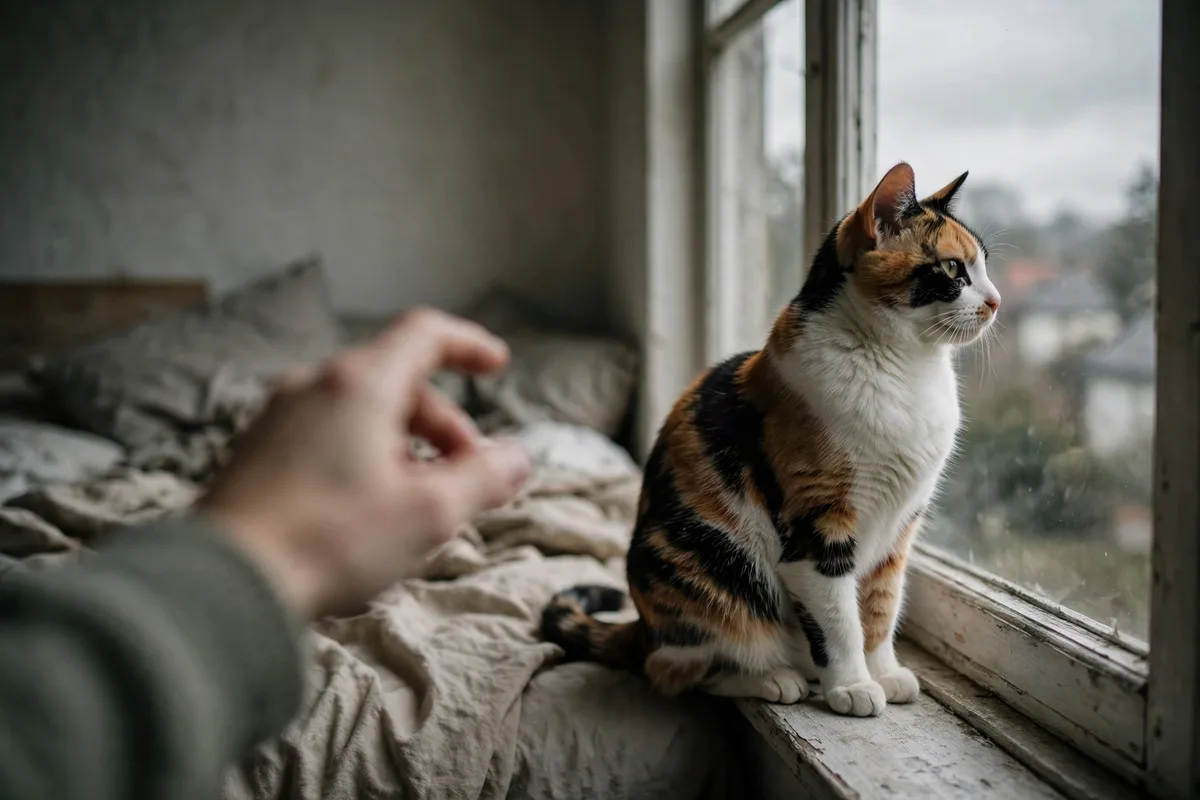
Why Does My Cat Ignore Me?
You call your cat. It looks at you, or rather it looks past you, and it does not move. You call again, louder. An ear twitches. That is all. Your cat is ignoring you, and it feels deliberate, as if the cat heard every word and decided you were not worth answering.
Here is the uncomfortable truth: your cat did hear you. Scientists have shown that cats recognise their owner voice and can tell it from a stranger voice, and they react differently when their owner speaks to them directly. Your cat is not failing to hear you. It is choosing not to respond right now, and that choice usually has a simple reason behind it.
The information here is general information only and is not veterinary advice. If a cat that was social suddenly starts ignoring you, or the ignoring comes with eating less, hiding, or a change in toileting, contact your vet.
Key Takeaways
- Your cat hears you. In a 2022 study of 16 cats, cats reacted to their owner voice in cat directed speech, but not to a stranger voice or to adult directed speech.
- Cats are not ignoring you out of malice or spite. Ignoring is usually about personality, alone time, fear, stress, age, or illness.
- First decide which kind it is: a cat that has always been aloof needs a different answer from a cat that was social and suddenly went distant.
- Kittens need consistent positive human contact between 2 and 7 weeks of age, declining until about 14 weeks. Without it, cats can grow up avoiding people.
- Cats seek out the person who ignores them, because that person poses no demand and feels safe. Chasing a cat makes it ignore you more, not less.
- Older cats may ignore you because they cannot hear or see you well, because they are in pain, or because of feline cognitive dysfunction.
- A sudden change in a social cat is a vet matter first. Kidney disease, infections, and pain can all cause withdrawal.
- The way to become the person your cat chooses is to stop chasing, sit low, look away, and let the cat come to you.
The Short Answer: Why Does My Cat Ignore Me?
Your cat ignores you because it is independent by nature, and because in this moment it wants something else more than it wants interaction: sleep, food, a quiet spot, a hunt, or simply to be left alone. Cats are not dogs. They do not come when called out of obedience, and they do not show affection on a schedule. They show it on their own terms, when they choose to, and they ignore you the rest of the time without meaning anything by it.
That is the normal answer, and it covers most cats most of the time. The answer changes if the ignoring is new. A cat that was affectionate last week and distant this week is telling you something has changed, and the change may be fear, stress, pain, illness, or a new person, pet, or smell in the house. Work out which kind of ignoring you have first, because the fix is different.
First, the Proof: Your Cat Hears You
It helps to know the science before you take the ignoring personally. In a study published in the journal Animal Cognition in 2022, researchers at Paris Nanterre University played recordings to 16 cats in their own homes. The recordings were the cat owner voice and a stranger voice, each speaking in two ways: cat directed speech, the higher pitched, familiar way people talk to cats, and adult directed speech, the normal way people talk to each other.
The cats reacted distinctively to only one combination: their own owner speaking in cat directed speech. When they heard that, their behaviour intensity increased: they turned their ears toward the speaker, their pupils dilated, and they moved around the room more. When they heard a stranger, in either tone, or their owner speaking in adult directed tones, they did not react the same way. Ten of the 16 cats decreased their behaviour intensity on hearing a stranger call them by name, then perked up when they heard their owner. An earlier study, from 2013, had already shown that cats recognise their owner voice and react more strongly to it than to a stranger voice.
The study was small, with only 16 cats, and the researchers said the results need confirming in a larger group. Even so, the message is clear: your cat knows your voice, knows when you are talking to it, and hears you when you call. When it does not respond, it is not confusion. It is a decision, and the rest of this guide is about what that decision usually means.
Always Aloof or Suddenly Aloof? The Decision Tree
Ask one question: has your cat always been like this, or did it change? A cat that has always been aloof, that never came when called, that sleeps alone and visits you on its own schedule, is probably just being itself. That cat needs acceptance and a routine, not a fix. The steps below will still help, because even an aloof cat chooses the calmest person in the room, but do not expect a lap cat to appear. Personality is not a problem to solve.
A cat that was social and suddenly went distant is a different matter. Something changed, and your job is to find what. Check the date the change started, and ask what else changed at the same time: a move, a holiday, a new person or pet, building work, a vet visit, a new food, or a change in your own routine.
8 Reasons Your Cat Ignores You
Work through these in order, and be honest about which one fits. Most cats have one main reason and one or two smaller ones.
1. It Is Just Their Personality
Some cats are affectionate, and some are not, and neither is wrong. Cats are naturally independent, because their ancestors were solitary hunters that only came together to mate. That independence is still in them. One cat will follow you from room to room, another will visit you once a day, sit near you for ten minutes, and leave. If your cat has always been like this, and it eats, plays, grooms, and sleeps normally, it is probably just its personality, and the kindest thing you can do is respect it.
2. They Want Alone Time
Cats need time alone the way people need sleep. A cat that has spent the morning playing, eating, and being stroked may simply be done with interaction for a while, and it will go to a quiet spot to rest. Calling it, following it, or picking it up at that moment will not make it affectionate. It will make it avoid you next time. Let the cat have its alone time, and it will come back when it is ready, usually within an hour or two.
3. They Are Busy With Something Else
A cat in the middle of eating, grooming, sleeping, or watching a bird out of the window is not ignoring you. It is busy. Cats focus completely on what they are doing, and they do not multitask the way people do. A cat that is grooming will finish grooming before it responds to anything, and a cat that is watching prey will not break its stare for a voice, even a familiar one.
4. Fear or Stress
Fear is the most common reason a social cat suddenly goes distant. A loud noise, an unfamiliar visitor, a new pet, a move, building work, or a frightening experience can all make a cat withdraw. A stressed cat is less likely to want cuddles, and more likely to hide, eat less, overgroom, or avoid the litter tray. If the ignoring started with a fright or a change, give the cat time, quiet, and routine, and let it come back at its own pace.
5. A Change in Routine or Scent
Cats build their world around routine and scent, and both are fragile. A holiday breaks the routine: you disappear, someone else feeds the cat, and the cat adapts to a rhythm without you. When you come back, you smell of hotels, airports, and other people, and the cat may treat you as unfamiliar for a day or two. The same happens with a new perfume, a new laundry detergent, a new job with different hours, or a new person in the house. The cat is not punishing you. It is waiting for the world to smell right again, and it usually does within 48 hours.
6. Poor Socialization as a Kitten
Kittens need consistent, positive human contact during their socialization period, which is between 2 and 7 weeks of age, and which begins to decline until approximately 14 weeks. Kittens that get that contact usually grow up confident around people. Kittens that get little contact, or frightening contact, can grow up avoiding people entirely, and they may ignore humans or even be fearful of them for life. This is common in rescue cats and in cats adopted as adults. It is not a flaw, and it is not your fault. It means the cat needs more time and more patience than a well socialized cat.
7. Old Age, Hearing, and Vision
Older cats may ignore you because they cannot hear or see you well. A cat with poor hearing may not know you are calling, and a cat with poor vision may not see you looking for attention. Both are common in senior cats, and both are easy to miss, because the cat still moves around the house normally. If your older cat ignores calls but responds to touch, or if it startles when you approach from behind, ask your vet to check its hearing and vision.
8. Illness or Pain
Cats often become more standoffish when they are not feeling well. Kidney disease, infections, dental pain, arthritis, and anything that causes pain can make a cat withdraw and interact less. Cats hide pain well, and they hide it by disappearing: sleeping more, hiding in unusual places, eating less, and avoiding touch. If your normally social cat suddenly starts ignoring you, and the change comes with any of those signs, book a vet check. The vet section below lists exactly what to watch for.
Senior Cats: Hearing, Vision, Pain, and Cognitive Dysfunction
Senior cats deserve their own section, because four different problems can look like ignoring, and each needs a different response. Hearing loss is the simplest: the cat does not hear you call, so it does not respond. Approach from the front, where the cat can see you, and use touch and routine rather than voice. Vision loss is similar: the cat may not see you across the room, so it does not come. Keep furniture in the same place, keep a night light on, and approach slowly from the front.
Pain is the third cause, and it is the one owners miss most. Arthritis makes jumping and being picked up hurt, so an older cat avoids both. Dental pain makes eating hurt, so the cat eats less and hides more. The fourth cause is feline cognitive dysfunction, a condition like dementia in humans, which causes disorientation, confusion, and anxiety in older cats.
Why Your Cat Chooses One Person and Ignores the Rest
In most homes, the cat has a favourite person, and it is rarely the person who tries hardest. Cats choose the person who is calmest, quietest, and least demanding, because that person feels safe. The person who feeds the cat, plays with the cat, and then leaves it alone is usually the chosen one. The person who chases the cat, picks it up, and follows it around the house is usually the ignored one, however much they love the cat.
If you are the ignored person, the fix is not to try harder. It is to try less, in the right way. Take over the feeding, do the quiet play sessions, sit near the cat without reaching for it, and let the cat come to you. It can take weeks, and the cat may still prefer the other person, but most cats will warm up to a second person who respects their rules.
How to Become the Person Your Cat Chooses: 6 Steps
These steps work together, and they work slowly. Give each one a week before you judge it.
Step 1: Stop Chasing the Cat
Stop following the cat, stop calling it repeatedly, and stop picking it up to bring it to you. Every chase confirms that you are a demand, not a safe place. Let the cat leave, and let it come back on its own.
Step 2: Be Boring and Available
Sit in the same room as the cat, reading or working quietly, without looking at the cat or reaching for it. Cats seek out the person who seems least interested, because that person poses no demand.
Step 3: Sit Low, Look Away, Blink Slowly
Crouch or sit on the floor, turn your body sideways, and avoid staring at the cat. When the cat looks at you, blink slowly, closing your eyes for a second and opening them again. A slow blink is a cat signal for trust, and many cats will blink back.
Step 4: Let the Cat Set the Time and the Place
Let the cat decide when interaction happens and when it ends. When the cat approaches, stay still and let it sniff you. When it walks away, let it walk away. Choice is what turns a feared person into a safe person.
Step 5: Be the Source of Food, Play, and Calm
Take over feeding, and give the food at the same times every day. Play with a wand toy so the cat can play at a safe distance, and end each session with a treat. A cat that links you with food and fun will start approaching on its own. Cats that choose a person to sleep on are cats that feel safe with that person, and cats that sleep on their owners show that trust most clearly. Cats that follow their owners from room to room are usually bonded cats, and cats that follow you are showing the same attachment that makes them ignore you when they want space.
Step 6: Keep a Routine the Cat Can Trust
Feed at the same times, play at the same times, and keep the house calm and predictable. A cat that knows what happens next feels safe, and a safe cat is a cat that comes to you. Routine matters more than any single trick.
When Ignoring Means Something Is Wrong: Vet Red Flags
Book a vet check if a normally social cat suddenly starts ignoring you, especially with any of these signs: eating or drinking less, hiding more than usual, sleeping much more, hesitating to jump, stiffness after resting, a hunched posture with squinty eyes, vomiting or diarrhoea, weight loss, or going off food entirely. Kidney disease, infections, dental pain, arthritis, and cognitive dysfunction can all show up first as withdrawal, and cats hide pain well. For the vet reviewed background, PetMD explains why cats ignore their owners and when a sudden change needs a vet. Never give a cat human painkillers, because many are dangerous to cats.
What NOT to Do
Do not chase, grab, or trap the cat to force affection, and do not punish it for ignoring you. Punishment teaches the cat that people are dangerous, which is the opposite of what you want. Do not use a spray bottle, loud noises, or a scare to get a reaction, and do not shut the cat in a room with no hiding place.
FAQ
Why does my cat ignore me when I call its name?
Your cat knows its name and knows your voice, but it does not come when called out of obedience. Try calling once, in a warm cat directed voice, when the cat is not busy, and reward it with a treat when it responds.
Why does my cat ignore me but follow me everywhere?
Following and ignoring are not opposites. Your cat wants to be near you, but on its own terms. It follows you to be close, and it ignores your calls because it does not want handling right now. Both are normal.
Why does my cat ignore me after vacation?
Your routine changed, and your scent changed. The cat adapted to a rhythm without you, and you came back smelling of travel. Give it a day or two of quiet and steady feeding times, and it will come back to you.
Why does my cat ignore me and hide?
Hiding plus ignoring usually means fear, stress, or pain. Leave the cat alone, put food and water nearby, and watch for other signs like eating less or toileting changes. If it lasts more than a day, book a vet check.
Why does my cat ignore my husband but not me?
Your cat has chosen its favourite person, usually the calmest and least demanding one. Your husband can become the second chosen person by feeding the cat, playing quietly, and letting the cat approach him.
Will my cat ever stop ignoring me?
Most cats do, once you stop chasing and let the cat choose. Some cats take weeks, and poorly socialized rescues can take months.
The Bottom Line
Your cat hears you, knows your voice, and is choosing not to answer right now. Most of the time that choice is about personality, alone time, or being busy. When the ignoring is sudden, it is usually fear, stress, routine, or pain, and the fix is to find the change, give the cat space, and book a vet check if the change comes with other signs. Stop chasing, sit low, and let the cat choose you. Most cats will.