
Why Does My Cat Knock Things Off Tables?
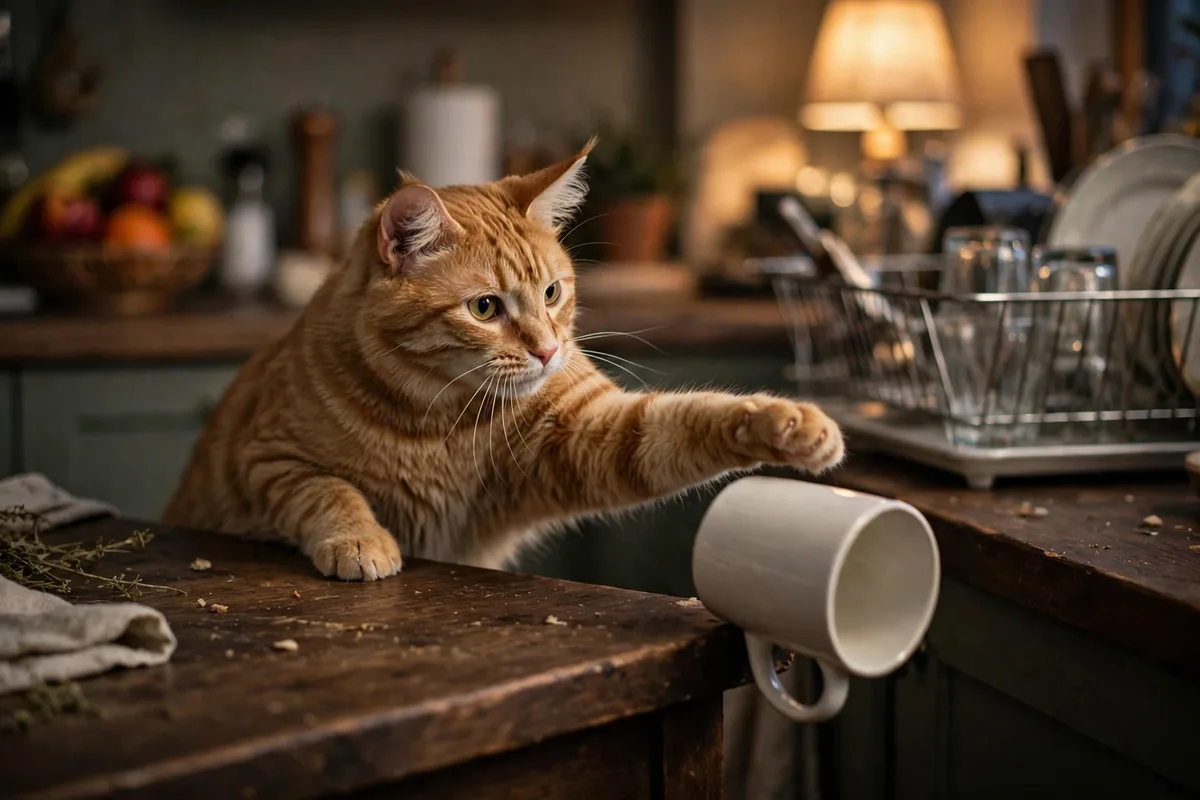
You set a glass on the table, turn your back for ten seconds, and hear the crash. Your cat sits on the table edge, paw still out, watching the pieces with total calm. It looks deliberate. It looks personal. It looks like your cat planned it and pushed the glass off on purpose just to watch you react.
It was not a plan, and it was not personal. A cat that knocks things off tables is doing something cats have done for thousands of years: testing a small object with a paw to find out what it is and what it does. The table edge makes the test dramatic, because the object falls, makes a noise, and disappears. To a cat, that is interesting. To you, it is a broken glass and a mess on the floor.
The information here is general information only and is not veterinary advice. If your cat starts knocking things over suddenly, or the behaviour comes with eating less, hiding, or litter tray changes, contact your vet.
Key Takeaways
- Knocking is normal cat behaviour, not spite or revenge. Cats test small objects with their paws because that is how they investigate prey.
- There are 5 common reasons: prey testing, curiosity, attention, boredom, and routine. The fix depends on which one fits your cat.
- Your reaction often rewards the behaviour. A cat that knocks a glass and gets you running across the room learns that knocking summons people.
- Lightweight, rollable items near an edge are the most likely targets. Moving them back from the edge cuts most accidents.
- Two short play sessions a day, 10 to 15 minutes each, with a wand toy, is the single most useful fix for play driven and boredom driven knocking.
- Never punish a cat for knocking. Yelling or spraying teaches fear, not a lesson, and it damages trust.
- A sudden increase in knocking, or knocking paired with appetite change, hiding, or aggression, is a reason to see a vet.
The Short Answer: Why Does My Cat Knock Things Off Tables?
Cats knock things off tables because their paws are their main tool for finding out what an object is. A cat sees a small object near an edge, reaches out, and tests it. Does it move? Does it roll? Does it make a noise? Does it run away? In the wild, that paw test is how a cat checks whether something is prey, and whether it is safe to grab. Your pen, your phone, and your water glass get the same test as a mouse would.
The edge matters. An object in the middle of a table can only slide a little. An object near the edge can fall, and falling is the most interesting result a paw test can produce. The object moves fast, makes a sound, and vanishes over the edge. For a cat, that is a result worth repeating. For you, it is a broken mug.
5 Reasons Your Cat Knocks Things Off Tables
1. It Looks Like Prey, and the Paw Is How Cats Test Things
Cats are predators, even the ones that have never been outside and have never seen a mouse. The hunting sequence is built into them: spot something small, stalk it, test it with a paw, chase it if it moves, and grab it. A pen near the edge of a table sits exactly where prey would sit: small, separate from its surroundings, and close to cover. Your cat does not think the pen is a mouse. Your cat runs the same motor pattern on the pen that it would run on a mouse, because that is what paws are for.
2. Curiosity: What Happens If I Push This?
Cats learn about the world by interacting with it. A cat that has never pushed a particular object has no idea what it will do, and the only way to find out is to push it. The table edge makes the experiment better, because the result is bigger: push, movement, sound, disappearance. Cause and effect, learned in one swipe.
3. It Works: Knocking Summons You
This is the reason most owners miss, and it is the one that keeps the behaviour going long after curiosity fades. Watch what happens after the crash. You come running. You talk to the cat. You pick the cat up, or you pick up the pieces while the cat watches. From the cat side, that is a clear result: knock something over, and a human appears immediately and gives full attention.
4. Boredom: Nothing Else to Do
A cat left alone for hours in a flat with no hunting, no play, and nothing new to investigate will invent its own entertainment, and the table is full of toys that you left there by accident. Boredom is a major trigger for knocking, and it is the most common reason for cats that do it when nobody is home. You come back to a floor full of objects, and the cat is asleep on the sofa, looking innocent.
5. Routine: The Object Is in the Way on a Favourite Route
Cats love high places. A table, a shelf, or a kitchen counter is part of a cat route: up onto the chair, across the table, onto the shelf, down to the windowsill. The cat walks that route many times a day, often without thinking about it. If you leave an object sitting on the route, the cat will nudge it while walking past, turning around, or settling down to sleep.
Accident or Deliberate Swipe? How to Tell
Before you try to fix the behaviour, work out whether your cat means it. An accidental nudge and a deliberate swipe need different fixes, and treating an accident like a behaviour problem wastes your time and confuses the cat.
A deliberate swipe has a clear build up. The cat crouches low, eyes fixed on the object, pupils wide, body still. The paw goes out slowly, touches the object, pulls back, and then pushes again, harder. The cat watches the object the whole time, and often watches it fall all the way to the floor. An accidental nudge has no build up at all. The cat is walking, turning, stretching, or settling down, and the object gets caught by a hip, a tail, or a back paw. There is no stare, no paw test, and no interest in the object once it is on the floor.
Diagnose Your Cat in One Day: The No Audience Test
The fastest way to separate play from attention seeking is the No Audience Test. It takes one day, costs nothing, and tells you more than a week of guessing. Put a light, safe object near the edge of a table, something that can fall without breaking, like a bottle cap or a small cardboard tube. Then leave the room, or sit somewhere your cat cannot see you, and watch from a distance or on a phone camera.
If your cat bats the object around, chases it, and knocks it off even when nobody is there to react, play and curiosity are the main drivers. The behaviour is rewarding on its own, because the movement is fun. If your cat ignores the object when alone, but knocks things over the moment you sit down to work, eat, or watch television, attention is the main driver. The behaviour only pays off when you are there to notice it, which tells you the fix is not more toys. The fix is changing what happens after the swipe, so that knocking stops being the fastest way to get your attention.
| What you see | Likely cause | First fix to try |
|---|---|---|
| Knocks light, rollable objects when alone, watches them fall | Play and prey testing | Wand toy play twice a day, plus rolling toys on the floor |
| Knocks things over only when you are busy, looks at you first | Attention seeking | Stay neutral after a swipe, reward calm behaviour, play before work |
| Knocks things over when the house is quiet or you are out | Boredom | Puzzle feeders, rotated toys, a window perch, more play |
| Knocks the same object from the same spot, no stare | Routine route accident | Clear the route or move the object back from the edge |
Is It Spite or Revenge? No, and Here Is Why That Matters
It is tempting to read human motives into a cat. The cat knocks your glass over right after you told it to get off the table, so it feels like revenge. The cat knocks your phone off the desk while you are on a call, so it feels like jealousy. Cats do not plan revenge. Revenge needs a sense of past wrongs, a plan for payback, and an understanding that the other creature will feel hurt. Cats do not think that way.
Safety First: What Must Never Stay on a Table
Before you train anything, make the house safe. Some objects are not just breakable, they are dangerous, and a cat that knocks them over can be hurt badly. Medicines top the list. Pills left on a bedside table or kitchen counter can be batted to the floor and eaten, and many human medicines are toxic to cats.
Toxic plants are next. Lilies are the worst: every part of a lily is highly toxic to cats, and even a small amount can cause kidney failure, so keep lilies out of the house entirely. Hot pans, candles, and sharp glass need the same treatment. A cat that jumps onto a stove can burn its paws, and a candle knocked over can start a fire. Small swallowable objects are easy to forget too. Hair ties, rubber bands, string, and small batteries can be batted off a table and swallowed, and string can cause a blockage in the gut that needs surgery. Keep them in closed drawers, not in open bowls on a desk.
How to Stop Your Cat Knocking Things Over: 6 Steps That Match the Cause
Step 1: Clear the Edges and Secure What Stays
The fastest win is also the simplest. Move everything back from the edge of every table, shelf, and counter. A good rule is a full hand width between any object and the edge. Objects in the middle of a table are far less tempting, because the paw test gives a boring result: the object slides a little and stops. Put away anything you do not need on the surface, and use museum putty or non slip mats under vases, lamps, and ornaments.
Step 2: Play Before the Trouble Hour, Not After It
Most knocking has a trouble hour: the hour before dinner, the first hour after you get home, or the small hours of the morning. Play before that hour, not after the crash. Two short sessions a day work best, 10 to 15 minutes each, with a wand toy that moves like prey: low to the ground, darting, hiding behind furniture, then freezing. Let the cat catch the toy at the end of each session, then give a small treat or a meal. That catch and eat sequence is the end of a real hunt, and it leaves the cat satisfied rather than wound up.
Step 3: Give the Hunting Instinct a Legal Target
A cat that knocks for play needs something legal to knock. Rolling toys, treat balls, and puzzle feeders give the same paw test and the same movement reward, without the broken glass. The same play drive is behind cats that attack feet under a blanket, so a proper play session helps both behaviours at once.
Step 4: Give Your Cat a Better High Place
Cats knock things over partly because tables and counters are the only high places in the house. Give your cat better ones, away from your breakables. A tall cat tree by a window, a shelf made for cats, or a window perch gives the same view and the same sense of height, with nothing fragile on it. Place the new high spot where the cat already likes to be, put a soft blanket on it, and clear a route to it, because cats like routes, not dead ends.
Step 5: Use Deterrents That Do Not Scare Your Cat
Deterrents can help, but the aim is to make a surface boring, not to frighten the cat. Double sided tape on a table edge works for many cats, because cats dislike sticky paws. Aluminium foil on a counter works for some cats and becomes a toy for others, so try it for a few days and watch what happens. Motion activated air canisters give a puff of air when the cat jumps up, but they can scare a nervous cat badly, so use them only for a confident cat, only on one surface, and remove them as soon as the behaviour improves. Do not use essential oil sprays or diffusers near a cat unless you have checked that the oil is safe, because some are toxic to cats.
Step 6: Reward Calm, Ignore the Swipe
This step matters most for attention driven knocking, and it is the hardest to do. When the cat knocks something over, stay neutral. Do not shout, do not rush over, do not pick the cat up. Clean up quietly, without talking to the cat, and carry on with what you were doing. The swipe must stop being the fastest way to get your attention. Then reward the opposite. When the cat walks past the table without touching anything, or settles on its own bed while you work, give a treat, a quiet word, or a stroke.
What NOT to Do
Do not yell at the cat, spray it with water, or tap its paw. Punishment after the event does not work, because the cat cannot connect your anger now with a swipe that happened minutes ago. All the cat learns is that you are unpredictable and frightening, and a frightened cat is more likely to knock things over, hide, or stop trusting you. A spray bottle may stop the swipe in the moment, but it teaches the cat to knock things over only when you are not holding the bottle, and it damages the bond between you.
When Knocking Means Something Is Wrong: Vet Red Flags
Most knocking is normal behaviour, but a sudden change deserves attention. If your adult cat has never knocked things over and suddenly starts, or if the knocking increases sharply over a few days, something may have changed in the cat, not just in the house. Book a vet check within a week if you see two or more of these signs alongside the knocking: eating less or more than usual, drinking much more water, hiding more than usual, using the litter tray less or more, aggression when touched, vomiting or diarrhoea, weight loss, or a stiff or hunched posture.
FAQ
Why does my cat knock things off the table at night?
Cats are most active at dawn and dusk, and many cats have a burst of energy in the small hours. A cat that knocks things over at night is usually a cat with hunting energy and nothing to hunt. Play in the evening before bed, leave a few rolling toys and a puzzle feeder out overnight, and keep breakables off the tables before you go to sleep.
Why does my cat only knock over my things and not my partner’s?
Your things are the ones that get a reaction. If you jump up, talk to the cat, or pick the cat up when your things fall, and your partner ignores it, the cat will target your things, because yours pay off. It is not personal. It is learning.
Why does my cat knock over its water bowl?
A water bowl is a different problem from a vase. Cats often knock a water bowl over because the bowl is too light, too narrow, or placed against a wall where the cat has to reach over it. Some cats also paw at water before drinking, which is normal. Use a heavy ceramic bowl with a wide base, place it away from walls, and keep it away from the food bowl, because many cats prefer water away from food.
Will a bell collar stop my cat knocking things over?
No. A bell warns prey, but it does nothing about the reasons a cat pushes objects off a table. The cat will keep testing objects, keep getting bored, and keep seeking attention, bell or no bell.
Why does my cat stare at me while knocking something off?
The stare is the giveaway for attention seeking. The cat has learned that knocking gets a reaction, and it is checking whether you are watching before it pushes. It may also be a play invitation: the cat wants you to engage, and the swipe is the loudest way to ask.
Is it normal for an older cat to start knocking things over?
It can be, but a new behaviour in an older cat deserves a vet check first. Older cats can develop cognitive changes, thyroid problems, or pain that shows up as restlessness, pacing, and knocking.
The Bottom Line
Your cat knocks things off tables because its paws are built for testing, and the table edge gives the most interesting result. Curiosity, play, attention, boredom, and routine each add their own reason, and most cats are driven by a mix of two or three at once. None of it is spite, and none of it means your cat is badly behaved.
The fix is to find the cause first, then match the help to it. Clear the edges, keep dangerous things out of reach, play before the trouble hour, give the hunting instinct a legal target, and give your cat a better high place than your table. Stay neutral when the swipe happens, and reward the calm moments that follow.