
What Your Cat Needs to Feel Secure (The 5 Pillars)
Your cat has food, water, a litter box, and a roof. So why does it hide under the bed, spray the sofa, or wake you at 3 a.m. to sprint around the house? Because a cat’s needs go further than food and shelter. In 2013, an expert panel from the American Association of Feline Practitioners and the International Society of Feline Medicine published the Feline Environmental Needs Guidelines, built around five pillars of a healthy feline environment. The guidelines were created to reduce the behaviour problems that fill vet waiting rooms: house soiling, scratching, aggression, overgrooming, and night waking. This guide works through all five pillars in plain language, with concrete changes you can make in a weekend, and shows how to tell when the pillars are working. The idea behind all five is one sentence: a cat that can choose where to rest, eat, toilet, play, and hide is a cat that feels safe, and a cat that feels safe rarely causes trouble.
The Short Answer
The five pillars of a healthy feline environment, from the AAFP and ISFM guidelines, are: a safe place to retreat to; multiple and separated key resources such as food, water, litter, scratching, play, and rest; opportunities for play and predatory behaviour; positive, consistent, and predictable human interaction; and an environment that respects the cat’s sense of smell. Most behaviour problems trace back to a missing pillar, and the fix is usually adding a choice rather than removing a behaviour: another litter box in another room, a high perch, a hiding place, or a daily play session.
Why Security Is the Whole Game
Cats are both predators and prey animals, and their behaviour only makes sense once you hold both halves in mind. As predators they need to stalk, pounce, climb, and survey. As prey they need to hide, retreat, and control who can approach them. A cat that cannot do either half feels trapped, and a trapped cat does the things owners complain about: it hides for hours, it sprays, it scratches the furniture, it bites the hand that reaches for it, or it stops using the litter box. The five pillars are not luxuries or enrichment extras. They are the conditions under which a cat’s nervous system settles, and the guidelines were written because vets kept seeing the same pattern: fix the environment and the behaviour often fixes itself.
Two ideas run through all five pillars. The first is choice. A cat that can choose between two resting places, two litter boxes, and two routes through a room is a cat that feels in control, and control is what security feels like to a cat. The second is that threats are perceived, not objective. A cat does not need an actual danger to feel unsafe. A washing machine starting, a visitor’s voice, a dog barking next door, or another cat staring through the window can all register as threats, and the cat’s response is real even when the danger is not. Your job is not to argue with the cat’s assessment. It is to give the cat places and options that make the assessment come out safe.
Pillar 1: Provide a Safe Place
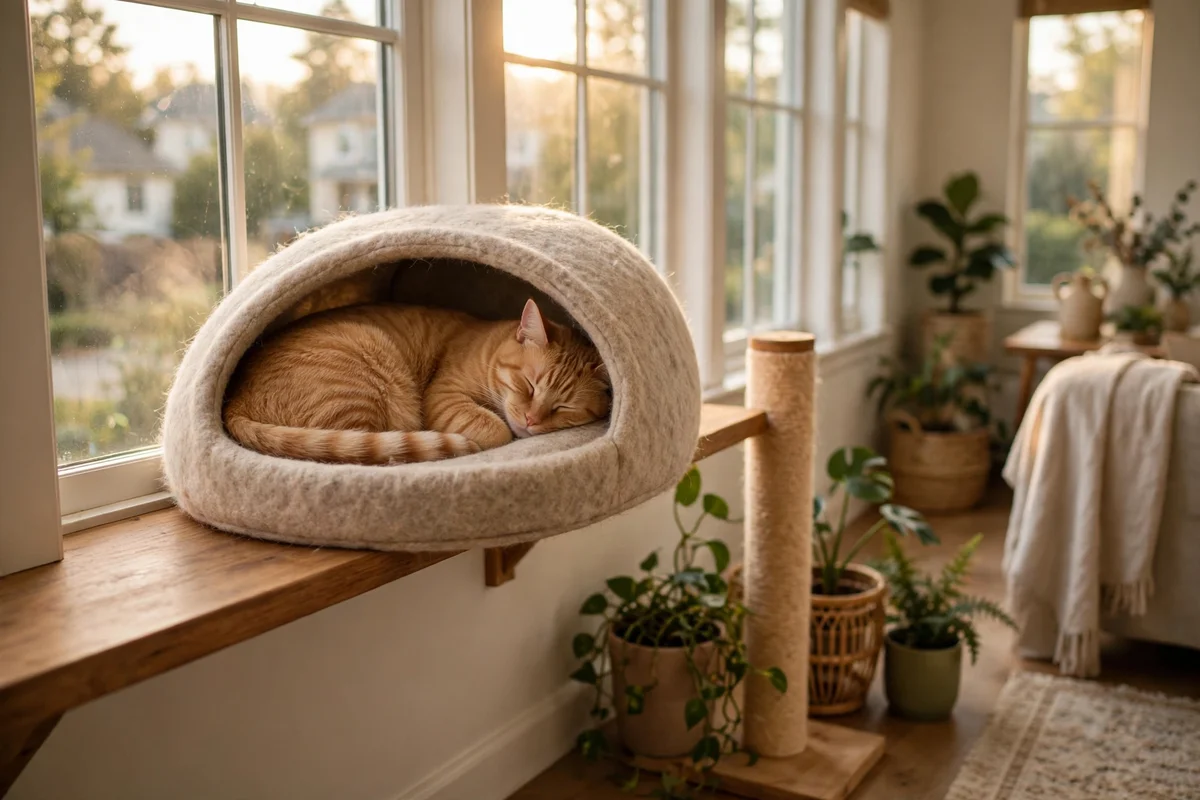
The first pillar is a safe place to retreat to, and it is the foundation the other four stand on. Cats need private, safe, and quiet places where they can go when they feel threatened or overwhelmed, and each cat perceives threats differently, so the safe place has to suit the individual cat rather than the owner’s idea of comfort. The RSPCA guidance on the five pillars stresses that safe places come in two kinds, and most cats need both: high observational perches where the cat can survey the room and see what is coming, and low, enclosed, private hiding places where the cat can be invisible.
High places work because height is safety to a cat. A cat tree, a window perch, a cleared shelf, or the top of a wardrobe all let the cat watch the room from above, where nothing can approach unseen. Low places work for the opposite reason: a cardboard box with a hole cut in it, a covered bed, an igloo bed on top of a sturdy table, or a bed inside a quiet cupboard all let the cat disappear. The best hiding places have more than one entrance, so the cat cannot be cornered in them, and they sit away from household traffic and loud noises. A box in a hallway is not a safe place. A box in a quiet corner is.
Every cat in the house needs its own safe places, and in a multi cat home the safe places must not be contestable: one cat should not have to pass another cat to reach its retreat. That is also why safe places must be respected by the humans. Never drag a cat out of its hiding place, never reach into a box to pull a cat out for cuddles, and teach children that a cat in its safe place is a cat that is not available. A retreat that can be invaded is not a retreat. If your cat hides a lot, the answer is usually more and better safe places, not fewer. Our guide to why cats hide covers the signs that hiding has crossed from normal into a problem worth a vet visit.
Pillar 2: Multiple and Separated Key Resources
The second pillar is the one most homes get wrong, because it sounds like overkill until you see the logic. Key environmental resources are the things a cat needs every day: food and feeding areas, drinking stations, toileting areas, scratching areas, play areas, and resting or sleeping areas. The guideline says each of these should exist in multiple locations, physically separated from each other, so the cat always has a choice and never has to compete or queue for a basic need. The VCA summary of the guidelines puts it plainly: each resource should be in its own location, separate from the others.
Start with the litter boxes, because they are where the rule is most concrete. The rule of thumb is one box per cat plus one extra, in physically separate locations. Two cats need three boxes, and three boxes side by side in one room count as one location, not three. A cat that has to pass another cat, a dog, or a noisy appliance to reach the only box will start finding alternatives, and the sofa is usually the first one. The same separation applies to food and water: cats prefer not to eat and drink in the same place, and many will drink more if the water bowl sits in a different room from the food bowl, away from the litter box. Scratching posts belong near resting places and near the places the cat already scratches, not hidden in a corner the cat never visits.
In a multi cat home, separation is also about social tension. Cats that appear to tolerate each other may still be competing over a single food bowl or a single sunny windowsill, and the loser of that quiet competition is the cat that sprays, hides, or stops eating. The fix is boring and effective: duplicate the resource and move the duplicate somewhere the other cat does not control. Spread resources across the home, keep the routes between them open, and remember that you, the owner, are listed in the guidelines as a key resource too. Each cat should get its own individual play and bonding time with you, not only group time, because a cat that has to compete for your attention is a cat missing a resource.
Pillar 3: Play and Predatory Behaviour
The third pillar is opportunity for play and predatory behaviour, and it is the one owners most often mistake for optional fun. Play is how a cat practises the hunting sequence it is built for: stalk, chase, pounce, catch, and kill. A cat that never gets to run that sequence does not stop wanting to run it. It runs it on your ankles at 3 a.m., on the curtains, or on the other cat. The RSPCA guidance puts it directly: playtime is more than just fun for your cat, it is essential for its wellbeing, and interactive toys and food based activities are how you simulate the predatory behaviours a house cat cannot otherwise perform.
A good play session is short, daily, and structured like a hunt. Use a wand toy that moves like prey, low and darting, with pauses that let the cat stalk, and finish with a catch: let the cat grab the toy, then offer a small meal or treat so the sequence ends the way a real hunt ends, with food. Two or three sessions of five to ten minutes beat one long session, and the evening session matters most, since it burns off the energy that would otherwise go into night waking. Puzzle feeders and food scattered in a few places rather than served in one bowl add hunting to mealtimes, and rotating the toys keeps them interesting. Hands and feet are never toys: a kitten that learns to attack hands becomes an adult cat that attacks hands, and that is a much harder habit to undo than to prevent.
Play is also diagnostic. A cat that suddenly stops playing, or that plays with unusual aggression, may be in pain or stressed, and a change in play is worth noting the same way a change in appetite is. And play is social: in a multi cat home, play the cats together only if they genuinely enjoy it, and play them separately if one cat dominates the toy or stalks the other after the session. The goal is a tired, satisfied cat that sleeps through the night, not a wired cat that has just been wound up.
Pillar 4: Positive, Consistent, Predictable Human Interaction
The fourth pillar is positive, consistent, and predictable human cat social interaction, and it is the pillar most about you rather than the house. Cats benefit from frequent but low intensity interaction, in the VCA summary’s words, and the emphasis is on the cat’s terms. Most cats prefer short, gentle contact that they initiate and can end, over long cuddling sessions imposed on them. A cat that approaches you, rubs against your hand, and settles beside you is asking for contact. A cat that walks away, flattens its ears, or flicks its tail is declining, and the correct response is to let it go.
Consistency matters as much as gentleness. The same person reaching for the cat in the same calm way, at roughly the same times, is predictable and therefore safe. Different people grabbing the cat in different ways, at unpredictable moments, is not. Teach visitors, and especially children, the same approach: let the cat come to you, offer a hand to sniff, stroke the head and shoulders rather than the belly, and stop while the cat is still enjoying it. Punishment has no place here. A cat that is shouted at or sprayed for scratching or biting learns to fear the person, not to stop the behaviour, and a frightened cat is a cat that hides, sprays, or bites more.
Predictability also covers the daily rhythm. Cats are crepuscular, most active at dawn and dusk, and a household routine that respects that rhythm, with play and feeding at roughly the same times each day, is a calmer household. Big routine changes, a new work schedule, a new baby, a house move, should be introduced gradually where possible, and the other pillars should be strengthened at the same time, since a cat with good retreats and resources copes with change far better than a cat without them. If the household has recently changed in a big way, our guide to cat sleeping positions is a useful window into how relaxed or tense your cat feels while it rests.
Pillar 5: Respect the Cat’s Sense of Smell
The fifth pillar is the one most owners never think about: provide an environment that respects the importance of the cat’s sense of smell. Cats depend on smell far more than humans do. They use it to detect threats, to recognise their territory, and to feel secure, and they mark their environment with pheromones by rubbing their faces and scratching objects, which establishes the core living area where they feel safest. When strong odours flood that environment, the cat loses its ability to read the world through its nose, and a cat that cannot smell its own territory is a cat that feels unsafe.
The practical rules follow from that. Avoid scented cat litter, air fresheners, plug in diffusers, and strong cleaning products in the cat’s core areas, and never use essential oils around cats: the Drake Center summary of the pillars notes that when strong odours are present, cats lose the ability to see the world, and safety, through their nose, and several common essential oils are toxic to cats in any case. When you clean, keep the cat’s scent marks in mind. Washing all the bedding, scrubbing every surface, and moving all the furniture in one day strips the home of the cat’s scent map, and the cat will respond by remarking everything, often by spraying. Clean gradually, leave one familiar smelling item untouched, and introduce new furniture one piece at a time.
Use scent in the cat’s favour. A blanket that smells of home goes with the cat to the vet, to a new room, or into a new carrier, and it makes each of those places safer. Synthetic pheromone diffusers, which mimic the facial pheromone cats deposit when they rub against things, are recommended in the guidelines handout for reducing stress and encouraging harmony, and they are worth trying in a multi cat home or after a big change. Let the cat scent mark its own things: a scratching post the cat has claimed is doing its job, and a cat tree the cat has rubbed is a safe place precisely because it smells of the cat. Do not wash that away.
Putting the Five Pillars to Work in One Weekend
You do not need to rebuild the house. Start with an audit, one room at a time, counting what the cat can actually choose between. Does the cat have a high perch and a low hiding place in the rooms it uses most? Is there a litter box in more than one location, with one per cat plus one extra? Is the water in a different place from the food? Is there a scratching post where the cat already scratches? Has the cat had a real play session today, with a wand toy and a catch at the end? Has anyone interacted with the cat on the cat’s terms today? And does the house smell of the cat, or of air freshener?
Fix the cheapest gaps first. A cardboard box with two holes cut in it is a hiding place. A cleared shelf is a perch. A second water bowl in another room is a resource. A ten minute play session before the evening feed is the third pillar done. The expensive fixes, a tall cat tree, a second litter box setup, a pheromone diffuser, come second, and only where the audit shows a real gap. In a multi cat home, audit per cat, not per household: the question is whether each cat has its own safe places and resources, not whether the house has them in total. And re-audit after any big change, a new pet, a new baby, a house move, a new work pattern, because the pillars are a maintenance job, not a one off project.
Give it two weeks and watch for the signs that the pillars are working: the cat sleeps in the open rather than under the bed, it uses the litter box reliably, it plays and then settles, it greets you rather than fleeing, and the night waking fades. Those are the signs of a cat that feels secure. If the problems persist after the environment is genuinely fixed, call your vet, because pain, illness, and anxiety can look exactly like bad behaviour, and no amount of shelving fixes a sore tooth. Our new cat owner starter kit covers the rest of the first year basics, from supplies to the first vet visit, and it pairs naturally with this guide: the kit sets the house up, and the five pillars keep it feeling like home.
Frequently Asked Questions
What are the five pillars of a healthy feline environment?
They come from the 2013 AAFP and ISFM Feline Environmental Needs Guidelines: a safe place to retreat to; multiple and separated key environmental resources such as food, water, litter, scratching, play, and rest; opportunities for play and predatory behaviour; positive, consistent, and predictable human interaction; and an environment that respects the cat’s sense of smell. Together they are the standard vets use to judge whether a home meets a cat’s needs.
How many litter boxes should I have?
One per cat plus one extra, in physically separate locations. Two cats need three boxes, and three boxes side by side in one room count as one location, not three. A cat that has to pass another cat or a noisy appliance to reach the only box will start finding alternatives, and the sofa is usually the first one.
Why does my cat need a high perch and a hiding place?
Because cats are both predators and prey animals. A high perch lets the cat survey the room and feel safe from above, while an enclosed hiding place lets the cat disappear when it feels threatened. Most cats need both kinds of safe place, and every cat in a multi cat home needs its own, with more than one entrance so it cannot be cornered.
How much play does an indoor cat need every day?
Two or three short sessions of five to ten minutes, using a wand toy that moves like prey and ending with a catch and a small meal or treat. Play is not optional fun: it is how a cat runs the hunting sequence it is built for, and a cat that never plays will run that sequence on ankles, curtains, or the other cat instead. An evening session helps most with night waking.
Are scented litter and air fresheners bad for cats?
They can be a real problem, because cats rely on smell to feel safe and to read their territory. Strong odours, scented litter, plug in diffusers, and essential oils can overwhelm the cat’s sense of smell and, in the case of several essential oils, are toxic to cats. Keep the cat’s core areas low scent, clean gradually rather than stripping the whole house at once, and let the cat keep its own scent marks on its bed and scratching post.
My cat still sprays after I fixed the environment. What now?
First, check the fix is real: separate litter boxes in separate rooms, safe places per cat, daily play, and low scent may take two weeks to show results. If the problems persist after the environment is genuinely fixed, call your vet promptly. Pain, illness, and anxiety can look exactly like bad behaviour, and a vet check rules out the medical causes before you work on the behavioural ones.