
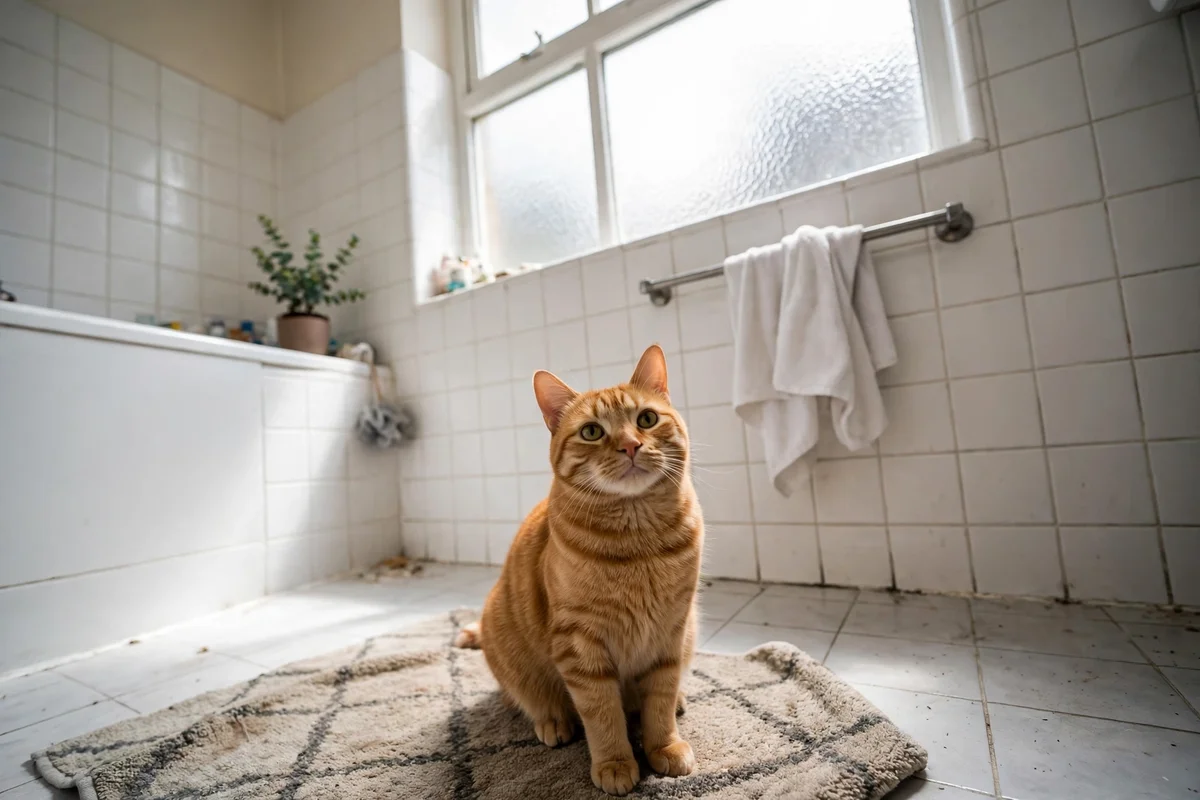
Why Does My Cat Follow Me to the Bathroom?
You close the bathroom door, and within seconds there is a paw under it. Or a meow. Or a cat sitting on the bath mat, staring at you like you have broken a sacred rule. If your cat follows you to the bathroom every time, you are not alone. Following you to the bathroom is normal, and it happens for a mix of reasons: you are still and easy to approach, the room is full of interesting sights and smells, the visit is part of a routine, and the bathroom smells strongly of you. Watch what your cat does after it arrives, because that tells you which reason is doing the work.
The information here is general information only and is not veterinary advice. If your cat’s following changes suddenly, or the change comes with hiding, appetite change, or signs of pain, contact your vet.
Key Takeaways
- Following you to the bathroom is usually normal, not a problem on its own.
- Watch what your cat does after it arrives. Settling near you means bonding, ignoring you means curiosity, and meowing outside means it wants access.
- Cats approach a still owner more readily, because sitting still signals no sudden movement and no threat.
- Many cats learn that a morning bathroom visit comes before breakfast, so they follow to stay close to the next step in the routine.
- Closed doors bother cats because a closed door blocks part of their territory and removes their control over it.
- Following alone is not separation anxiety. Anxiety shows in what happens when you leave.
- A sudden start in clinginess, especially in an older cat, needs a vet check first. A sudden stop in following can matter too.
- You can teach a cat to wait outside the bathroom in 7 days, without punishment and without damaging the bond.
The Short Answer
Your cat follows you to the bathroom because you are the most interesting thing in the house at that moment, and the bathroom makes you easy to reach. You sit still for several minutes in a small, enclosed, familiar room. That is the perfect setup for a cat that wants contact, curiosity, or just to know where you are. The bathroom also holds your scent on towels and laundry, running water, warm floors, cool tile, and a routine your cat has learned by heart. Most cats follow for three or four reasons at once, and the balance changes from day to day.
What Your Cat Does After It Follows You Tells You Why
Watch your cat for 30 seconds after it arrives, and match what you see to one of three patterns.
Pattern 1: Follows in and settles near you
Your cat walks in, picks a spot near you, and settles down. It may curl up on the bath mat, sit on your lap, or lean against your leg. It purrs, slow blinks, or half closes its eyes. This is the bonding pattern. Let the cat stay if you are happy with it, or give it a comfortable spot near the door.
Pattern 2: Follows in, then ignores you
Your cat walks in, sniffs the bin, bats at the toilet paper, watches the tap, and then walks out again. It barely looks at you. This is the curiosity and territory pattern. Your cat did not follow you for company. It followed you because you opened a door, and the room behind it is interesting. Let the cat look around and leave on its own.
Pattern 3: Waits outside and meows or scratches
Your cat does not get in, because the door is closed. Instead it meows, scratches, or puts a paw under the door. This is the access pattern. Your cat wants the door open to keep its territory whole and to know what is happening on the other side. The 7 day privacy plan below covers the response. Do not punish the scratching, it only makes the cat more anxious.
7 Reasons Your Cat Follows You to the Bathroom
The seven reasons below explain why the bathroom, of all rooms, is the one cats refuse to let you visit alone.
1. You are still, so you are safe to approach
Cats approach a still person more readily than a moving one. A sitting owner signals no sudden movement and no threat, so the cat can come close without risk. Chewy quotes cat behaviorist Mieshelle Nagelschneider: cats feel most comfortable approaching us when we are stationary. The bathroom is one of the few places where you sit still for several minutes. Still means safe, and safe means a good time to say hello.
2. You are their person, and this is bonding time
Cats form strong attachments to their people. A 2019 study in Current Biology by Vitale, Behnke, and Udell found that most cats tested showed secure attachment to their owners. Pages report the share differently, from over 60 percent to about 65 percent, so treat the exact figure as unsettled. A cat that follows you to the bathroom may simply want time with its person.
3. The bathroom is full of interesting sights, sounds, and smells
To a cat, a bathroom is a small adventure park. Running water, dripping sounds, flushing, mirrors, cabinets, toilet paper, bins, and laundry all give a curious cat something to investigate. The bathroom changes more than any other room: steam after a shower, cold tile in the morning, warm water in the evening. The room is the attraction, not you.
4. Your bathroom visit is part of a daily routine, often before food
Cats are creatures of routine, and they learn your patterns faster than you think. Many cats learn that a morning bathroom visit comes before breakfast, so they follow to stay close to the next step. If your cat follows you to the bathroom and then leads you to the kitchen, food timing is doing most of the work.
5. The bathroom smells strongly of you
The bathroom holds more of your scent than any other room. Towels, laundry, worn clothes, skin, and hair all carry your smell, and the small, enclosed space concentrates it. Your scent is the most familiar and reassuring smell in the house. A cat that settles on your laundry pile is sitting in the strongest patch of your scent in the house.
6. The room itself feels good: warm floors, cool tile, steam, and running water
Bathrooms offer temperatures and textures cats love. Warm floors after a shower, cool tile on a hot day, steam in the air, and running water from the tap all give a cat something to enjoy. Many cats sit in a dry bathtub because the smooth, cool surface feels good, and the curved shape holds their body heat when they curl up. Others drink from the tap because moving water tastes fresher to them.
7. They want to keep their territory in view, and a closed door breaks that view
Your cat sees the whole house as its territory, and it likes to know what is happening in every part of it. A closed door blocks a piece of that territory, removes the cat’s control over it, and cuts off social access to you. The cat wants the option, and it wants to know the room is still there and still safe. This reason explains Pattern 3, the cat that meows and scratches at a closed door.
Why Cats Hate Closed Doors
Closed doors bother cats for three reasons, and they all come back to territory and control. First, a closed door removes a piece of the cat’s territory from view. Second, it removes choice: a cat that can walk through a door whenever it likes is in control, and a cat that cannot is not. Third, it cuts off social access. The cat cannot reach you or check on you.
If you want privacy, close the door calmly and keep it boring, as the 7 day plan below explains. If you do not mind the company, leave the door open a crack. Do not punish a cat for wanting a door open.
Why Does My Cat Watch Me Shower or Sit in the Tub?
Cats watch showers because running water, steam, and noise are all interesting, and because you are standing still in a small space. A cat that sits on the bath mat while you shower is keeping you company in a room it finds interesting. Cats that sit in a dry tub are usually after the cool, smooth surface. Never let a cat into a running shower or a bath full of water. Cats can panic in water, and shampoo and soap are not safe for them to lick off their fur.
Is It Normal for a Cat to Follow You to the Bathroom?
Yes, in most cases. Following alone is not a problem. What matters is the rest of the picture: body language, timing, and the other signs in your cat’s day.
| What you see | Usually normal | Worth a closer look |
|---|---|---|
| Body language in the bathroom | Relaxed ears, slow blinks, loose body, purring, settling down | Crouching, pacing, tense tail, flattened ears, constant vocalising |
| After it arrives | Settles, explores, then leaves on its own | Will not settle, follows you all day |
| Eating, play, sleep, grooming | All normal | Eating less, hiding, overgrooming, toileting outside the litter box |
| When you leave the house | Calm, sleeps, eats normally | Vocalising, soiling, scratching near exits, frantic greeting |
| Change over time | Steady habit for months or years | Sudden start or sudden stop, especially in an older cat |
Signs it is normal bonding
Your cat follows you, settles nearby, and carries on with its normal day. It eats, plays, sleeps, grooms, and uses the litter box normally. It follows you to the bathroom and to other rooms, but it also spends time alone and is happy to be left for a few hours.
Signs it needs a closer look
Your cat follows you everywhere, all day, and becomes distressed when it cannot reach you. It vocalises constantly, overgrooms, hides, eats less, or toilets outside the litter box. Two or more signs together, or a sudden change in a cat that was steady before, is worth a vet visit. Rule out medical causes first.
When Following Could Mean Separation Anxiety
Following alone is not separation anxiety. Anxiety shows in what happens when you leave. A 2020 study in PLOS ONE found that about 13 percent of cats in its sample showed at least one separation related behaviour. Watch for these signs when you are out, or on a camera while you are away.
- Vocalising for long stretches after you leave, not just a few meows at the door.
- Toileting outside the litter box, often on your bed or your clothes.
- Overgrooming, sometimes to bald patches, or destructive scratching near exits.
- A frantic greeting when you return.
If you see two or more of these, talk to your vet. The usual plan is enrichment, predictable routines, food puzzles, vertical space, and slow desensitisation to departures, with vet care if the distress is severe. Do not punish the behaviour. Our guide on what your cat is trying to tell you when it meows explains the sounds cats make.
When Sudden Clinginess Needs a Vet Check
A cat that was independent and suddenly becomes clingy needs a vet check first. Pain, hyperthyroidism, failing sight or hearing, and cognitive decline are the causes named most often, and they are all more common in older cats. Hyperthyroidism in middle aged and older cats is commonly linked to weight loss despite a strong appetite, restlessness, and extra vocalising. Feline cognitive dysfunction signs become noticeable around 10 years of age. A cat that has not eaten for 24 hours needs urgent vet care, because cats can become very sick quickly when they stop eating.
A sudden stop can matter too. A cat that used to follow you everywhere and now hides instead may be in pain or unwell. Our guide on why cats hide explains what hiding usually means and when it needs a vet visit.
Kittens, Seniors, Pregnant Cats, and Cats in Heat
Kittens follow more than adults, because they are learning the house and they stick close to the safest person in it. A kitten that follows you is staying near the warm, familiar body, as it did with its mother. Seniors often follow more too, for the opposite reason: failing sight, hearing, or memory makes the owner a safe anchor in a confusing house. Pregnant cats may become clingy, and cats in heat may vocalise and follow more. At every age, keep routines predictable, keep the bathroom safe, and get a vet check for any sudden change.
Which Cats Follow Most, and Why Breed Is Only Part of the Story
Social breeds are named again and again as more likely to follow: Siamese, Ragdoll, Burmese, Abyssinian, Maine Coon, Oriental Shorthair, and Sphynx. No ranking page gives a study for this breed list, so treat it as a commonly reported pattern, not proven breed science. Individual personality matters more than breed. What matters is your cat’s own pattern, not its pedigree.
Is Your Cat Following You, or Avoiding Another Cat?
Sometimes following is not about you at all. In a multi cat home, one cat may stay near you because another cat blocks a hallway, guards the food bowl, or owns the best sleeping spot. The bathroom becomes a safe room, because the other cat is less likely to follow you in there. Watch for the signs: one cat waits in the hallway while the other is with you, or one cat eats only when the other is asleep. If you see that pattern, add a second litter box, a second food and water station, and a second high perch.
Bathroom Safety Checklist: Make the Room Safe Before You Let Them In
If your cat comes into the bathroom with you, make the room safe first. Keep the toilet lid closed. Store cleaners, medicines, toothpaste, razors, cotton buds, hair ties, essential oils, and candles in closed cabinets. Keep the bin covered, because cats will fish out cotton buds and hair ties and swallow them. Mop up spills of cleaning products at once, and never leave a bath full of water unattended.
How to Get Some Privacy Without Upsetting Your Cat: A 7 Day Plan
Wanting a few minutes alone does not mean rejecting your cat. Teach the cat to wait outside calmly, one step at a time.
- Days 1 to 2: put a comfortable bed just outside the bathroom door, and give your cat a food puzzle or a short play session right before you go in.
- Days 3 to 4: teach a settle spot near the door. Lead the cat to the bed, reward it for lying there, and go into the bathroom with the door open. Come back out calmly and reward the cat again.
- Days 5 to 7: close the door for a minute, then two, then five, always coming back out calmly and rewarding the cat for waiting. Keep departures and arrivals low key, with no big hellos or goodbyes.
Do not punish the cat for meowing or scratching at the door. Do not spray it, shout at it, or push it away. Punishment teaches the cat that the door is a source of conflict, and it makes the anxiety worse. If the cat becomes distressed when the door closes, go back a step and hold it there for a few more days. Most cats learn within the week, and the bond stays intact because nothing scary happened.
Frequently Asked Questions
Why does my cat follow me to the bathroom every time?
Because you are still, the room is interesting, the visit is part of a routine, and the bathroom smells strongly of you.
Why does my cat stare at me in the bathroom?
Your cat is watching you because you are the most interesting thing in a small room, and it wants to know what you will do next. A relaxed stare with slow blinks is friendly. A fixed stare with a tense body means the cat is unsure.
Why does my cat meow outside the bathroom door?
It wants the door open so it can keep its territory whole and know what is happening on the other side. The 7 day plan above teaches the cat to wait calmly outside.
Why does my cat sit on my lap on the toilet?
Your lap is warm, still, and available, and your cat trusts you enough to sit there. Kneading often comes with it. Our guide on why cats make biscuits explains kneading in full.
Should I let my cat in the bathroom with me?
Yes, if the room is safe and you enjoy the company. Run through the safety checklist first, keep the toilet lid closed, and store cleaners and medicines away. If you want privacy, use the 7 day plan instead of shutting the cat out suddenly.
The Bottom Line
Your cat follows you to the bathroom because you are still, familiar, and interesting, and because the room is full of scent, warmth, and routine. Watch what your cat does after it arrives, and you will know which reason is doing the work. Most of the time it is normal bonding, curiosity, or territory. If the following comes with hiding, appetite change, or distress when you leave, talk to your vet. If you want privacy, teach the cat to wait outside over 7 days, calmly and without punishment.