
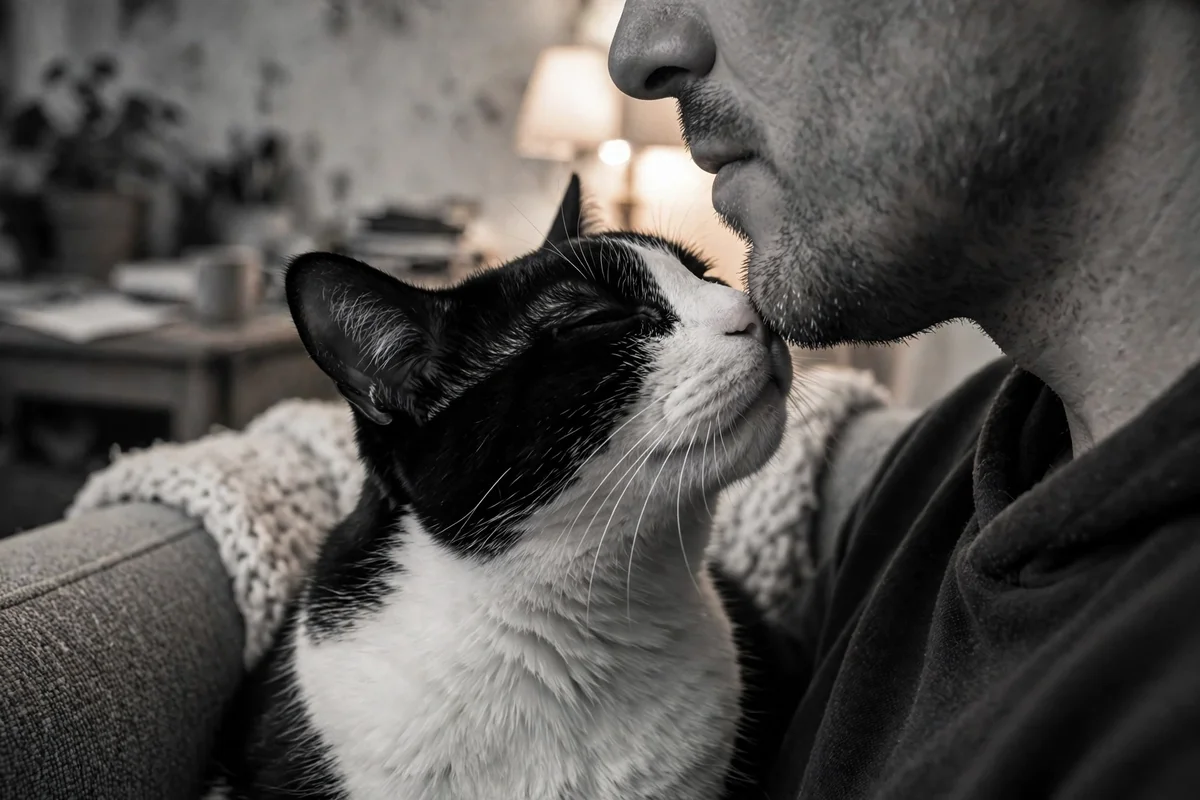
Why Does My Cat Headbutt Me?
Your cat walks up and presses its forehead against your chin. Or it bumps your hand and rubs its cheek along your leg. If your cat headbutts you, it is almost always good news. The behavior is called bunting, and it is one of the clearest signs a cat can give that it feels safe with you.
A headbutt is not a random bump, and it is not aggression. It is a deliberate social move that mixes scent, touch, and trust.
The information here is general information only and is not veterinary advice. If your cat presses its head against a wall and holds it there, contact your vet urgently.
Key Takeaways
- Headbutting is called bunting: a gentle press of the forehead, cheeks, or chin against a person, animal, or object.
- Cats bunt to deposit facial pheromones from glands on the cheeks, forehead, chin, and in front of the ears. Humans cannot smell them.
- Bunting is an affiliative, social behavior. It signals familiarity, trust, and bonding, not aggression or dominance.
- The most common reasons are greeting, trust, group marking, attention seeking, self soothing, meeting a new person, and play.
- Read the whole body, not just the bump. Relaxed ears and a tail held up mean a comfortable cat. A flicking tail and flat ears mean stop.
- Respond with a gentle cheek or chin scratch, then pause. Let your cat decide whether it wants more.
- Not all cats headbutt, and that is normal. A cat that never bunts can still be deeply bonded to you.
- Bunting is not head pressing. Head pressing is a persistent, forceful push of the head against a wall, floor, or corner, and it needs urgent vet care.
The Short Answer: Why Does My Cat Headbutt Me?
Your cat headbutts you because it is marking you as safe and familiar. Cats carry scent glands on their faces, and when they press their forehead, cheek, or chin against you, they leave a trace of their own scent on you. Sometimes the bunt is a request: a scratch, a meal, a game. Sometimes it is comfort after a loud noise or a change in the house.
What Is Bunting, Exactly?
Bunting is the name behaviorists use for the headbutt. A cat approaches a person, another animal, or an object, and deliberately presses or rubs the front of its head against it. The contact is usually brief and gentle.
The word matters because it separates the behavior from head pressing, which looks nothing like it once you know the difference. A bunt is social, voluntary, and brief.
Bunting is also different from nuzzling. A nuzzle is a soft, sleepy push of the nose into a warm spot. A bunt is a deliberate, waking social act. Not every cat bunts. Confident cats bunt more often and with more force than shy cats, according to PetMD.
The Scent Glands Behind the Bump
The reason a headbutt works as communication is that a cat’s face is covered in scent glands. The main clusters sit on the cheeks, the forehead, the chin, the lips, and just in front of the ears. When your cat presses its face against you, those glands leave a thin layer of oily secretion that carries pheromones other cats can read.
Researchers have identified five fractions of feline facial pheromone, labelled F1 to F5. Two have a known association with bunting. The F3 fraction is associated with marking familiar territory. The F4 fraction is associated with social rubbing between bonded individuals.
The scent your cat leaves is not a claim of ownership in the human sense. Dr. Meghan E. Herron, a board certified veterinary behaviorist at Ohio State University, puts it plainly: cats bunt to mark something as safe, rather than to claim it. Pam Johnson-Bennett calls bunting an affiliative display.
7 Reasons Your Cat Headbutts You, Decoded
One headbutt can carry more than one meaning, and the reasons below often overlap. Read the reason that fits the moment.
1. It is saying hello
The most common bunt is a greeting. You come home, walk into the kitchen, or wake up, and your cat meets you with a head bump. It is the cat version of a handshake and a hug in one move.
2. It trusts you
A cat that puts its face against yours is taking a risk. Its eyes, teeth, and throat are inches from your hands, and it has no way to defend itself in that position. A cat only does that with a creature it trusts completely.
3. It is marking you as part of its group
Cats that live together mix their scents until they smell like one group. They bunt each other, rub along each other’s sides, and sleep in the same spots, and the shared scent becomes the group’s identity card. When your cat bunts you, it is adding you to that card.
4. It wants your attention
Sometimes the bunt is a request, plain and simple. Your cat bumps your hand, and you pet it. It bumps your laptop, and you look at it. It bumps your leg at 5 in the morning, and you get up and feed it. Cats learn fast, and a behavior that reliably produces a reward gets repeated.
5. It is calming itself down
Cats also bunt when nobody else is involved. A cat alone in a room will rub its face along a doorframe, a chair leg, or a table corner, eyes half closed, purring softly. PetMD describes this solitary face rubbing as self soothing: the cat regulates its own emotional state by surrounding itself with its own familiar scent.
6. It is learning about a new person
A cat that bunts a stranger is investigating. The cat approaches slowly, sniffs the person’s hand or shoe, and gives a tentative bump, gathering scent information about someone it does not know yet.
7. It wants to play
A bunt can be an invitation to play, especially in young cats. The cat bumps your hand, then flops on its side or dashes a few steps away and looks back. The sequence is the offer: the bump gets your attention, the flop or the dash tells you what kind it wants. Our guide on why cats get the zoomies explains the dawn and dusk energy burst that often comes with this kind of invitation.
Bunting People, Cats, and Objects: Same Move, Different Meaning
The move is the same, but the meaning shifts with the target. People get the social version: a greeting, a bonding moment, or a request, usually on your hand, your leg, or your face.
Other cats get the colony version. Two cats that live together and trust each other will bunt head to head, then rub along each other’s sides in a move called allorubbing. They are mixing their scents into the shared colony scent.
Objects get the maintenance version. Your cat bunts the corner of the sofa, the leg of the table, and the doorway, refreshing the familiar scent on the things it uses every day. New objects get special attention: a new chair or a new box will be bunted repeatedly.
Reading the Rest of the Body: Ears, Tail, Eyes, and Posture
A headbutt on its own tells you very little. The same bump can mean hello, play, or leave me alone.
| Signal | Comfortable bunt | Overstimulated or stressed bunt |
|---|---|---|
| Ears | Forward and relaxed | Flat, sideways, or swivelling back |
| Tail | Held up with a soft curve, or still | Flicking rapidly, lashing, or tucked low |
| Eyes | Half closed, soft gaze, slow blink | Wide open, staring, pupils very large |
| Posture | Loose body, may flop or knead | Tense body, crouched low, skin twitching |
| Sound | Soft purr, quiet chirp, or silence | Growl, hiss, or a sharp meow |
| What it means | Enjoy it, respond gently, let the cat lead | Stop touching, give space, let the cat leave |
The most important pair to watch is the tail and the ears. A cat with its tail up and its ears forward is a happy cat. A cat with its tail flicking and its ears turning back has had enough.
One more caution: purring alone proves nothing. Cats purr when they are content, but they also purr when they are stressed, in pain, or frightened.
How to Respond When Your Cat Headbutts You
The best response to a headbutt is a small one. Your cat has offered you a moment of trust.
- Stay still for a second. Let the cat finish the bunt.
- Offer a gentle cheek or chin scratch with one or two fingers.
- Pause after a few seconds. If your cat leans in, it wants more. If it walks away, it has had enough.
- Slow blink back. Close your eyes slowly, hold them shut for a beat, and open them again.
- Offer what the bunt was asking for. If the cat led you to the kitchen, feed it. If it led you to a toy, play.
- Do not force it. Never grab your cat or hold its head still.
One thing you should not do is headbutt your cat back. PetMD is clear on this: most cats would not want you to return the gesture with something unexpected.
If the moment made you laugh, you are not alone. Cats have a gift for picking the worst possible moment to demand attention. Our collection of cat memes has plenty of cats doing exactly that.
When Headbutting Increases or Stops, and What That May Mean
A change in how often your cat bunts is worth noticing, in both directions. A cat that suddenly bunts far more than usual, and a cat that suddenly stops, are both telling you something.
More bunting usually has a simple explanation. A new person, a new pet, a new piece of furniture, or a house move can trigger a round of extra bunting, because the cat is re-marking a world that smells different.
Extra bunting can also mean the cat has learned that bunting works. If every bunt earns a treat, a meal, or a long petting session, the cat will bunt more, because bunting pays.
Less bunting deserves a closer look, especially if the change is sudden. A cat that used to greet you with a headbutt every morning and now walks past you may be feeling unwell, in pain, or stressed. PetMD notes that a cat that stops bunting, especially with lethargy or grumpiness, should see a vet.
The rule is simple: a change on its own is a note, not an alarm. A change plus other symptoms is a vet visit. If your cat stops bunting and also stops eating, hides for hours, or flinches when touched, call your vet.
Bunting vs Head Pressing: The Difference That Matters Most
This is the most important section in the whole piece. Bunting and head pressing sound similar, but they are opposites. One is a friendly social behavior. The other is a possible medical emergency.
Bunting is brief, gentle, and deliberate. The cat chooses a target, makes contact with its forehead or cheek, rubs, and then carries on behaving normally. The cat looks relaxed, its eyes are soft, and it can stop whenever it wants. Head pressing is the opposite. The cat pushes its head firmly against a wall, a corner, the floor, or another hard flat surface, and holds it there.
| Feature | Bunting (normal) | Head pressing (emergency) |
|---|---|---|
| Target | A person, animal, or familiar object | A wall, corner, floor, or hard surface |
| Pressure | Gentle press or rub | Firm, sustained push |
| Duration | Brief, a few seconds | Held for a long time, repeated |
| Posture | Relaxed, eyes half closed, ears forward | Tense or blank, no relaxed posture |
| Context | Social, greeting, play, or attention | No social reason, often alone |
| Afterwards | Behaves normally, walks away or settles | May seem confused, unsteady, or unresponsive |
| Action | Enjoy it | Call the vet urgently |
If you see your cat pressing its head against a wall or a corner, do not wait to see whether it stops on its own. Head pressing can be a sign of a serious neurological or metabolic problem, and only a vet can find out what is causing it.
Watch for these red flags alongside head pressing. Any one of them is a reason to call the vet now.
- Circling, walking in circles, or difficulty walking
- Loss of coordination, stumbling, or falling over
- Disorientation, staring blankly, or not responding to its name
- Changes in vision, bumping into furniture, or dilated pupils
- Seizures, twitching, or sudden collapse
- Sudden changes in awareness, responsiveness, or personality
- Pacing without purpose, or pressing the head again and again
Do not try to diagnose the cause yourself. Lists of possible causes online are not diagnoses, and they are not a reason to delay. Your job is to notice the behavior, keep the cat safe and calm, and get it to a vet as fast as you can. If your regular vet is closed, use an emergency vet clinic, and tell them the words ‘head pressing’ when you call.
Kittens and Bunting
Bunting starts in kittenhood, and it starts with the mother. Kittens rub and knead against their mother to seek stimulation and comfort, and the mother bunts her kittens back as reassurance and bonding.
A kitten’s bunt is clumsier than an adult’s. The kitten may miss, bump too hard, or bunt your chin and then try to climb you. That is normal. If you have just brought a kitten home, expect a lot of bunting in the first few weeks. The kitten is mapping a new world and marking everything it meets. Do not punish a kitten for bunting too hard. Redirect instead: offer a toy, or offer your hand for a gentler bunt.
Multi Cat Homes and the Colony Scent
In a house with 2 or more cats, bunting does a job that no other behavior can do. It keeps the group smelling like a group. Each cat bunts the others, rubs along their sides, and sleeps in the same spots, and the shared scent becomes the glue that holds the household together.
Mutual bunting happens mainly between cats that are already bonded: littermates, a mother and her offspring, or two cats that have lived together peacefully for years. The confident cat usually starts it, and the other cat answers. When a new cat arrives, watch the bunting. In the first days there will be none, and that is normal. As the cats get used to each other, the resident may bunt the newcomer’s bedding. That is progress. The first mutual head bunt is the moment the household has become one group. If the bunting stops, something may have changed. Give them separate resources, reintroduce them slowly, and talk to your vet if the tension does not ease.
Frequently Asked Questions
Is headbutting a sign my cat loves me?
It is a sign of a positive social relationship, and one of the warmest signals a cat can give. A cat that bunts you is saying you are familiar, safe, and part of its group.
Why does my cat headbutt me and then bite me?
Your cat probably enjoyed the contact and then had enough of it. The bunt starts the interaction, and the petting that follows can become too much, too fast. A gentle nip is the cat’s way of saying stop. Watch for the warning signs before the bite: a tail that starts flicking, ears turning sideways, or a tense body. When you see them, stop touching and give the cat space.
Why does my cat headbutt my phone or laptop?
Your cat has learned that the phone and the laptop are the things that steal your attention. A bunt on the screen, the keyboard, or your hand while you type is a reliable way to make you look up.
Why does my cat headbutt strangers?
Your cat is investigating. A stranger smells new, and a cat gathers information about new people through scent. The cat approaches, sniffs, and gives a tentative bunt to learn more. Guests should stay still and let the cat come to them.
Why does my cat headbutt furniture and doorways?
Your cat is maintaining the scent map of its home. Furniture corners, doorframes, and table legs are the landmarks of a cat’s territory, and bunting them refreshes the familiar scent that tells the cat it is safe.
Why does my cat headbutt me at night?
Cats are most active at dawn and dusk, and many cats do their social rounds in the evening when the house quiets down. A night time bunt can be a greeting, a request for a last play session, or a bid for a spot on the bed. A short play session before bed often settles the cat for the night. If the night bunting is new and comes with restlessness or crying, mention it to your vet.
Should I headbutt my cat back?
No. Most cats would not enjoy a human forehead moving toward their face, and the gesture reads as a threat rather than a greeting. PetMD advises chin scratches, head rubs, and gentle strokes along the back instead.
What if my cat never headbutts me?
That is normal, and it does not mean your cat dislikes you. Not all cats bunt. Shy cats, older cats, and cats that were not well socialised as kittens may rarely or never bunt, and they show affection in other ways: sitting near you, following you, kneading, or sleeping beside you.
The Bottom Line
A headbutt is one of the best things a cat can do. It is a greeting, a trust signal, and a scent message, all in one small press of the forehead. Your cat is telling you that you are familiar, that you are safe, and that you belong to its group. Answer it gently, with a cheek scratch and a slow blink. And remember the one distinction that matters most: a brief, relaxed bunt is a compliment, but a cat pressing its head hard against a wall is an emergency.