
10 Cat Facts You Didn’t Know
Your cat has a third eyelid. It cannot taste sugar. Its nose is as unique as your fingerprint. None of that is obvious from the sofa, and all of it explains something your cat does every day. These 10 facts are the ones most owners never hear, grouped so you can see how your cat senses the world, moves through it, and talks to you.
Each fact below comes with the why, not just the wow. Read them in order, or jump to the group that matches what your cat just did.
The information here is general information only and is not veterinary advice. If your cat’s behavior or health changes suddenly, contact your vet.

Key Takeaways
- Cats have a third eyelid, the nictitating membrane, which protects the eye and helps keep it moist.
- A cat’s tongue is covered in backward facing keratin papillae that groom fur and scrape meat from bones.
- Cats cannot taste sweetness because the Tas1r2 gene does not produce a working sweet receptor.
- Whiskers are sensitive touch sensors that help a cat judge space and feel air movement.
- Each ear can turn independently, with about 32 muscles, to pinpoint sounds.
- Most adult cats sleep 12 to 16 hours a day.
- Every cat’s nose pattern is unique, like a human fingerprint.
- Cats can pull their claws away when they are not using them, which keeps the claws sharp.
- A healthy adult cat can jump about six times its own height, powered by strong hind legs.
- Cats talk with meows, purrs, trills, and slow blinks, and purring does not always mean happiness.
The Senses: How Your Cat Experiences the World
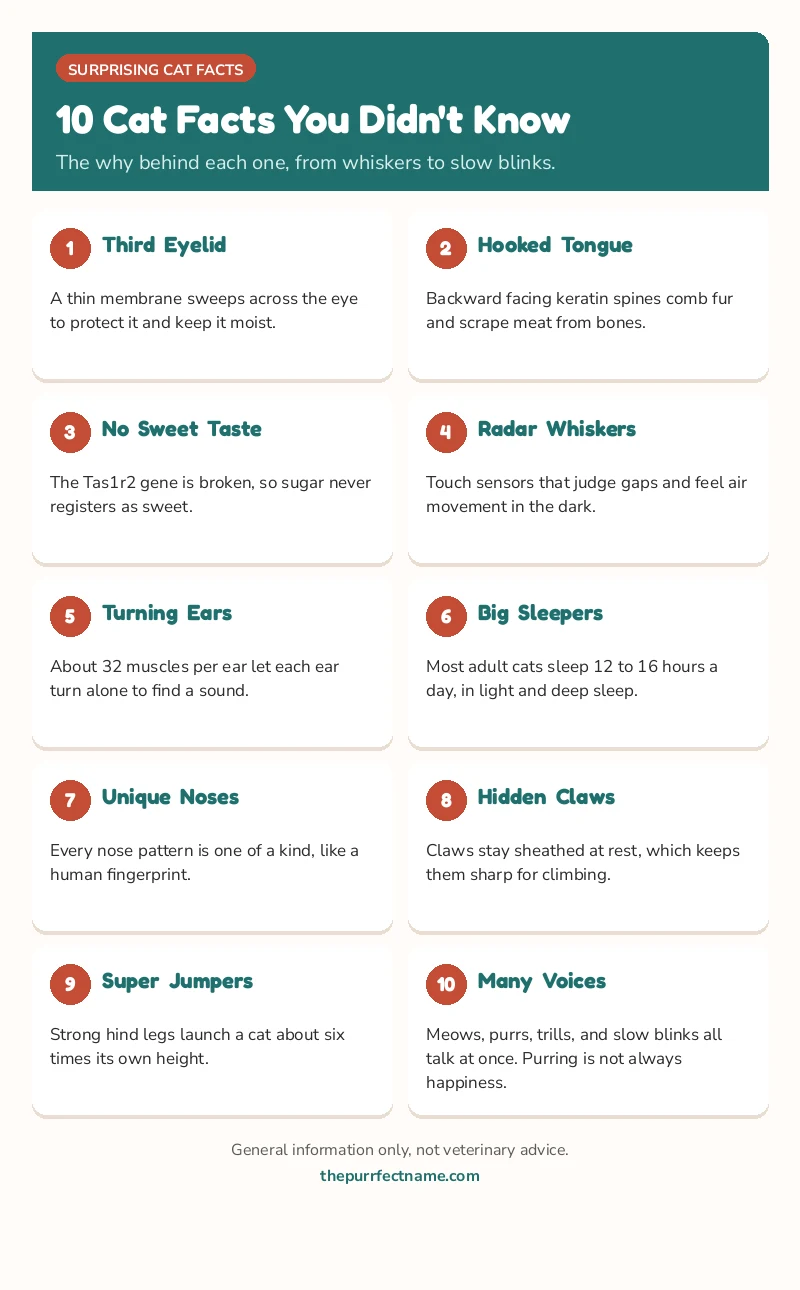
1. Cats Have a Third Eyelid
Under the upper and lower eyelids, on the nose side of each eye, sits a thin, semi transparent membrane called the nictitating membrane. It sweeps across the eye to protect it and helps keep the surface moist.
You rarely see it, because it stays tucked away when the eye is healthy. If it stays visible, especially with other signs of illness, that is a reason to call your vet. Our guide on whether cats can see in the dark covers the rest of the eye, including the reflective layer that makes eyes shine in photos.
2. Their Tongues Are Covered in Tiny Hooks
Run a finger the wrong way across a cat’s tongue, in your imagination only, and you would feel the barbs. The tongue is covered in tiny backward facing spines called papillae, made of keratin, the same protein as claws. They work like a comb, pulling loose fur out of the coat and scraping meat from bones.
A 2018 study of six cat species found the tips of these spikes are hollow, so the tongue also acts like a sponge, pulling saliva into the fur during grooming. That is why a cat can groom itself clean with no soap and no towel.
3. Cats Cannot Taste Sweetness
Sugar holds no attraction for a cat, because the cat cannot taste it the way you do. In most mammals, sweetness is detected when two receptor proteins, T1R2 and T1R3, pair up on taste cells. In cats, the gene for T1R2 has a 247 base pair deletion, so it cannot produce a working T1R2 protein, and the pair never forms.
The finding comes from a 2005 study led by Cornell scientists, published in PLoS Genetics. Your cat may still beg for ice cream, but it is after the fat and the cold, not the sugar.
4. Whiskers Are Sensitive Touch Sensors
Whiskers, called vibrissae, are not stiff hairs. They are deeply rooted sensors that detect touch and tiny changes in air movement. They help a cat judge whether it can fit through a gap, feel objects nearby in the dark, and sense prey close to its face.
They are roughly as wide as the cat’s body, which is why the old rule works: if the whiskers fit, the cat usually fits. Never trim whiskers. Cutting them leaves a cat disoriented, because you have taken away one of its main ways of measuring the world.
5. Their Ears Can Turn to Find a Sound
Each ear has about 32 muscles, and the two ears move independently. A cat can turn one ear toward a sound without moving its head, and can rotate each ear up to 180 degrees. That is how a cat pinpoints a mouse behind a wall, or your footsteps in the next room, before it ever looks at you. High pitched sounds are the easiest for a cat to place, which is why a cat’s ears often move before its eyes do.
The Body: Built to Sleep, Jump, and Land
6. Cats Sleep 12 to 16 Hours a Day
Most adult cats sleep 12 to 16 hours a day, and kittens and older cats often sleep more. It is not laziness. Cats are built for short, intense bursts of hunting, and sleep is how they save energy between bursts.
About two thirds of that sleep is light, so a cat can spring into action if something changes. The rest is deep sleep, and that is when you may see whiskers or paws twitch, which many vets read as dreaming. A cat that sleeps all day and plays hard for twenty minutes at dawn is following a normal pattern, not a broken one.
7. Every Cat’s Nose Is Unique
Look closely at your cat’s nose and you will see tiny ridges and bumps. No two cats have the same pattern, in the same way no two people have the same fingerprint.
The pattern is set by the shape of the nose leather, the small bumps on its surface, and the grooves between them. It is unique enough that it could in theory identify a cat, though no one is scanning noses at the vet yet. It is also a good reason to look at your cat’s nose now and then. A change in color or discharge is easier to spot when you know what normal looks like.
8. Cats Can Retract Their Claws
A cat’s claws are sheathed at rest and extended only when needed. Elastic ligaments pull the claw back into a fold of skin and fur when the muscles relax, and the cat flexes its muscles to push the claw out for climbing, gripping, or scratching. That is why a relaxed cat can walk across your lap in silence and leave no marks, and why the same cat can climb a tree in seconds.
Keeping the claws tucked away also keeps them sharp, because they are not worn down by walking. All domestic cats have fully retractable front claws. If a claw cannot retract, or it keeps catching on fabric, that needs a vet exam.
9. Cats Are Agile Jumpers
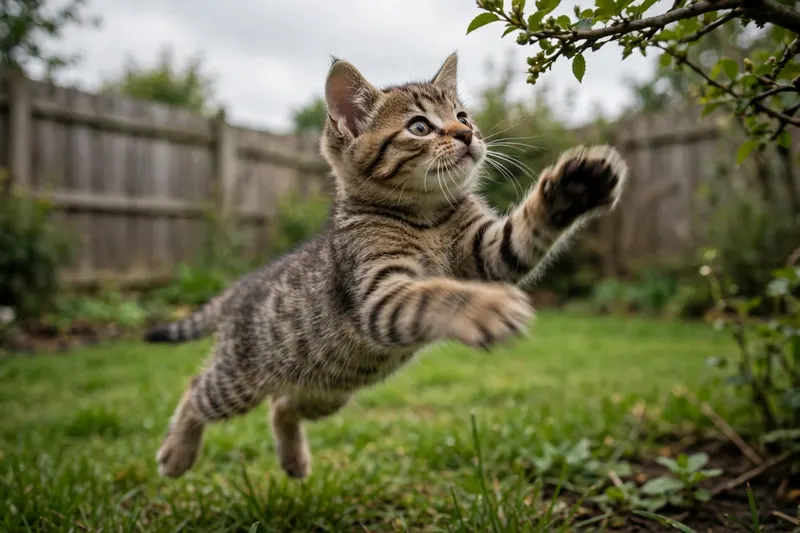
A healthy adult cat can jump about six times its own height, which for a typical house cat means 5 to 6 feet straight up from standing. The power comes from strong hind legs that crouch and release like a coiled spring, a flexible spine with up to 53 vertebrae, and a light body. The front legs stretch out during the jump and steady the landing.
The same build gives cats their righting reflex, the mid air twist that turns a fall into a feet first landing. Our guide on whether cats always land on their feet explains the limits of that reflex, because a short fall can still hurt. Age, weight, and health change how high any one cat can jump, so six times is an average, not a promise.
Communication: More Than Meows
10. Cats Talk in Many Ways at Once
Cats communicate through sound, body language, and scent at the same time. A meow is mostly aimed at people, and adult cats rarely meow at each other. A trill, a rolling chirp, is a friendly greeting, often meaning hello or follow me. A purr usually means contentment, but not always. Cats also purr when they are stressed, in pain, or unwell, as a way to soothe themselves.
Read the body around the purr: a relaxed cat on your lap is happy, while a hunched cat that is hiding or refusing food is coping, not content. A slow blink, soft eyes closing and opening, is a trust signal, and many cats will blink back if you do it first. Our guide on what your cat’s meows mean breaks down the sounds one by one.
Frequently Asked Questions
How many hours a day do cats sleep?
Most adult cats sleep 12 to 16 hours a day. Kittens and older cats often sleep more. Light sleep makes up about two thirds of that total.
Can cats taste sweet food?
No, not the way people do. The Tas1r2 gene does not produce a working sweet receptor, so sugar does not register as sweet for a cat.
Why should you never trim a cat’s whiskers?
Whiskers are touch sensors that help a cat judge space and feel air movement. Cutting them can leave a cat disoriented and unsure of gaps it could normally judge.
Do all cats have unique nose prints?
Yes, as far as anyone can tell. Each cat’s nose has its own pattern of ridges and bumps, like a human fingerprint.
Does purring always mean a cat is happy?
No. Purring most often means contentment, but cats also purr when stressed, injured, or in pain. Check the body around the purr before you decide.
The Bottom Line
Your cat is carrying a third eyelid, a barbed tongue, a broken sweet receptor, radar whiskers, and radar ears, and it uses all of them before breakfast. Then it sleeps for most of the day, jumps six times its own height without warming up, and tells you about it in meows, trills, purrs, and slow blinks.
None of these facts changes how you feed or play with your cat, but each one explains a habit you have already seen. Watch for the next one, and you will spot it the same day.