
3 Things Cats Do That Look Like Respect Tests (And What They Really Mean)
Your cat rolls onto its back and shows you its belly. It stares at you without blinking. It knocks your favorite mug off the table and walks away. It is easy to read all of that as a test, and easy to read the test as a power game: your cat is checking whether you respect it, and whether it is the boss. That reading is popular, it is dramatic, and it is mostly wrong.
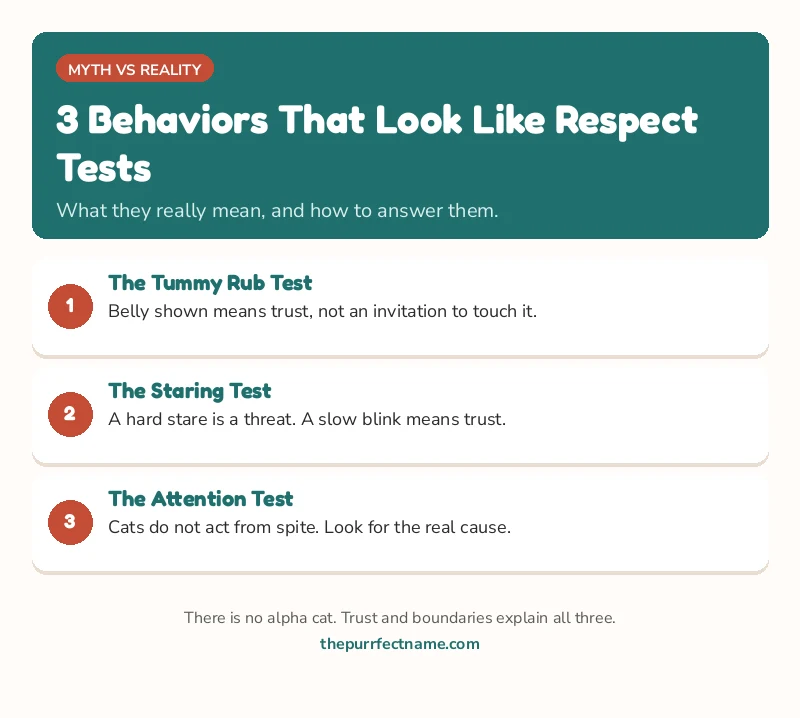
Cats do not run respect tests the way the internet describes them. They do not have alpha hierarchies like dogs, they do not plot revenge, and they do not break things to spite you. What they do have is trust, boundaries, and very clear body language, and all three of the behaviors in this article are about those things. Here are the 3 behaviors that look like respect tests, what they really mean, and how to answer them well.
Key Takeaways
- There is no alpha cat. Cats do not form linear dominance hierarchies, and they do not try to dominate people.
- A cat showing its belly is showing trust, not offering an invitation to touch it. Most cats do not enjoy belly rubs.
- A hard, unblinking stare is a threat signal in cat language. A slow blink is the opposite: trust and affection.
- Cats do not act out of spite or revenge. Knocking things over is curiosity, play, hunting practice, or stress, not payback.
- Respecting a cat means reading its signals, stopping before it has to escalate, and giving it choice and space.
The Alpha Cat Myth Is Wrong
Before the three behaviors, the correction matters, because it changes everything that follows. The idea of an alpha comes from a 1970s study of captive wolves, and even that study was later shown to be wrong about wild wolf packs. Cats are not wolves, and they are not dogs. They evolved as solitary hunters, not pack animals, and their social life is built around territory, resources, and individual relationships, not rank.
Cats.com puts it plainly in its guide to alpha cats: the concept of a hierarchy led by an alpha is now recognized as applying only to select species, such as lions and apes, and cats do not conform to pack animal behavior like dogs. Its companion guide adds that the terms alpha, top cat, and boss cat are outdated and dangerous labels that serve no purpose and offer no solutions.
Feral cats do form loose, flexible social groups, often matrilineal, where older females may reach resources first, but that is not a linear ladder with one cat at the top and the rest submitting below. Cats do not use force to dominate humans or other pets. When conflict comes, they usually prefer to walk away rather than fight.
That matters because the alpha story tells owners to win a contest that does not exist. If you think your cat is testing your rank, you may answer with punishment, staring contests, or forced handling, and all of those damage trust. If you understand that your cat is communicating comfort, stress, or a boundary, you can answer with the thing it actually needs: space, a choice, or a calm retreat. The rest of this article reads the three famous tests through that lens.
1. The Tummy Rub Test
What it looks like
Your cat rolls onto its back, paws curled, belly fully exposed, looking soft and inviting. You reach out to rub it. One second later, teeth and back claws. The popular version of this story says your cat presented its belly to test your respect, and you failed the test by touching it.
What the Popular Version Gets Wrong
The belly is not a test, and there is no pass or fail. It is a display of trust with a trap built into the biology, not the intention. The abdomen holds vital organs with no ribcage protecting them, so it is the most vulnerable part of a cat’s body. A cat that rolls over in your presence is saying it feels safe enough to lower its guard. That is the compliment. It is not an invitation.
Multiple behavior sources agree on this point. Adoptapet quotes feline behavioralist Jennifer Van de Kieft: a cat exposing its belly is a sign they trust you, and not to be mistaken with an invitation to touch the belly. The belly is also one of the most sensitive areas on a cat, packed with nerve endings around the hair follicles, so even a welcome touch can overload quickly and trigger a defensive grab and kick.
That reflex is not anger at you. It is a survival reflex firing before the cat has time to think.
What it really means
Context decides the meaning. A relaxed belly show, with loose paws, slow blinks, and a soft tail, means comfort and trust. The same belly up posture with stiff legs, wide eyes, and flattened ears can be a defensive position, ready to fight with all four sets of claws. Some cats do enjoy a brief belly rub, usually cats that were handled gently there as kittens, but they are the minority, and even they have a short limit.
How to answer it
Admire the belly with your eyes, not your hands. If you want to try touch, go for the cheeks or chin first, the scent gland zones most cats enjoy, and watch the body. If the tail starts flicking, the ears turn back, or the skin ripples, stop before the bite.
A cat that trusts you enough to show its belly has already given you the compliment. You do not need to touch it to accept it. If your cat does nip during petting, our guide on why your cat bites you explains the overstimulation pattern behind most mid pet bites, and the warning signs that come first.
2. The Staring Test
What it looks like
Your cat sits across the room and stares at you. No blinking, no looking away. The popular version says this is a dominance contest: whoever looks away first loses, and if you do not turn away, your cat’s eyes will enlarge as it asserts itself as the alpha.
What the Popular Version Gets Wrong
Almost everything in that version is wrong. Cats do not hold staring contests for rank, and there is no evidence that a cat’s eyes enlarge because you failed to look away. Pupils widen with arousal, fear, low light, or intense focus, not with victory in a dominance game. A direct, unblinking stare is a threat signal in cat language, and answering it with a hard stare of your own is the worst possible reply, because it tells the cat you are a threat too.
The real signal is almost the opposite of a stare. Cats slow blink at people they trust: a deliberate, unhurried closing and reopening of the eyes, sometimes repeated two or three times. Rover, quoting cat behaviorist Stephen Quandt, notes that direct staring is challenging and indicates distrust, while a slow blink is a sign of love and trust.
A 2020 study by Humphrey and colleagues at the University of Sussex, published in Scientific Reports, found that cats were more likely to slow blink back at people who slow blinked at them, and more likely to approach those people. That is not a test. It is a conversation.
What it really means
Read the whole face, not just the eyes. A soft stare with half closed eyes and slow blinks means affection, comfort, or a request for attention. A hard stare with wide pupils, stiff body, and flattened ears means tension, fear, or a warning to back off. A stare plus a meow often means something simpler still: feed me, play with me, or open the door. Our guide on what your cat’s meows mean helps separate those asks from each other.
How to answer it
Never try to out stare your cat. If the stare is soft, slow blink back: look at your cat with relaxed eyes, close them slowly, hold for a second, and open them again. Many cats will return it. If the stare is hard, break eye contact gently, turn your body sideways, and give the cat space. Looking away is not losing. In cat language, looking away is polite, and it is the fastest way to lower the tension.
3. The Attention Test
What it looks like
Your cat demands food and play only on its terms. Give too much attention and there are consequences, the popular version says: your cat will break the things you love, just to spite you, because it cannot stand disrespect.
What the Popular Version Gets Wrong
The spite part is wrong, and it is the most harmful error in the popular version. Cats do not act out of spite, revenge, or grudge holding. That is the consistent view of the behaviorists interviewed by Great Pet Care, Catster, and Trupanion: cats remember negative experiences and form associations, but they do not plan payback, and they do not have the human concepts of resentment or moral intent. Rachel Geller, a cat behaviorist, puts it directly: cats behave in a way that meets their instinctual needs to be safe, and they do not act out of spite, revenge, or holding grudges.
So what is the knocked over mug? Usually one of four things, and none of them is revenge. It is curiosity and hunting practice: a cat tests an object with its paw to learn its weight, sound, and movement, and gravity does the rest.
It is attention seeking that worked once: the cat learned that knocking something over brings you running. It is boredom or unspent energy, especially in young indoor cats. Or it is stress: a change in routine, a new person, or a vet visit leaves a cat anxious, and anxious cats seek out items that smell like you, or act out in ways that look personal but are really coping.
What it really means
Your cat is not testing whether you respect it. It is telling you something about its day: I am bored, I am overstimulated, I am stressed, or I have learned that this action gets a reaction. The attention itself is not the problem. Cats do ask for interaction on their own schedule, and they do walk away when they have had enough, but that is a boundary, not a power move. A cat that leaves mid cuddle is saying the session is over, the same way a person puts a book down when they are done reading.
How to answer it
Give attention on the cat’s terms and end sessions before the cat has to. Keep petting short, watch for the tail flick and ear turn, and stop while the cat is still relaxed. Play in short hunting style sessions, especially in the evening, and put breakable things away from edges if your cat is a keen tester of gravity.
If the behavior is new or sudden, rule out pain and stress first: a cat that has changed its behavior may be unwell, and a vet check comes before any training plan. And when your cat chooses your lap for a nap, take it as the compliment it is. Our guide on why your cat sleeps on you explains why that choice is about warmth, scent, and safety, not about rank.
How to Pass the Only Test That Matters
There is no alpha exam, but there is a real measure of how well you and your cat understand each other, and it is much simpler. Does your cat choose to be near you? Does it slow blink, head bunt, knead, or settle on your lap? Does it walk away when it needs space, and trust that you will let it go? Those are the signs of a cat that feels safe, and safety is the whole point.
Respect, for a cat, looks like this: let the cat come to you. Pet the cheeks and chin, not the belly, unless you know your cat enjoys it. Stop before the warning signs. Never punish a bite or a knock over, because punishment teaches fear, not respect, and a frightened cat hides or escalates. Offer choice: a high perch, a hiding place, a second litter box, a quiet room. And answer a slow blink with one of your own. It costs nothing, it takes two seconds, and the research says your cat will notice.
Frequently Asked Questions
Do cats have alpha hierarchies?
No. Cats do not form linear dominance hierarchies, and they do not try to dominate people. Feral cats form loose, flexible groups shaped by age, sex, personality, and access to resources, not a fixed ladder with one alpha at the top.
Does showing its belly mean my cat wants a belly rub?
Usually not. It usually means your cat feels safe and relaxed around you. Most cats dislike belly touch because the area is sensitive and vulnerable, and even a cat that enjoys it has a short limit. Admire it, and pet the cheeks instead.
Should I stare back at my cat?
No. A hard stare is a threat signal to a cat. Slow blink instead, or look away gently if the cat looks tense. Looking away is polite in cat language, not a defeat.
Is my cat breaking things to spite me?
No. Cats do not act out of spite or revenge. Knocking things over is usually curiosity, play, hunting practice, boredom, or stress. Look for the cause, usually a need for play or a change in routine, rather than a motive.
The popular version called these three behaviors tests of respect. The honest version is kinder and more useful: your cat is not testing you. It is trusting you, warning you, or asking you for something, and it is doing it in the only language it has. Learn that language, answer it well, and you will not need to pass any test at all.