
Minuet: Breed Guide, Napoleon Origins, Temperament, Health & Best Names
Some breeds in our cat breed library were shaped by centuries. The Minuet was shaped by one man’s idea in the 1990s: take the Munchkin’s short legs, give them the round face, dense coat and sturdy boning of the Persian family, and build a cat that looks purebred at any leg length. The result, first called the Napoleon and renamed the Minuet by TICA in 2015, is a small, round, doll-faced cat with a Persian’s gentleness and a Munchkin’s mischief.
Because the Minuet stands at the crossing of two famous family trees, it also inherits two health conversations, one from each side: the short-leg debate that follows every Munchkin-derived breed, and the Persian family’s kidney screening. This guide covers both honestly, with each claim attributed to the side that makes it.
History: A Basset Man, a Newspaper and a Napoleon
📖 Breed History
Joe Smith was a Basset Hound breeder, so short legs were familiar territory, when the Munchkin cat caught his eye in the mid-1990s. His problem with the breed was aesthetic, not medical: because the short-leg gene is dominant and lethal in double dose, Munchkin litters always include normal-legged kittens, and those kittens looked like any mixed-breed shelter cat. Smith wanted a breed whose long-legged kittens would still look unmistakably purebred, and chose the Persian breed group as the outcross, for its beauty and its boning.
Smith began crossing Munchkins with Persian-group cats (Persians, Himalayans and Exotic Shorthairs) in 1996; WebMD dates the founding litter, a Munchkin female bred to an Exotic Shorthair male, to 1997. He named the breed Napoleon, after Napoleon Bonaparte and the popular belief that the emperor was short (he was of average height for his time). TICA classifies the Minuet as a domestic hybrid, developed from a deliberate cross between two existing breeds, and its standard allows only three ingredients: Minuet, Munchkin and the Persian group.
The registry road took fifteen years. TICA listed the breed as experimental in 2001, moved it to Registration Only in 2002 and to Preliminary status in 2011, with cats shown from 2012. In January 2015 TICA’s board voted to rename the breed Minuet, after the stately French dance. TICA’s published record documents the vote rather than a stated motive; secondary accounts of the decision commonly describe a sensitivity around the old name, a breed named for a French emperor as a joke about his height, and a wish to move away from that association. Full championship eligibility followed in 2016. The old name has not disappeared: some smaller registries still recognize the breed as the Napoleon, and many breeders still use both. Outside TICA, the major registries (CFA, FIFe, the GCCF and the World Cat Federation) do not recognize the breed at all, for reasons covered in the health section.
The Dwarf Gene in a Persian Frame
The short legs come from a single autosomal dominant gene, the same chondrodysplasia gene behind the Munchkin. One copy is enough to shorten the legs, and the same gene sets the breed’s hardest breeding rule: it is lethal in double dose, so two short-legged (standard) Minuets are never bred together. Pairings are managed so kittens inherit at most one copy, which is why every litter can contain both leg lengths.
The short-legged kittens are the standard type, historically the show type; their long-legged littermates are the non-standard type, called Talls in current TICA wording (breeders also say Shorts and Talls). A Tall is not a failed Minuet: it carries the same round face, coat and boning, is registered in the same breed group, and TICA calls the non-standard cat an important part of any breeding program. TICA’s current breed-group standard (revised May 1, 2026) lists four varieties side by side, Minuet and Minuet Longhair alongside Minuet Tall and Minuet Tall Longhair, the Talls matching the short-legged cats in every sense except leg length. What the Persian frame adds is support: the substantial boning Smith selected for is what carries the short legs.
Appearance: Round, Low and Plush
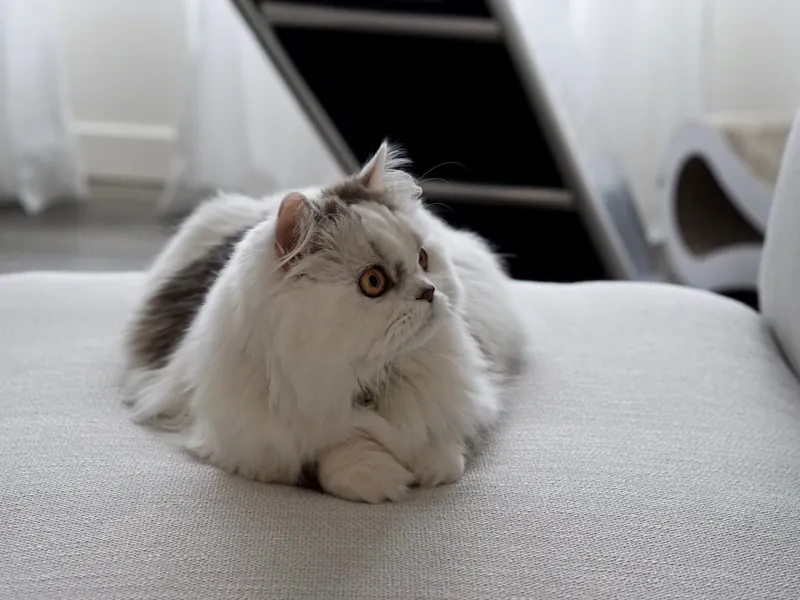
TICA’s own summary of this breed is one word: round. The head is round, with full cheeks and a round chin; the eyes are large and round, set well apart and open without protruding; the ears are small to medium with rounded tips, set wide. The muzzle and nose are short but present, blending into the forehead in a gentle slope in profile. This is the old-style doll face, not the extreme flat face of the modern show Persian: the Minuet standard treats pronounced Persian extremes such as a broken nose profile as faults, and the nostrils must allow easy breathing.
The body underneath is semi-cobby, sturdy and substantial, with significant boning that TICA credits with supporting the short legs. A Minuet is low, not little: adults typically weigh 5 to 9 lb, and TICA’s breed introduction describes a medium-sized cat averaging 7 to 8 lb.
Both coat lengths belong to the same breed. The longhair wears a dense, abundant coat that stands slightly away from the body; the shorthair’s is shorter but still plush and full. Neither is as massive or cottony as a Persian’s. Minuets come in every color and pattern, with eye color following the coat.
Temperament & Personality: Persian Gentle, Munchkin Playful
TICA describes the blend directly: the gentleness of a Persian with the energy, curiosity and playfulness of a Munchkin. In practice the Minuet lands between its parents, calmer than a Munchkin and livelier than a Persian: an adaptable cat that matches the household’s rhythm, playing hard in short bursts and then settling close to its people.
Do not mistake low for slow. TICA’s longhair introduction notes that Minuets are self-starting when it comes to activity and can take the tightest corners at breakneck speed, the low center of gravity working in their favor. Breed guides describe a sociable, trainable, puppy-like companion that follows its people, investigates everything, and dislikes being left alone for long stretches; company, human or animal, is a genuine need. They are generally good with children and other pets, and their Persian side keeps the volume low: an affectionate cat rather than a demanding one.
Care & Grooming
Start at floor level, as with any short-legged breed. Steps or a ramp to the sofa and bed, a low-entry litter box, and play built around ground-level chases and wand toys suit the Minuet’s build; it will climb in stages, but furniture arranged with a route in mind makes daily life easier. Weight control matters doubly here: short limbs carry the load at a mechanical disadvantage, and the Persian side is famously good at lounging. Measure meals, watch the waistline, and keep the cat lean.
The coat is the regular commitment. TICA recommends daily combing for the longhair, a few minutes the cats reportedly enjoy, and the shorthair needs the same routine less often; the coat is more forgiving than a Persian’s, but dense enough to tangle if ignored, especially behind the ears and under the legs. The doll face needs a quick daily look: wipe tear overflow before it stains, and check that the eyes stay clear and the breathing easy. Nail trims, dental care and annual vet visits complete the routine.
Health & the Welfare Debate: Two Family Trees to Watch
The Minuet is a young breed with two inherited watch-lines, one from each parent family. TICA calls it an overall healthy breed, and WebMD’s veterinary review notes no condition associated with the Minuet alone. The honest picture is the two screening conversations below: both sides attributed, nothing promised away.
The Munchkin side: the short-leg gene. The legs come from the same dominant chondrodysplasia gene as the Munchkin’s, and the same breeding logic applies: the gene is lethal in double dose, so pairings are managed so kittens inherit at most one copy. The breed side’s case, per TICA’s breed material, is that TICA presents both the Munchkin and the Minuet as sound, healthy breeds. Critics answer from the same anatomy. The Universities Federation for Animal Welfare concludes that short-legged breeds carry a higher risk of severe osteoarthritis, because shortened limbs change how joints are loaded; the standard veterinary text Feline Orthopaedics records a higher incidence of lordosis and pectus excavatum in chondrodystrophic cats, and WebMD notes that increased osteoarthritis rates have been reported in Munchkins carrying the same mutation. Institutionally, the GCCF and FIFe both bar Munchkin-derived breeds from registration on these welfare grounds, and breeding cats with inherited limb-shortening defects is prohibited in parts of Australia. Where you land is a values judgment; what is not in dispute is the practical list: a vet check of gait, spine and chest before you commit, a breeder who pairs responsibly and discusses joints honestly, a lean cat for life, and any new stiffness treated as a vet question.
The Persian side: kidneys and the moderate face. Polycystic kidney disease (PKD) is the Persian family’s signature inherited condition: an autosomal dominant fault in the PKD1 gene that grows cysts in the kidneys, historically found in roughly 38 percent of Persians worldwide in the survey literature, with a DNA test validated for Persians, Exotics, Himalayans and their crosses. TICA’s own Minuet page is blunt about the consequence: because of the heavy Persian background, every Minuet should come with a certificate stating that its parents have been checked and cleared for PKD. Ask to see it; as our Persian profile notes, PKD screening is a standard part of responsible breeding in this family. The face is the softer version of the same story. Persian-family brachycephaly is linked to tear-duct overflow and staining and, at the extreme, breathing difficulty, which is precisely why the Minuet standard insists on the moderate doll face and faults the extremes; TICA advises checking that a kitten’s parents do not have teary eyes or excessively narrowed nasal passages. These are general notes, not medical advice; your vet is the authority on your cat.
Living With a Minuet
A Minuet home is an indoor home with people in it. These are small, low, companionable cats that expect to be part of the day’s activities, suiting apartments and houses alike, and they generally handle children and other pets with Persian calm, provided play is supervised as with any cat. If the house empties for long working days, a second pet or a plan for company is worth making from the start.
The cautions are the ones this page has already covered: a coat routine you actually keep, a waistline you actually watch, and paperwork you actually read, starting with the PKD clearance certificate. Rarity makes careless sellers more likely, not less: a Minuet offered with no pedigree, no parent information and no health documents is a walk-away. Setting up for a first cat? Our new cat owner starter kit covers the essentials before arrival day.
Best Names for a Minuet
A breed renamed for a French dance deserves names with a little ceremony. Minuet itself is in our database, from the French menuet, a stately triple-time dance. Napoleon is recorded for the French emperor the breed was first named after, and Josephine, “Jehovah increases,” is his natural partner. Bijou means “jewel” and Petit “small,” both about right for this cat. Giselle, “pledge,” and Odette, “wealth,” bring the ballet; Amelie, “hardworking,” and Colette, “victory of the people,” bring Paris; Margaux means “pearl,” for the lustrous coat. Gigi and Fifi are described in our database as chic, tiny French pet names. Every meaning above comes from our name database. For more in this spirit, browse our French cat names and royal cat names.
Frequently Asked Questions
Is a Minuet the same as a Napoleon cat?
Yes, exactly the same breed. Napoleon was the original name, chosen in the 1990s for Napoleon Bonaparte and the popular (if inaccurate) belief that he was short. In January 2015 TICA’s board voted to rename the breed Minuet, after the stately French dance in triple time; secondary accounts describe a sensitivity around naming a breed for a French emperor as a height joke. Nothing about the cat changed, and the old name survives: some smaller registries still register the breed as the Napoleon, and many breeders and listings use both names.
Is it ethical to breed Minuet cats?
People of good faith land on both sides, and this page does not settle it. Supporters, including TICA, point to an active, agile cat, a standard that faults extremes, responsible one-copy pairings and required PKD screening. Critics, including the GCCF and FIFe, which refuse all Munchkin-derived breeds, point to UFAW’s conclusion that short-legged cats face a higher risk of severe osteoarthritis; some jurisdictions ban breeding cats with inherited limb-shortening defects altogether. The practical summary: choose a breeder who pairs responsibly, screens for PKD and discusses joints openly; if the critics’ position troubles you, that is a legitimate reason to choose a different breed.
Are Minuet cats healthy?
TICA calls the Minuet an overall healthy breed, and there is no condition unique to it. Two family watch-lines apply. From the Munchkin side, the short-leg gene brings the osteoarthritis debate covered in our health section, which is why gait and joints belong in the vet check you arrange before bringing one home. From the Persian side, PKD is screened by DNA test, and TICA states that every Minuet should come with a certificate showing its parents were checked and cleared.
Can Minuet cats jump and climb?
Yes, in stages rather than in one leap. TICA describes them as fast and sure-footed, cornering at breakneck speed on a low center of gravity, and they route their way up furniture in smaller hops. Steps or ramps to favorite spots help, and a Minuet that stops attempting jumps it used to make should see a vet.
How much grooming does a Minuet need?
Less than a Persian, more than an ordinary domestic. Both Minuet coats are dense and plush; TICA recommends daily combing for the longhair, a few minutes a day, with the shorthair needing the same routine less often. Add a daily glance at the face to wipe tear overflow before it stains, plus the usual nails, teeth and ear checks.
How long do Minuet cats live?
Estimates genuinely vary, because the breed is young and long-term data is thin. Catster gives 9 to 15 years and Catpedia 12 to 15, while WebMD cautions that no well-established figure exists yet and advises planning on roughly a decade or more. Treat the honest answer as a normal-cat span with the usual levers: weight, joints, kidney screening and vet care.
By Brianna Baxter
Featured photo: Photo: Parkerwh, CC BY-SA 4.0, via Wikimedia Commons.