
Suphalak Cat: Thailand’s Copper Cat from the Cat-Book Poems
The Suphalak is Thailand’s copper cat: a solid, warm chocolate-brown cat with large golden eyes, described in the centuries-old Tamra Maew, the Cat-Book Poems, and so rare by the late twentieth century that few people had knowingly seen one. Its everyday Thai name, Thong Daeng, means “copper”; the breed name itself combines Thai words for “excellent” and “characteristics”.
One honest note first: the Suphalak spent decades confused with the Burmese. This page, part of our cat breed library, separates the two properly, sticking to the documented record: the manuscripts, the World Cat Federation (WCF) standard, the breed’s only major-registry standard, dated 2024, and the genetics research behind the Thai revival.
History: Written in the Cat-Book Poems
📖 Breed History
The Suphalak is one of the heritage cats of the Tamra Maew, the Thai Cat-Book Poems thought to originate in the Ayutthaya Kingdom (AD 1351 to 1767). Its poem praises a cat of pure copper colour with eyes lit like shining rays, among the auspicious cats that bring wealth. Copies survive in the National Library of Thailand, the British Library and the National Library of Australia.
The manuscripts describe seventeen auspicious cat types; five traditional Thai breeds survive today: the Korat, the Wichien Maat (the original Siamese), the Khao Manee, the Konja and the Suphalak.
Legend adds a darker chapter: when Ayutthaya was sacked on 7 April 1767, the Burmese King Hsinbyushin is said to have read the poem and ordered every Suphalak carried to Burma with the royal treasure, a tale Thais tell half-jokingly today to explain the breed’s scarcity.
The real cause of the scarcity is genetics. A true Suphalak is a “chocolate self”: two recessive copies of the brown gene (TYRP1), plus the full-colour gene (TYR C), so the brown stays even from root to tip. Cats carrying the Burmese colourpoint allele (cb) develop a darker mask, ears, feet and tail instead, and Thailand’s cats carry those alleles widely: a 2025 study found every cat sampled at the Thai Cat Conservation Center carried them. Untested, pointed copper cats passed as Suphalaks for decades; Clutterbuck’s 2004 Siamese Cats: Legends and Reality pictured them as one.
The revival began with Kamnan Preecha Pukkabut, of the Thai Cat Conservation Center at Amphawa, Samut Songkhram. Before 2013, one male, Samsen, was the only Suphalak in a breeding programme. In 2014 The International Maew Boran Association (TIMBA; Maew Boran means “ancient cat”) was founded to preserve Thailand’s heritage cats, on a Suphalak programme of six tested foundation cats. Its 2016 study genotyped 127 cats across five coat-colour genes; selecting against the colourpoint alleles cut their frequency from about 98 to 43 per cent and identified 55 solid chocolate cats.
Only one solid copper Suphalak has ever been officially exported: Thonga, declared a proper Suphalak in May 2013 and shown in Thailand that year, the first Suphalak entered in competition. Imported to the United States by Lisa Young on 29 September 2013, she became, on 6 September 2015, the first Suphalak registered as one with an established registry, the American Cat Association; on 15 September 2015 her daughter became the first Suphalak born outside Thailand.
Top-level recognition is recent: WCF officially recognised the Suphalak in 2024, publishing its standard (code SUP) on 1 November 2024, with no outcrosses permitted. In November 2025 Thailand named the breed one of its five national pet symbols.
Appearance: Solid Copper, Golden Eyes
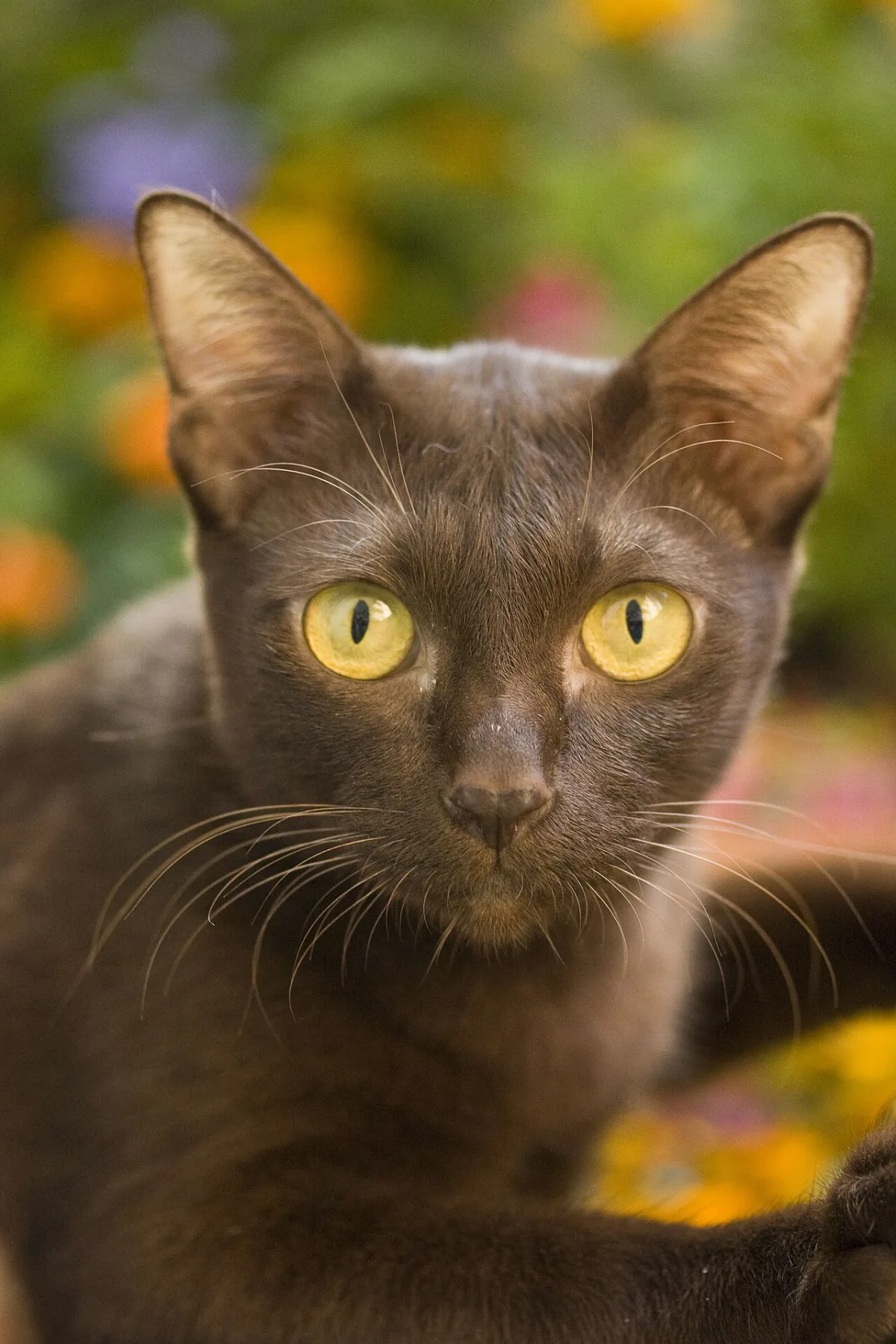
Almost everything that can be said with confidence about the Suphalak’s looks comes from one document, the WCF standard. The body is medium-sized, semi-foreign in type, well balanced, muscular and graceful, on long, slender legs with oval paws. The tail is medium to moderately long, tapering to a blunt tip, a kinked tail is a disqualification.
The head is a medium wedge with gently rounded contours and a slightly heart-shaped form. High, rounded cheekbones curve in toward a fine muzzle; pronounced brow ridges, with sparse hairs above the eyes, give the face the standard’s “astonished” expression. The ears are moderately large, wide at the base, set wide apart, tips gently rounded.
The eyes dominate the face: large, wide open and slightly slanted. The standard allows light yellow to rich golden, a slight green shade permitted, intense golden-yellow is preferred, and any colour outside yellow to green disqualifies. The Tamra Maew described them as shining and sprinkling sun rays.
The coat is very short, fine and close-lying, with no undercoat and a silky feel, and it must shine: a Suphalak with no shiny coat cannot be awarded a certificate. The colour is a glossy, warm chocolate; a reddish-copper cast is preferred to a dull, matt chocolate. Slight ghost markings are acceptable in young cats. The brown runs all the way down: nose leather chocolate brown, whiskers brown, paw pads warm cinnamon, shifting toward an orange, coffee-latte hue with age. White lockets disqualify. Size: the standard says only “medium sized”, giving no weight, while pet guides print 6 to 15 pounds with no registry or study behind them, treat those figures as unverified.
Temperament & Personality: People-Oriented and Vocal
The description that repeats across Thai sources and breed references is consistent: the Suphalak is a people cat, clever, friendly and sociable in Thailand’s official profile; intelligent, affectionate and playful in breed references, often dog-like in how it attaches to its household, communicative and active.
That profile comes from a very small number of cats in Thai preservation programmes, not from any breeder-club survey. Read it as reported character, not promise.
Care & Grooming
There is no Suphalak-specific care literature, the breed has never had the numbers, so care is the ordinary short-coat plan: a weekly brush to lift loose hair and spread the oils that keep the copper glossy, and no routine bathing.
The real demand is the documented temperament: an active, people-oriented cat needs daily play and company, not an empty house all day. Rarity adds one rule, a Suphalak is a theft target, and the Thai and American programmes keep their cats indoors. Setting up for a first cat? Our new cat owner starter kit covers what to have ready.
Health Notes
The honest health section for this breed is short. No veterinary literature documents a breed-specific disease list for the Suphalak, and breed references state plainly that there are currently no known health issues specific to it, it is subject to the ordinary diseases of domestic cats, nothing documented beyond that. Nor is any lifespan documented: pet guides print 7 to 20 years, figures that contradict each other and trace to no study.
The one genuinely documented concern is the gene pool: the world population descends from a handful of cats, which is why the Thai programme genotypes its breeding stock and manages matings on test results. That is a programme-level fact, not a diagnosis for any individual cat; for a pet, the plan is standard preventive veterinary care. These notes are general published information, not medical advice.
Suphalak vs Burmese: Not the Same Cat
The two are constantly merged, “Suphalak” is even used in Thai as a synonym for the Burmese, but they are not the same cat.
Origin. The Suphalak is a natural Thai type described in the Tamra Maew centuries ago and preserved in Thailand. The Burmese is a created breed, developed in the United States and Britain from 1930 out of one walnut-brown female, Wong Mau, bred with Siamese. Claims in print that today’s Suphalaks descend from Wong Mau have the history backwards.
Coat genetics. The decisive difference is visible. The Suphalak carries full colour (C) over two recessive brown genes (bb): the warm chocolate is even over the whole body, and the skin, nose leather, paw pads, is reddish-brown too. The sable Burmese carries the colourpoint allele twice (cb cb): pigment concentrates at the cooler extremities, giving the darker mask, ears, feet and tail. A “Suphalak” with a dark mask carries cb, genetically not the cat the manuscripts describe, whatever its paperwork says. The Tonkinese is a third thing again: a Burmese-Siamese crossbreed with one copy of each allele (cs cb), the “mink” pattern.
Recognition. The Burmese is recognised by every major registry, CFA, TICA, FIFe and WCF among them. The Suphalak is recognised by WCF alone (2024), with registrations through TIMBA and, since 2015, the American Cat Association; it appears on none of the TICA, CFA or FIFe lists. (The other brown lookalike, the Havana Brown, is a created English breed, Siamese crossed with black domestics in the 1950s, not a Thai cat at all.)
Names for a Suphalak Cat
A cat whose own name means “excellent characteristics” deserves a considered shortlist. Thai names sit naturally on a Thai breed, more in our cat names from around the world, and copper and warm-earth tones suit the coat, as in our brown cat names. Or browse the cat name library and cat name generator.
Shortlist: Thai Names and Copper Tones for a Suphalak
Tap a name to copy it.
Suphalak Cat FAQs
Is the Suphalak recognised?
Yes, by one major registry. WCF officially recognised it in 2024 (standard, code SUP, 1 November 2024). TIMBA registers it in Thailand; the American Cat Association registered the first Suphalak in 2015. It is not recognised by TICA, CFA or FIFe, on none of their breed lists (checked October 2026).
Is a Suphalak the same as a Burmese?
No. The Suphalak is a natural Thai type described in the Tamra Maew; the Burmese is a pedigree breed created in the United States and Britain from 1930, founded on one imported female, Wong Mau. Genetically, the Suphalak is full-colour (C), evenly copper all over, skin included, while the sable Burmese carries cb twice, darkening its mask, ears, feet and tail.
What colour is a Suphalak, exactly?
One colour only: solid, glossy warm chocolate with a reddish-copper cast, even from root to tip, brown whiskers, chocolate-brown nose leather, warm cinnamon paw pads, yellow-to-gold eyes. A darker mask or points means colourpoint alleles, not the manuscripts’ solid copper cat.
How rare is the Suphalak?
Among the rarest of all breeds. Only one has ever been officially exported, Thonga, to the United States in 2013, and the revival began from six tested foundation cats. Suphalaks live almost entirely in Thailand.
What is a Suphalak’s temperament like?
People-oriented, according to every source that describes it: intelligent, affectionate, playful, sociable, often called dog-like, communicative and active, unhappy when left alone, a profile documented from a tiny population, so treat it as reported character, not a guarantee.
Does the Suphalak have any health problems?
None documented as breed-specific: references state there are no known health issues specific to the Suphalak, though like any cat it remains subject to ordinary feline diseases. No lifespan is documented in a source we can stand behind, pet guides print 7 to 20 years and cite no studies. The documented concern is the small gene pool, managed in Thailand with genetic testing.
Featured photo: Photo: Maewboran, CC BY-SA 4.0, via Wikimedia Commons.
Sources: the WCF breed standard for the Suphalak (SUP, 2024), TIMBA, and the 2025 coat-colour genetics study of the Suphalak restoration programme.