
Chinchilla Cat: Breed or Colour? Silver Persian Guide
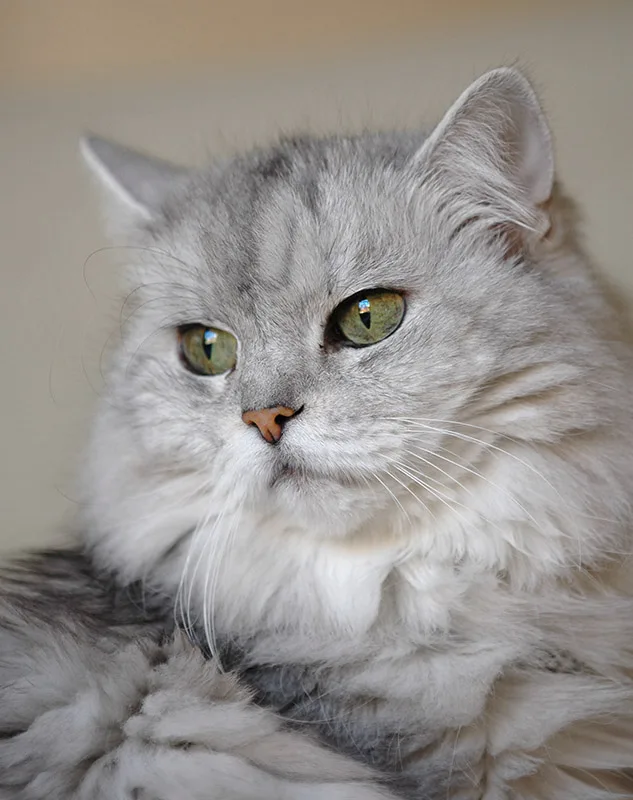
Some cats are named for a place, and some for a person. The Chinchilla is named for a coat: long, snow-white hairs tipped at the very ends with black, so lightly that the whole cat looks dusted with silver frost, and sparkles when it moves. The animal underneath that famous coat is a Persian.
That is what confuses people: “Chinchilla” behaves like a breed name while working, almost everywhere, as a colour name. This guide separates the two, what the coat is, how it differs from a shaded silver, what each registry calls it, and the one country where it is a real breed.
History: A Colour Born in Victorian England
📖 Breed History
Every Chinchilla line traces back to a single cat: Chinnie, born in 1882. Her descendant Champion Silver Lambkin is regarded as the first recognisable Chinchilla, and by 1894 the variety had its own exhibition class, among the earliest Persian colour varieties to be standardised.
Silver longhairs appeared in England as the Persian itself was being standardised, and the palest of them caused a sensation. Chinnie’s own ancestry was never properly recorded, cat historian Sarah Hartwell notes prize-winning cats on one side of her line and a stray tomcat on the other, but her pale, silvered kittens were unlike anything on the show bench, and Frances Simpson, a leading figure of the early fancy, called her “the Mother of Chinchillas.” Mated to a very pure silver called Fluffy I, Chinnie founded the line that, a few generations later, produced Champion Silver Lambkin, still pointed to as the foundation of the modern Chinchilla.
The name is borrowed, and it is only a name: the sparkling, frosted fur reminded fanciers of the pelt of the chinchilla, the South American rodent prized for its fur. There is no chinchilla, or any rodent, in the cat’s ancestry at all.
Success brought an argument that has never entirely gone away: how much tipping makes a Chinchilla? Around 1900 the silver classes were split three ways, Silver Tabbies, Chinchillas (lightly tipped, also called Self Silvers) and Shaded Silvers (heavily tipped), but judges drew the line in different places, and the two tipped classes were soon combined; they are still shown together in Britain today. Even the eyes were contested: orange was originally preferred, and when a green-eyed Chinchilla appeared in 1895, Fur and Feather declared it useless to exhibit her. Green won, emerald or blue-green eyes are now compulsory.
The most famous Chinchilla of all may be a film star: cat writer and zoologist Desmond Morris identifies Solomon, the white Persian stroked by Blofeld in the 1960s, 70s James Bond films, as a Chinchilla, the role that fixed the “villain’s silver cat” in popular culture.
Chinchilla vs Silver Persian vs Shaded Silver
Start with the umbrella term. A Silver Persian is any Persian whose coat carries the silver (inhibitor) gene, which switches off colour in most of each hair and leaves a white undercoat. Silver Persians include silver tabbies, smokes, shaded silvers and chinchillas: “Silver Persian” names a family of coats, and “Chinchilla” its palest member.
The difference between a Chinchilla and a Shaded Silver is purely depth. In a chinchilla, only the tip of each hair carries colour, breeders put it at roughly the last eighth, so the cat looks almost white, with a silvery sparkle over the back, head and tail and a pure white face, chest and legs. In a shaded silver the colour runs about a third of the way down each hair, forming a dark mantle over the back and flanks; the general effect, as the CFA standard puts it, is “much darker than a chinchilla.” The two are ends of one scale, which is why kittens can be hard to classify until the adult coat comes in.
A second gene, the wideband gene, pushes colour toward the hair tip: two copies of it, on a silver cat, produce the shell-light chinchilla coat, and one copy the heavier shaded. Both varieties also exist in a golden form, the same tipping over a warm apricot-gold undercoat, the Chinchilla Golden and Shaded Golden.
What the Registries Call It
Registry by registry, the position is unusually consistent:
GCCF (Britain): the Chinchilla sits in Section 1, Persians and Exotic Shorthairs, inside the Persian standard, but with its own standard of points and breed code, PER ns 12 64: Persian, black-silver, shell pattern, green eyes. A Blue Chinchilla (blue tipping, PER as 12 64) is listed alongside it, and the Shaded Silver (PER ns 11 64) is “shown with the Chinchilla.”
FIFe (Europe): the same arrangement. The Persian is a Category 1 breed whose recognised colour varieties include “Silver Shaded / Shell”, codes s 11 and s 12, with green or blue-green eyes required. Chinchilla is the shell end of that variety, not a breed.
CFA (America): again a colour, not a breed. “Chinchilla Silver” is a named colour of the Persian’s Silver and Golden Division, registered under Persian colour codes, described as an undercoat of pure white tipped with black enough to give “the characteristic sparkling silver appearance.”
The exception is South Africa. There, breeders who had preserved the older, colour-bred Chinchilla type, longer-nosed and lighter-boned than the modern show Persian, won recognition for it as a separate breed, the Chinchilla Longhair (code CHL), with the South African Cat Council in 1996. It remains the only major registry that treats the Chinchilla as a breed. An American attempt to do the same, under the name “Sterling,” was registered with TICA in the 1990s but never won enough support and was dropped.
Appearance: Frosted White, Emerald Eyes
Underneath the coat is the familiar Persian build: a cobby, broad-chested body on short legs, a round, massive head, small ears set wide and low, and a short, bushy tail. The Chinchilla is not a separate shape, it is that shape in a silver coat.
The coat itself is the whole point. The undercoat must be pure white, with black tipping laid evenly over the back, flanks, head, ears and tail; the chin, ear furnishings, chest and stomach stay pure white, and any tabby markings or brown or cream tinge are defects under the GCCF standard. The effect judges look for is sparkle: colour so shallow on each hair that it reads as light, not pattern.
The face carries the signature “makeup”: brick-red nose leather outlined in black, black rims around the eyes and lips like eyeliner, and black paw pads. The eyes are large, round and emerald green or blue-green, both the GCCF and CFA standards treat any other eye colour (copper, yellow, gold, amber) as a disqualifying fault in this variety, .
Temperament & Personality
A Chinchilla has a Persian’s temperament, because it is a Persian: quiet, placid, gentle and affectionate. It chooses a favourite chair and a predictable routine, supervises the household from it, and asks to be admired rather than entertained. The voice is soft and used sparingly.
They are affectionate without being demanding, and generally excellent with calm children and other pets, given sensible introductions. What they do not suit is a chaotic household, or an owner expecting a playful, follow-you-everywhere companion, energy is the one thing the Persian family does not trade in. Short bursts of interactive play keep them fit without asking them to be something they are not.
Care & Grooming
Be honest with yourself here: this is among the highest-maintenance coats in the cat world. The long, dense, fine-textured coat tangles quickly, and the routine is a comb-through every day, ten minutes prevents the mats that form behind the ears, under the legs and along the belly. Shedding is heavy and seasonal.
The white face needs its own routine: Persians’ eyes can water, and on a pure white coat any tear staining shows, so wipe the face daily with a damp cloth. Occasional baths keep the silver bright, as white undercoats pick up discolouration from dust and oils. Raised with it from kittenhood, most Chinchillas accept the ritual as part of life.
Health Notes: The Persian Family Picture
There are no Chinchilla-specific health statistics, the variety shares the Persian gene pool, and its health picture is the Persian one. Polycystic kidney disease (PKD) screening is a standard part of responsible Persian breeding, so choose breeders who test their lines. Persians can also be prone to progressive retinal atrophy (PRA), night blindness is typically the first sign, and there is no cure.
The face itself deserves a word. Colour-bred Chinchillas traditionally kept a longer muzzle than other Persians: Jeanne Ramsdale, the American breeder who campaigned for their recognition, argued that this preserved normal tear ducts and breathing, and avoided the snub-nosed type’s jaw problems. Show-ring Chinchillas, though, are judged against the Persian standard and have largely followed the breed toward a flatter face, which can bring breathing, dental and eye issues. Whatever the fashion, a Chinchilla should breathe quietly and eat comfortably, and a breeder should be happy to show you that its parents do.
Best Names for a Chinchilla Cat
Names that suit a silver-frosted cat with emerald eyes, silver and sparkle names, white names and a little Persian luxury. Every meaning below comes from our name database; where a name has no recorded meaning, we say so. For more, browse our grey cat names, our white cat names and our gemstone cat names.
Bianca (“white” in Italian) and Alba (“white, dawn”) name the coat directly. Crystal (“ice”) and Diamond (“unbreakable”) catch the sparkle in the tipping, while Opal (“precious stone”) suits a coat that shifts between white and silver with the light. Luna (“moon”), Stella (“star”) and Aurora (“dawn”) are the celestial set. Four picks are honest inspiration choices from our database, with no translation claimed: Sterling (sterling silver, the obvious title for the palest silver of all), Silver, Shimmer and Cashmere, for the softness of that coat.
Frequently Asked Questions
Is a Chinchilla a breed or a colour?
Almost everywhere, a colour. In the GCCF, FIFe and CFA the Chinchilla is a colour variety of the Persian, the palest, shell-tipped silver, with its own standard of points and codes, but no breed status. The one exception is South Africa, where the South African Cat Council recognises the Chinchilla Longhair as a separate breed (since 1996).
Is a Chinchilla cat related to the chinchilla animal?
No. The cat is named after the chinchilla, a South American rodent, purely because the frosted silver coat resembled the rodent’s prized fur. There is no chinchilla ancestry in the cat at all, it is a Persian whose coat borrowed the name.
What is the difference between a Chinchilla and a Shaded Silver?
Depth of tipping. A chinchilla carries colour only on roughly the last eighth of each hair, so it looks almost white with a silvery sparkle. A shaded silver carries colour about a third of the way down each hair, forming a much darker mantle, “much darker than a chinchilla,” as the standards put it. The GCCF shows the two together for exactly this reason: they are ends of one scale.
Do Chinchilla cats have green eyes?
Yes, green or blue-green eyes are compulsory in this variety. The GCCF requires emerald or blue-green and treats copper, yellow, gold or amber as incorrect, and the CFA disqualifies silvers with the wrong eye colour outright. Brick-red nose leather and black “eyeliner” rims complete the standard look.
How much grooming does a Chinchilla need?
A lot, by cat standards: a comb-through every day to stop the long, fine coat matting, a daily face wipe for tear staining on the white fur, and an occasional bath to keep the silver bright. Budget ten minutes a day, every day, most Chinchillas treat the routine as quality time.
Are Chinchilla cats healthy?
They share the Persian health picture. Ask a breeder the Persian questions: are the parents PKD-tested (screening is standard in responsible Persian breeding), and is there any history of progressive retinal atrophy, whose first sign is night blindness? Traditional, colour-bred Chinchillas also kept longer muzzles, which their breeders credited with easier breathing and healthier tear ducts, worth remembering when you compare kittens.
Sources: the GCCF Persian standard of points (Chinchilla, PER ns 12 64; Blue Chinchilla, PER as 12 64; Shaded Silver, PER ns 11 64), the FIFe Exotic/Persian standard and recognised colour varieties table, the CFA Persian standard (Silver and Golden Division), Sarah Hartwell’s history of silver longhairs (Messybeast), and this site’s Persian breed profile and Exotic Shorthair profile.
Featured photo: Photo: Gourdo 1, Public domain, via Wikimedia Commons.