
European Burmese Cat: Breed Guide, Size, Temperament & Names
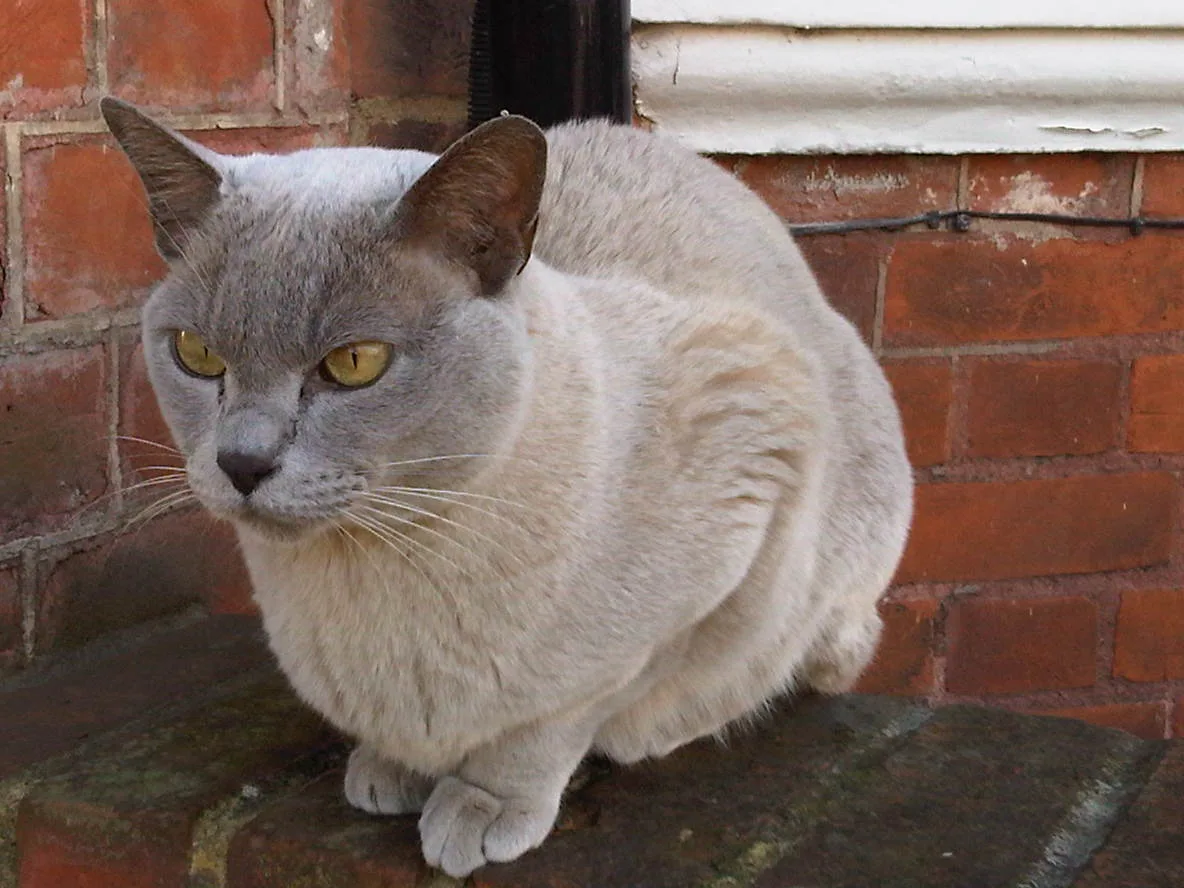
Buy a Burmese in London and a Burmese in Louisville, and you may come home with two noticeably different cats. The European Burmese is the elegant branch of the family: a slim, muscular cat with a wedge-shaped head, slanting golden eyes, and a satin coat in ten colours, not just the famous brown. The American type is rounder and stockier. Both are genuinely Burmese, and both trace back to a single cat.
What they share matters more than what divides them. European Burmese are famously people-oriented, playful well into adulthood, and talkative in a softer, sweeter voice than their Siamese ancestors. If you want a cat that is present for your whole day, not just the feeding parts, this is that cat.
Below: how one brown cat split into two types on two continents, an honest side-by-side comparison, the full colour list, what the health research actually says, and names that suit this cat’s brand of elegance.
History
📖 Breed History
Every Burmese, European or American, descends from Wong Mau, a walnut-brown female brought from Burma to San Francisco in 1930 by Dr Joseph Thompson. Thompson bred her with Tai Mau, a seal point Siamese, and the dark brown kittens from those litters founded the breed. The CFA recognised the Burmese in 1936, suspended recognition in 1947 after years of heavy Siamese outcrossing muddied the type, and reinstated it in 1954. Burmese cats reached Britain after the Second World War, and by 1952 British breeders had produced three true generations and won recognition from the GCCF. The split into two types happened from there.
The divergence was about taste. American breeders selected for an increasingly round, compact cat: broad head, round eyes, short muzzle. British breeders kept the slimmer, longer-bodied cat closer to the early imports: what the GCCF standard calls an elegant cat of foreign type. British breeders, working from a small gene pool, also outcrossed to Siamese, and those crosses changed the breed’s colour story: the first blue Burmese was born in Britain in 1955, and over the following decades red-point Siamese crosses brought in the red, cream, and tortoiseshell cats the American standard never accepted.
The two populations were then kept deliberately apart. The GCCF banned the registration of Burmese imported from the United States to preserve the traditional bloodlines, and the CFA dropped the European-style “traditional” Burmese from its breed in the 1980s, keeping only the American type. That is why the registry picture still confuses buyers: most registries use the single name “Burmese” for both types but judge them to different standards, and those that do distinguish the two call the British type the European Burmese. Neither branch has a better claim to the name; both were simply bred, on opposite sides of the Atlantic, toward two different ideas of a beautiful cat. Our Burmese breed profile covers the American type and the shared family tree, which also produced the Tonkinese from Wong Mau’s own Siamese-cross kittens.
European vs American Burmese
Side by side, the differences are all in the blueprint, not the personality. Temperament is essentially identical in the two types. What changed is the shape of the cat and the colours on the show bench.
| European Burmese | American Burmese | |
|---|---|---|
| Head | Short wedge, wide at the cheeks, tapering to a blunt muzzle | Broad and rounded, with a short muzzle and a distinct break |
| Eyes | Almond-shaped; the top line slants down toward the nose | Round and set wide apart |
| Ears | Medium to large, broad at the base, tilted slightly forward, continuing the lines of the wedge | Medium, set well apart, rounded at the tips |
| Body | Medium and elegant but hard-muscled; longer legs ending in neat oval paws | Noticeably stockier and more compact, heavier-boned, with rounded paws |
| Colours | Ten under the GCCF: brown, blue, chocolate, lilac, red and cream, plus tortoiseshell versions of brown, chocolate, blue and lilac | Four under the CFA: sable, blue, champagne (chocolate) and platinum (lilac) |
| Registries | The standard in Britain (GCCF) and Europe (FIFe), registered simply as “Burmese”; the type the CFA dropped in the 1980s | The CFA standard in the United States; US imports were barred from GCCF registration to protect the traditional lines |
| Genetic notes | Shares the Burmese-family watch-list (hypokalaemia and GM2 gangliosidosis, covered under Health) | Shares the same watch-list, plus the “head defect” linked to the extreme contemporary head; not a European-line issue |
One honest simplification: these are tendencies in two breed standards, not two species. Individual cats vary, and pet-quality cats of either type may not show every trait. Choose the look you prefer, then judge the breeder on health testing, not on which side of the Atlantic their cats lean toward.
Appearance
The European Burmese is a medium-sized cat, typically 9 to 13 lb (4 to 6 kg), but pick one up and it feels heavier than it looks: dense muscle and solid bone in a frame with no wasted space. Owners describe the breed as “a brick wrapped in silk”; the European version simply wraps the brick in a slightly longer parcel, with longer legs, neat oval paws, and a medium tail tapering toward the tip.
The head is the easiest way to tell the types apart. Where the American cat is round everywhere, the European head is a short wedge: wide at the cheekbones, narrowing to a blunt muzzle, with a firm chin. The eyes are moderately almond-shaped, set well apart, with the upper line slanting toward the nose; that slant gives the breed its thoughtful, slightly imperious expression. Gold and yellow are the classic eye colours, with green also allowed under the British standard. Ears are medium to large, wide at the base, tilting slightly forward, as if the cat is listening. It usually is.
The coat is the same in both types and it is superb: very short, fine, and glossy, lying close with a satin-like finish and almost no undercoat. All Burmese colours are sepia-toned, solid and even, shading lighter on the underparts; kittens are born pale and darken as they mature. The European palette is the wide one: brown (the original rich dark brown, called sable in the US), chocolate, blue, lilac, red, and cream, plus those four darker colours in tortoiseshell. If the tortie pattern has your heart, browse our tortoiseshell cat names before the kitten comes home. In overall silhouette, the European Burmese sits between the cobby American type and a true Oriental Shorthair: foreign in shape, but with more muscle and moderation than the oriental breeds.
Temperament & Personality
Burmese of both types are the breed people describe as dog-like, and the European is no exception. These cats form intense attachments, follow their humans around the house, greet visitors at the door, and insert themselves into whatever is happening: laptop work, cooking, reading, showering. Many learn fetch and tag, carry toys in their mouths, and keep a kittenish energy well into adulthood. They are intelligent cats who get bored, and a bored Burmese invents its own entertainment, usually at the expense of a cupboard door or your sleep schedule.
They are talkative, too, but with a catch Siamese owners will appreciate. The Burmese voice is persistent yet softer and sweeter than the Siamese foghorn it descends from: expect conversation and the occasional firmly stated opinion, at a volume a household can live with. What they are not is independent. European Burmese do not suit homes that are empty all day; they want company, human or feline, and breeders often recommend keeping two. With children and dogs they are generally excellent, provided introductions are done properly.
Care & Grooming
This is one of the lowest-maintenance coats in the pedigree world. A weekly once-over with a soft brush, or stroking with a damp hand, removes loose hair and keeps the satin finish polished; shedding is low, baths are rarely needed, and there is no undercoat to mat. Round it out with regular nail trims, ear checks, and attention to teeth, since no breed is exempt from dental disease.
The real care work is everything else. Feed a quality diet and measure it: this muscular cat should feel solid, not soft, and weight control matters doubly because of the diabetes findings covered below. Keep the mind busy with daily play, puzzle feeders, perches, and things to climb. And treat company as a care requirement, not a bonus: keep the cat indoors or supervised outside, and if your household is out at work all day, a second cat is close to a necessity with this breed.
Health
The European Burmese is generally a hardy, long-lived cat. In a UK study of veterinary records, Burmese averaged 14.4 years, the highest figure of any breed in that study, and living into the late teens is common. Like every pedigree breed, though, it has a known watch-list, and a good breeder will talk about it openly.
Diabetes. Burmese appear in the veterinary literature as a breed with higher-than-average diabetes rates: a 2016 study of English practice records found diabetes in 2.27% of Burmese compared with 0.58% of cats overall, and a 2009 Australian study reported similarly elevated figures. The UK and Australian populations are European-type Burmese, so this finding is directly relevant here: keep the cat lean, and raise weight gain or increased thirst with your vet promptly.
Hypokalaemia (Burmese hypokalaemia). An inherited, autosomal recessive condition of Burmese and closely related breeds, traced in 2012 to a mutation in the WNK4 gene. Affected cats have episodes of low blood potassium that cause muscle weakness, often a drooping head. It is not usually fatal and can generally be managed with potassium supplementation under veterinary care, and a DNA test exists, so ask any breeder whether their cats are tested.
GM2 gangliosidosis. The Burmese is one of the breeds most associated with this rare autosomal recessive storage disease, caused by a mutation in the HEXB gene, in which affected kittens develop progressive neurological signs. A DNA test is available, and responsible breeders screen for it; it is a question worth asking directly.
Two smaller notes. Certain UK bloodlines have been linked to feline orofacial pain syndrome, a painful teething-related condition in kittens that typically resolves as the teeth finish erupting. And the much-discussed “Burmese head defect” belongs to the American side of the family: it is tied to the extreme rounded head of contemporary American lines, which the European standard does not select for. As always, these are general, widely published breed notes, not medical advice; your vet is the authority on your cat.
Living With a European Burmese
A European Burmese fits households that want a cat involved in daily life: families with children, couples, and singles who are home a lot. It is a poor match for an empty flat and a nine-to-nine job, not because it is fragile but because it is social to its bones and will be miserable, and then destructive, alone. Apartment living is fine; these cats care about people, not acreage. Expect a shadow in the kitchen, a supervisor on the desk, and a cat that still wants a game of fetch at twelve years old. If that sounds like a lot of cat, it is. It is also exactly why owners of the breed rarely switch to any other. New to cats altogether? Start with our new cat owner starter kit, then come back and pick a name below.
Best Names for a European Burmese
An elegant cat with a wider wardrobe than its American cousin deserves names in the same spirit: European classics and gemstones. Every meaning below comes from our name database; nothing is invented. For more, browse gemstone cat names, French cat names, and royal cat names.
- Sable, from the French, meaning “black”; also what American breeders call the breed’s original rich brown coat, known in Europe simply as brown.
- Bijou, French for “jewel,” for a small cat with a polished-gem shine.
- Margot, French, meaning “pearl”; Parisian, poised, and easy to call.
- Opal, meaning “precious stone”; a soft, luminous name for a cat whose coat shifts tone in the light.
- Jade, the green gemstone; the obvious pick for one of the green-eyed Europeans.
- Amber, a descriptive pick for the classic golden-eyed cats, named for the warm fossil resin of the same colour.
- Aurelia, Latin, meaning “golden,” with Roman-empress grandeur for a very self-assured cat.
- Colette, French, meaning “victory of the people”; chic, literary, and slightly mischievous.
- Vivienne, Latin, meaning “alive,” for a breed that stays kittenish for years.
- Esme, French, meaning “esteemed, beloved”: less a prediction than a certainty with this breed.
- Lucien, French, meaning “light”; a soft, elegant name for a tom who follows the sun around the house.
- Leopold, German, meaning “bold people”; old-European grandeur for a cat with total confidence.
Frequently Asked Questions
What is the difference between a European Burmese and an American Burmese?
The European type is slimmer and more elegant, with a wedge-shaped head, slanting almond eyes, and ten recognised colours including red, cream, and tortoiseshell. The American type is stockier and rounder, with round eyes and four CFA colours. Temperament is essentially the same in both. The comparison table above breaks it down trait by trait.
Is the European Burmese a separate breed?
It depends on the registry, which is why the answer confuses people. In Britain and Europe the breed is registered simply as “Burmese” but judged to the European standard; the CFA in the US recognises only the American type, having dropped the European-style cat in the 1980s. Both types descend from the same cat, Wong Mau: two branches of one breed rather than two breeds.
What colours do European Burmese cats come in?
Ten under the GCCF standard: solid brown, chocolate, blue, lilac, red, and cream, plus tortoiseshell versions of brown, chocolate, blue, and lilac. All are sepia-toned, shading lighter on the underparts, and kittens are born pale before the colour deepens. That is six more colours than the CFA accepts in the American Burmese, where only sable, blue, champagne, and platinum are recognised.
How long do European Burmese cats live?
Typically in the 10 to 17 year range, with many reaching their late teens. In a UK study of veterinary records, Burmese averaged 14.4 years, the highest average of any breed in that study, so weight control and regular vet visits give this breed a realistic shot at a very long life.
Are European Burmese cats very vocal?
They are persistent talkers, like their Siamese ancestors, but the voice is noticeably softer and sweeter. Expect regular conversation and firmly expressed opinions rather than full-volume demands. If you want a silent cat, look elsewhere; if you want a chatty one you can live with, this breed is a good compromise.
Do European Burmese cats need much grooming?
No. The coat is very short, fine, and satiny, with minimal shedding and no undercoat to tangle. A weekly once-over with a soft brush, or a few strokes with a damp hand, is enough to keep it glossy. Add routine nail trims, ear checks, and dental care, and the grooming list is complete.
By Brianna Baxter
Featured photo: Photo: Emőke Dénes, CC BY-SA 4.0, via Wikimedia Commons.