
Kanaani Cat Breed Guide: Israel’s Wildcat-Look Cat
The Kanaani is the cat Israel built to look like its own wildcat. It is an experimental breed created in Jerusalem in the 1990s by the German-Israeli artist Doris Pollatschek, who crossed a rescued African wildcat (Felis lybica) with a local domestic stray and bred on from that hybrid foundation toward the look of the region’s native wild steppe cat. Even the name points home: Kanaani is Hebrew for the Canaanite cat, after Canaan, the ancient name for the land that is now Israel and its neighbours.
One honest note first, because most short write-ups blur it: only one major registry, the World Cat Federation (WCF), recognises the Kanaani, as an experimental breed with a written standard. There is no big breeder network behind it, and the documented numbers are tiny, a 2020s revival programme reports just three registered cats. This page, part of our cat breed library, sticks to the documented record and says plainly where it runs out.
History: An Artist, a Wildcat and a New Breed
📖 Breed History
The Kanaani began in Jerusalem in the 1990s with Doris Pollatschek, a German-Israeli artist who is considered the breed’s founder. Her foundation stock came from a hybrid cross between a rescued African wildcat and a local domestic stray, and the breeding goal was a domestic cat that resembled the wild steppe cat native to the region. The breed was named after Canaan, and development later continued in Germany.
The foundation cross was only the start. Breed accounts describe domestic cats folded into the programme alongside the wildcat hybrids, Catster’s breed history names the Abyssinian and the Bengal among them, and Messybeast’s specialist breed list records that outcrosses to spotted Bengals and spotted Oriental Shorthairs were permitted until 2005, which accounts for the slightly oriental look of some early cats. The model was specific: the spotted wildcat subspecies Felis lybica gordonii, with a domestic temperament.
Formal recognition came from one registry only. The World Cat Federation recognised the Kanaani in 2008, making it, as Wikipedia puts it, the first national cat breed established in Israel, and its standard, updated in 2010, closed the book: kittens born after 1 January 2008 count as Kanaani only if both parents are Kanaani. No new outcrosses since. The International Cat Association (TICA) allows the breed to be registered for recording purposes only; that is paperwork, not recognition.
The breed then nearly disappeared. Its modern chapter is a revival: in the 2020s a Brooklyn-based WCF breeder, Rabbi Mikhail Salita, began a programme to bring the Kanaani back, working from cats bred in Jerusalem by Lyudmila Vlasova. The revival’s foundation pair, Haifa and Arbuz, produced a daughter, Laila, and Wikipedia reports Haifa as one of only three registered Kanaani cats in the world. Much of the revival record comes from the programme’s own accounts, reported in the press in 2026, so read the numbers as reported rather than audited.
Appearance: Spotted, Ticked and Built Like an Athlete
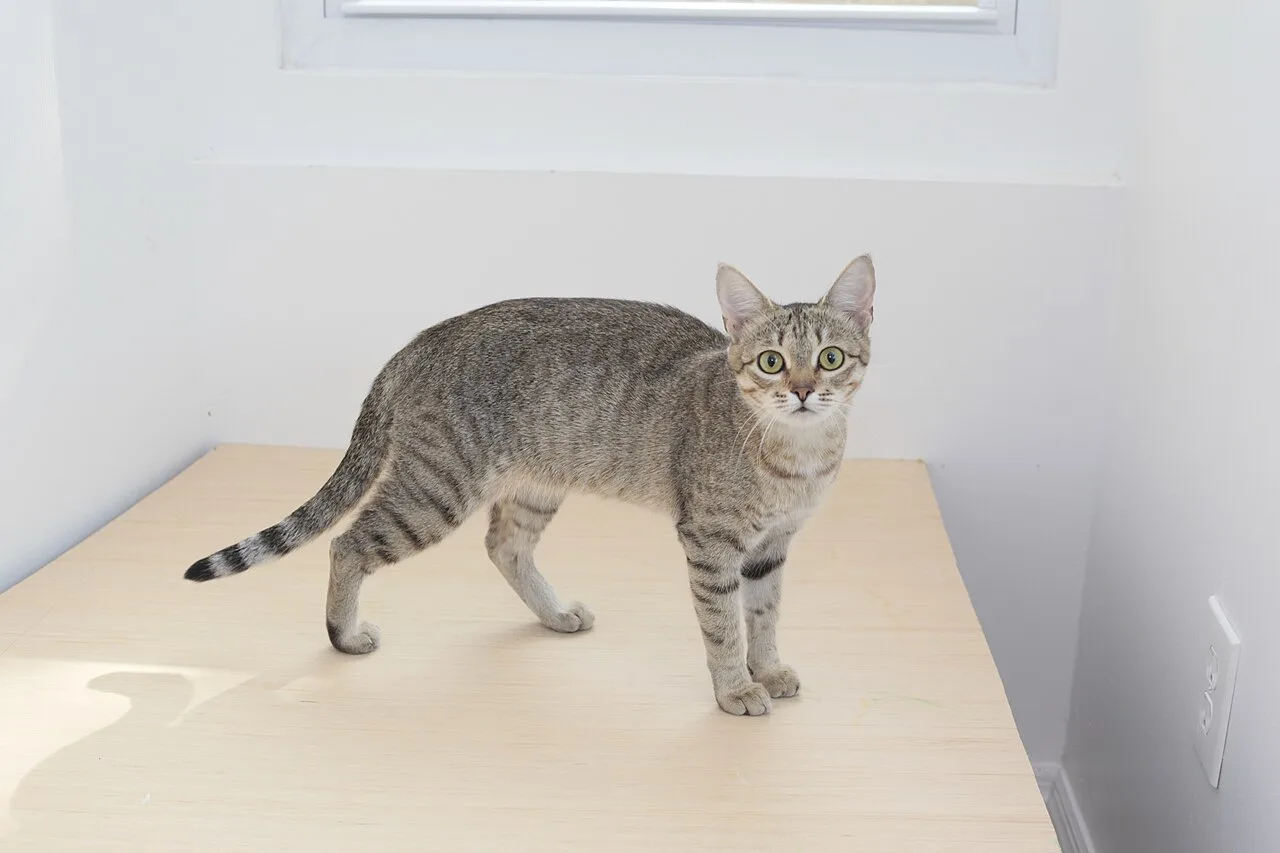
Almost everything that can be said with confidence about the Kanaani’s looks comes from one document, the WCF standard. The body is medium to large, slender, muscular and athletic yet elegant, on long slender legs with oval paws; Messybeast adds that longer hind legs give a slightly raised rump. The tail is long, rather thick at the base and tapering, and ringed in the pattern descriptions.
The head is a broad triangle on a long, slender neck: flat skull, visible cheekbones, a straight, well-defined nose with no stop, a slightly flattened muzzle and a firm chin. The ears are a signature, large, broad at the base and tapering, erect and wide-set, with tufts desired and a thumbprint marking on the back. The eyes are large, almond-shaped and slightly oblique; in adults the standard requires green, yellow-green tolerated.
The coat is short, close-lying and rather coarse, with little undercoat, the standard is explicit that it is not soft like a Siamese’s. Each hair shows clear ticking in both ground colour and pattern, but the ticking must never swallow the spots. On a beige-to-cinnamon ground, the accepted patterns are spotted and marbled, in seal, chocolate and cinnamon. Messybeast adds the placement detail, spots aligned horizontally or diagonally, leg barring, chest necklaces, a light beige spotted belly, and notes classic tabby is also permitted. Silver is not permitted at all, and an oriental appearance is a listed fault, despite the outcross history.
Size needs the same honesty: the standard gives no weight, only “medium to large”. The figures in pet guides, 7 to 12 pounds is common, have no registry or study behind them; treat them as unverified.
Part Wildcat? What the Foundation Cross Actually Means
In ancestry, yes. The Kanaani is a genuine hybrid-foundation breed: its founding cross was a domestic cat with an African wildcat, and the breed was developed from selectively bred hybrid stock. That is its documented origin, not a marketing line, and it is why the breed is usually classed among the hybrid breeds.
In the modern, registered sense, it is a closed domestic breed. Since the WCF’s post-2008 rule, a registered Kanaani is bred only from two Kanaani parents, so today’s cats stand many generations from the founding wildcat. Wikipedia describes the breed as fully domestic, retaining visible similarities to the local wild population. “Part wildcat” describes where the Kanaani came from; it does not make a pet kitten half wild.
One legal footnote shows how recent that hybrid origin is: in the Netherlands and Belgium (Flanders and Brussels), official pet lists make it illegal to own or breed African wildcats and their early-generation hybrid offspring, the Kanaani’s F1, F4 generations included. Anyone considering a hybrid breed should check local rules first; they vary sharply by country and generation.
Temperament & Personality: Active, Affectionate, Self-Directed
The description that repeats across the breed references is consistent: the Kanaani is described as active, energetic, playful and affectionate, whilst also displaying a marked degree of independence, and it is regarded as an excellent hunter. That pairing, people-oriented but self-directed, runs through everything written about the breed.
Pet-guide accounts add colour, and should be read as reported experience from very few cats rather than breed-club data. Catster describes a high prey drive, cats that are affectionate without being lap cats, noisy kittens and chatty adults, and clever escape artists that learn cabinets and doors; it stresses early socialisation as crucial. None of that is implausible for an athletic hybrid-foundation breed, but no temperament survey stands behind it.
So the safe baseline the record supports is an energetic, intelligent hunter that bonds with its household and keeps its own counsel, a cat for owners who enjoy an animal with its own agenda. Anything more specific, children, dogs, flat living, is individual-cat territory the literature does not settle.
Care & Grooming
There is no Kanaani care literature as such, the breed has never had the breeder base to produce one, so care is the ordinary short-coat plan, weighted toward activity. The coat asks little: short, close-lying, minimal undercoat, no more than an occasional brush and no routine bathing.
The real demand is outlets for the documented temperament. An athletic cat with a strong hunting drive needs daily interactive play, climbing territory and puzzle feeding, and a home secured against a cat reported to be good at opening things. Setting up for a first cat? Our new cat owner starter kit covers what to have ready before arrival day.
Health Notes
The honest health section for this breed is short, because the data does not exist. No veterinary literature documents a breed-specific disease list for the Kanaani, no registry runs a screening programme for it, and no lifespan figure appears in any source this page can stand behind, the 12 to 15 years printed in pet guides is repeated from guide to guide without a study behind it. Pet guides sometimes call the breed “very healthy”, usually reasoning from its hybrid origin; that is speculation, not evidence, and this page will not repeat it as fact.
What can fairly be said is narrower. The population is tiny and closed to outcrosses since 2008, which makes genetic diversity a legitimate open question for the revival programme, raised here as an unknown, not a diagnosis. For an individual cat, the plan is standard: preventive veterinary care, vaccinations and parasite control kept current, prompt attention when something changes. These notes are general published information, not medical advice; your vet is the authority on your cat.
Living With a Kanaani Cat
This is a cat for active, experienced owners, that is how the pet guides consistently frame it, with the space and time to feed an athletic, hunting-minded animal’s day. Expect engagement, noise and problem-solving; do not expect a lap ornament.
Finding one is the hardest part, and the plainest answer on this page. The revival programme is the only documented active breeding, the reported registered population is three cats, and there is no breeder network to apply to. Kanaanis are, in practical terms, unavailable as pets, which also means being deeply sceptical of anyone offering “Kanaani” kittens: most registries cannot verify the breed at all, and in some countries early-generation hybrids are restricted by law.
Best Names for a Kanaani Cat
Names with Hebrew roots from our name database, plus desert and wildcat picks, with meanings exactly as recorded there. From the breed’s homeland: Jericho, “city of the moon,” an ancient city of the Jordan valley; Zion, “highest point”; Salem, “complete, safe, peaceful”; and Jordan itself, “flowing down,” for the river. Ari records “lion” and Zev “wolf,” two short, strong wild names; Talia is “heavenly dew” and Liora “my light.” From the desert: Sahara, presented from our database’s inspiration notes as “the desert queen” rather than a recorded meaning, and Dune, from the note “wind-shaped desert sand.” Lynx records simply “lynx,” the tuft-eared wildcat, and Gazelle is “gazelle,” the desert runner. Browse more in our around the world cat names collection.
Frequently Asked Questions
Is the Kanaani part wildcat?
In ancestry, yes; in daily life, no. The foundation stock was a deliberate hybrid cross between a rescued African wildcat (Felis lybica) and a local domestic stray, selectively bred on from there. But since 2008 the WCF has only registered kittens born to two Kanaani parents, so a modern Kanaani is a fully domestic cat many generations removed from any wildcat, one that keeps the wildcat’s looks, not a half-wild pet.
Is the Kanaani cat recognized?
Only by the World Cat Federation (WCF), which recognised it in 2008 as an experimental breed and publishes its standard (updated 2010). It is the only major registry that recognises the Kanaani. TICA allows registration for recording purposes only, which is not recognition, and CFA, FIFe and GCCF do not recognise the breed. Claims of FIFe recognition that circulate online are not supported by any registry source.
How many Kanaani cats are there?
Nobody publishes a census. The documented figure comes from the revival programme: Wikipedia reports its queen Haifa as one of only three registered Kanaani cats in the world, alongside the tom Arbuz and their daughter Laila. Unregistered cats of Kanaani type may survive in Israel or Germany from the original breeding, but nothing documents them, so “three registered cats, total unknown” is the honest answer.
How big do Kanaani cats get, and how long do they live?
The WCF standard describes a medium-to-large, slender, muscular cat but sets no weight, and no study or registry publishes a Kanaani lifespan. The numbers in pet guides, weights around 7 to 12 pounds, lifespans of 12 to 15 years, are repeated without a source behind them. On the present record, both are undocumented.
Are Kanaani cats good pets?
The accounts describe an active, affectionate but independent cat with a strong prey drive, engaging company for experienced owners with space and time for play, and not a lap cat. In practice the question is mostly academic: with a reported three registered cats in one revival programme, Kanaanis are not available as pets, and any seller claiming otherwise deserves real scepticism.
Why is so little known about the Kanaani cat?
Because almost everything about it is small-scale: one founder, one registry, an experimental status, and a population that dwindled close to extinction. No breed club, veterinary literature or registry census ever built up around it. What survives is one primary document, the WCF standard, a handful of secondary accounts, and the revival programme’s own reports.
By Brianna Baxter
Featured photo: Photo: KanaaniStudies, CC BY-SA 4.0, via Wikimedia Commons.