
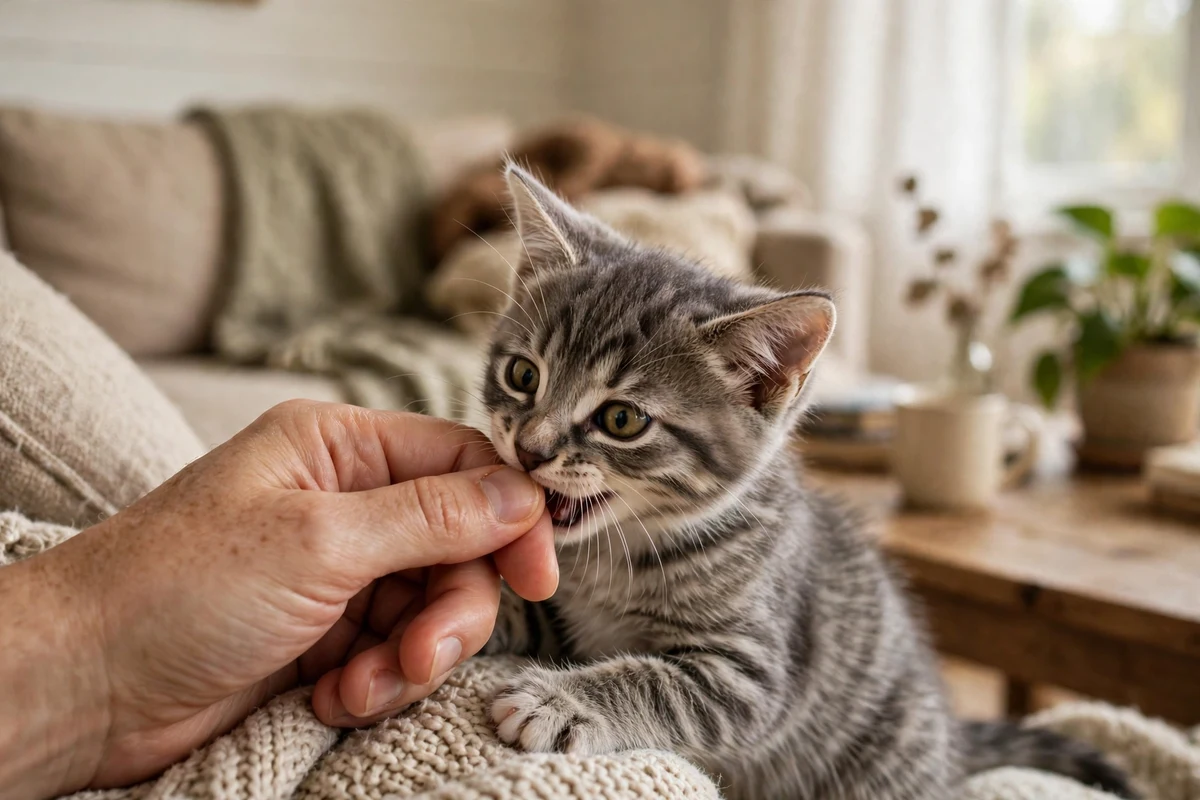
Why Does My Cat Bite Me?
If you are asking why does my cat bite me, start with the simplest reading: biting is communication, not spite. A cat that bites is usually saying that an interaction has gone on too long, that a game has turned into a hunt, that it feels cornered, or that something hurts. The bite itself is only half the message. The pressure, the body language just before it, and what was happening in the room complete it.
This guide helps you sort those messages out. It gives you a bite decoder, a way to find your cat’s petting limit, separate fixes for ankles, hands, and face nips, and a calm plan for the moments right after a bite. It does not diagnose your cat. Where pain or a sudden change is involved, the right next step is a vet visit, not a guess from a list.
The Short Answer: Biting Is Communication, Not Spite
Cats do not have many ways to end an interaction politely. They cannot say that stroking has stopped feeling good, that a hand has started to feel like prey, or that a stranger in the room has made them uneasy. Teeth are blunt, direct, and hard to ignore, so they get used.
That does not mean every bite means the same thing, and it does not mean a biting cat is a bad cat. A gentle nip during grooming play, a sudden bite after a long petting session, and a hard bite from a frightened cat are different behaviours with different fixes. Treating them all as aggression, or all as affection, is where most owners go wrong.
Reader’s Digest, quoting veterinarians, puts bites into three broad buckets: a cat that is annoyed, overstimulated, or threatened; a cat that is playing; and a cat that is trying to get attention. Those buckets are a useful starting point, but this guide goes further, because the fix for a play bite is not the fix for a fear bite, and neither is the fix for a bite linked to pain.
The Bite Decoder: What Kind of Bite Is This
Use this decoder before you decide what to change. Ask four questions about the last bite: how hard was it, did it break skin, what did the body look like just before, and what had just happened. The table below sets out the five common types. The sections after it explain each one in more detail.
| Bite type | Pressure and skin | Body language | Usual trigger | First response |
|---|---|---|---|---|
| Gentle nip | Soft, usually does not break skin | Relaxed, may follow licking or grooming | Affection, grooming, or a mild request to change the interaction | Pause, watch the body, and redirect calmly if it becomes unwanted |
| Sudden petting bite | Light to hard, may or may not break skin | Freeze, ears back, tense body, tail flick | Petting that passed the cat’s tolerance limit | Stop petting at once, say the session is done, and give space |
| Play bite and arm grab | Harder and faster, may leave marks | Crouch, focus on a moving hand or foot, bunny kick with back legs | Hunting play aimed at a person instead of a toy | Go still, then redirect to a toy once the cat lets go |
| Fear bite | Hard, often breaks skin | Crouch low, flat ears, wide eyes, puffed fur, hissing | Feeling trapped, startled, or threatened, with no escape route | Back away, leave an escape route, and do not pursue |
| Redirected bite | Hard and sudden | Aroused or tense after seeing another cat, a loud noise, or another trigger | A trigger you did not cause, discharged onto the nearest person | Do not approach, wait for calm, and remove the trigger if you safely can |
| Pain linked bite | Varies, often new or aimed at one spot | Flinch, tense, or pull away when one area is touched | Discomfort when a sore area is petted or moved | Stop touching that area and book a vet visit |
One honest note on wording, before the detail. PetMD calls gentle nips cat love bites, and notes that they can signal affection, overstimulation, play, attention seeking, or frustration. Other behaviour writers argue that petting induced aggression is the more accurate label for many of those nips, because the bite often means the petting should stop. Both views are worth holding at once. A soft nip is not automatically a declaration of love, and it is not automatically aggression either. Context decides.
The gentle nip that does not break skin
This is the bite most owners describe as a love bite. PetMD describes it as a cat gently placing its mouth on a person, usually without breaking skin, often during petting when the cat looks relaxed. It may follow licking, it may come with purring or kneading, and it may be a request to end a long session or, in PetMD’s words, a plea for longer affection. The ambiguity is the point. If the body stays soft and the nip stays soft, it is a low urgency signal. If the pressure rises, or the body tenses, treat it as an early warning, not as affection, and end the session calmly.
The sudden petting bite
This is the classic petting induced aggression pattern. VCA Canada describes cats that look perfectly comfortable in a lap and then suddenly turn and bite, a pattern sometimes called “do not pet me” aggression. VCA Canada explains that what appears to happen is that the cat enjoys the interaction for a while, but at some point the sensation of being stroked is no longer pleasant, and instead of walking away the cat bites. Some cats deliver a light bite that does not even cause a scratch, while others bite hard enough to cause a puncture wound. The full petting section later in this guide deals with this type in detail, because it has the clearest training fix: find the limit and stop before it.
The play bite and the arm grab with bunny kick
Play bites are hunting behaviour aimed at the wrong target. Cats Protection describes hugging an arm or leg and biting while bunny kicking with the back legs as a classic hunting move. When a cat catches large prey, it grasps with the front legs and bites while kicking with the back legs, and a cat that does this to your arm is misdirecting that sequence onto you. Play bites are often faster and less warned than petting bites, and they are the type most often taught by accident, when hands and feet are used as toys in kittenhood. Cats Protection notes that kittens have a socialisation period of 2 to 7 weeks of age, and that kittens encouraged to play with fingers and toes in that period may keep treating hands and feet as toys as adults, when teeth and claws are much sharper.
The fear bite
A fearful cat usually prefers to run and hide, Cats Protection notes, and bites as a last resort when it feels trapped and unable to escape. The warning signs are usually visible first: hissing, crouching low, flat ears, wide eyes, an arched back, a tense tail, whiskers forward, and puffed fur. A fear bite is not a training problem in the first instance. It is a safety and environment problem. The cat needs distance, an escape route, and time, and the household needs to work out what made escape feel impossible.
The redirected bite after a trigger you did not cause
Redirected aggression in cats happens when a cat is aroused by something it cannot reach or confront, such as another cat seen through a window or a sudden loud noise, and then bites the nearest person instead. The person bitten did nothing wrong, and the cat is often still tense after the bite. The key point is timing. Do not try to comfort, pick up, or reason with a redirected cat in the minutes after the trigger. Wait for the arousal to fall, and deal with the trigger separately, for example by blocking the window view or reducing the noise, rather than by punishing the bite.
The pain linked bite that is new or aimed at one spot
A bite that is new, sudden, or aimed at one spot deserves a different response from a long standing play habit. VCA Canada advises that pain can trigger an aggressive response to being touched, and should be considered if bites mainly occur when one specific area of the body is petted. A vet exam, in VCA Canada’s account, should cover ears, teeth, and gums for infection or inflammation, and joints, limbs, neck, and back for discomfort, along with inflamed skin, which can increase sensitivity to touch. This guide does not turn that list into a diagnosis. It is a prompt to ask a vet to check, not a way for a reader to decide which condition a cat has.
Why Your Cat Bites While You Pet Them
Petting bites are the most common complaint in this guide’s topic, and the most fixable, because they follow a pattern you can observe. The question why does my cat bite me when I pet him has a practical answer in most cases: the session passed a limit that was invisible until the bite. Finding that limit, and respecting it, changes the pattern faster than any single technique.
The petting threshold, and how to find yours
VCA Canada describes the core method plainly: learn how many strokes are consistently tolerated and always stay below that threshold. The goal in each training session is to stop petting while the cat is calm, then say “All done” and reward the cat with a small, tasty treat. Over time, with additional training, it may be possible to increase the length and frequency of sessions, but the first step is recognising the threshold, not pushing past it.
Turn that into a 3 day observation test. Keep sessions short, count strokes, and stop at the first warning sign, not after the bite. Note the number, the place you were stroking, and the time of day. If your cat regularly tolerates about 8 strokes on the back before the tail starts to flick, your working limit is below 8, not at 8. End the session there, on a calm note, for a few days. Log the numbers rather than relying on memory, because memory smooths over the early signs and remembers only the bite.
Two cautions belong here. First, a threshold is not a fixed number for life. Tiredness, a new stressor, or a sore spot can lower it on a given day, so the log is a guide, not a rule to enforce. Second, do not run the test as a provocation. If you already know the warning sign, stop there. The point is to end sessions before the bite, not to collect bites as data.
Warning signs to stop at, not after
VCA Canada lists the signs to watch for: freezing, pulling ears back, tensing the body, and flicking the tail. PetMD adds muscle tension, a twitching tail, and dilated pupils to the same early warning set. Dial A Vet’s short answer adds twitching skin, ears laid back, and a swinging tail. Taken together, the list is consistent: the body tightens, the skin or tail moves, and the cat stops looking relaxed, before the teeth appear.
Practice spotting the earliest sign for your cat, because cats differ. One cat’s first sign is a tail flick. Another’s is a skin ripple across the back. Another’s is a head turn to watch your hand. When you see it, stop the interaction immediately, as VCA Canada advises, and offer a calm exit, such as inviting the cat to leave your lap for a treat. Do not stroke through the warning to see if it was real. That teaches the cat that warnings do not work, and the next warning will be a bite.
The tail is often the earliest warning, and our guide to cat tail language shows how a flick, a lash, and a puffed tail differ.
Places most cats prefer, and places that often end the session
Most cats prefer short, predictable strokes on the head, cheeks, and chin, and many dislike long strokes along the back and sides, or any handling of the belly. VCA Canada notes that some cats tolerate light scratching around the neck and chin but will bite if you attempt longer strokes, particularly along the back and sides. Cats Protection adds that most cats do not like having their belly rubbed, even if they roll over and show it to you, and suggests starting with gentle strokes, head scratches, and chin rubs, and watching what your cat responds to.
Use that as a starting map, not as a guarantee for your cat. Learn which areas your own cat resists, in the same way you learned the stroke count. If the back is a short session area and the chin is a long session area, respect that split instead of trying to even it out. A cat that rolls over is often showing trust or inviting a different kind of interaction, not asking for a belly rub, so do not treat an exposed belly as permission.
The lap trap: sitting with you is not always asking to be stroked
Two misreadings cause a large share of petting bites, and VCA Canada names both. A cat rubbing its cheek on a person’s leg may not be requesting petting; it may be covering the person with a familiar scent from cheek glands. A cat jumping onto a lap does not necessarily want to be stroked; for some cats petting disrupts their comfort rather than providing a pleasant experience. The cat may simply want warmth, height, company, or a safe resting place.
The practical fix is to separate companionship from petting. Let the cat sit without stroking, and see whether it stays. If it stays, it wanted company. If it asks for strokes by nudging your hand or leaning in, you have a clearer invitation. If it walks away when you start stroking, believe that answer. Enjoying a lap cat without petting it is not a failed interaction. VCA Canada makes the same point at the end of its guide, suggesting play with wand toys and other enrichment as social interaction in its own right.
Why Your Cat Bites Your Ankles, Hands, or Face
Bites by location need different fixes, because the trigger is different in each place. A single “redirect to a toy” paragraph does not cover a cat that attacks moving feet, a cat that treats hands as prey, and a cat that nips a nose during grooming.
Ankle attacks while you walk past
If you are wondering why does my cat bite my ankles, the usual answer is hunting play aimed at moving targets. Feet in motion look like prey, especially to a young or underplayed cat, and a hallway or staircase gives the cat a perfect ambush spot. Encore Pet Food makes the same point in its bite guide, noting that moving feet can trigger a cat’s prey drive and make them targets for playful pounces.
Break the pattern in three places. First, give the hunt a proper target before the ambush hour, with a wand toy session that ends with a catch, so the energy is spent on a toy, not on your feet. Second, when an ankle attack starts, go still rather than jerking away, because sudden movement can read as prey escaping and deepen the bite, then move away slowly once the cat lets go. Third, keep a toy within reach in the ambush spot for a few days, so you can redirect at once instead of using your feet as the game. If ankle attacks continue despite regular play, or if they become hard and unprovoked, treat that as a vet or behaviourist question, not as a game to win.
Hands used as toys, and how to undo that lesson
Hands become toys when play uses them as targets. PetMD’s advice is direct: do not encourage your cat to play with any human body parts, including your hands. Cats Protection adds the kitten angle, noted above, that early hand play can teach a lasting lesson. Undoing it takes consistency from the whole household, which is why the household rule section later matters so much.
The undo method is simple but strict. Every person in the home stops using hands, fingers, and feet as play targets, without exception, and every play session uses a toy as the middleman, as Reader’s Digest’s veterinarian source puts it. When a hand bite starts during play, go still, wait for release, and then offer a toy. Reward gentle play, with a treat or a calm word, when the cat plays with paws on a toy rather than teeth on a hand. Expect the habit to fade over weeks, not days, because the cat has to learn that the old target no longer works and the new target always does.
New owners get bitten most often during the first weeks of hand play, so our new cat owner starter kit covers the routines that prevent hands becoming toys from the start.
Nose and face nips
Face and nose nips usually sit in one of three groups: grooming linked nips, attention seeking nips, and play nips when a face is close to a cat that is already aroused. Encore Pet Food notes that nose or hair biting may be grooming behaviour or an attention seeking move. The safest response is the same in all three groups: do not bring your face close to a cat that is tense, overstimulated, or in the middle of a play sequence, and do not punish a face nip by shouting or pushing the cat away, which can startle it into a harder bite.
If face nips happen when you lean in for a close greeting, change the greeting. Offer a hand to sniff at the cat’s level, let the cat come to you, and keep your face out of the cat’s immediate space until the cat is relaxed. If a face nip breaks skin, follow the wound section below and contact a doctor, because face bites need prompt medical attention on general wound care grounds, and this guide does not assess individual wounds.
Why Your Cat Licks You and Then Bites
Lick then bite is its own sequence, and it confuses owners because it starts affectionately. Cats Protection explains it directly: licking humans or other cats is usually a bonding exercise that helps cats share scent and feel good, but if it is accompanied by biting, the cat is probably overexcited or feeling playful. In other words, the lick is not a trick. The session crossed from grooming into overstimulation, and the bite is the signal that the line was crossed.
Respond to the sequence, not just the bite. When licking turns faster, or the body tenses, or the tail starts to move, end the session before the nip. Direct the excitement onto an appropriate toy, or leave the cat alone for a while to calm down, as Cats Protection suggests. Do not try to prolong the grooming phase by stroking through the change, because that is what turns a soft sequence into a bite.
If the nip always comes right after licking, that sequence has its own explanation, and our guide to why cats lick people walks through the grooming and bonding side of it. This guide owns the bite half: what the nip means, and how to stop the session before it.
Why Your Cat Bites You and Not Your Partner
The question why does my cat bite me and not my partner usually has a practical answer in interaction history, not in favouritism. Cats Protection lists four factors: the bitten person is around more and interacts with the cat more regularly; they have previously encouraged play with fingers and toes; they react more when bitten, and movement can excite the cat further; and they are more fidgety, moving fingers and toes around a lot, which can provoke attacks more than sitting still and calm.
Work through those factors honestly before concluding that the cat dislikes one person. Who feeds and plays most? Who used hands as toys in kittenhood? Who jumps, shouts, or pulls away fastest when bitten? Who sits with restless hands near the cat’s face? The answers usually point to a changeable habit, not a fixed preference. A fear based exception exists: if the cat is fearful of one person in particular, perhaps because that person is new in the home or has frightened the cat, Cats Protection notes the cat may bite that person as a last resort when it cannot escape. That case needs distance and a slower introduction, not more interaction.
The household fix follows from the diagnosis. The bitten person shortens sessions, stops hand play, and keeps hands still near the cat. The other person does not become the only safe person by avoiding the cat; both people use the same rules, so the cat learns one consistent lesson. If only one person changes, the cat will keep testing the old pattern with the other.
What to Do in the 30 Seconds After a Bite
The moments after a bite matter, because the wrong reaction can deepen the bite or teach the cat that biting works. Keep the protocol short and repeatable, so anyone in the household can follow it under stress.
What to do right away
First, go still. PetMD advises that if redirecting is not possible, you should freeze and allow the cat to disengage before calmly moving away, because sudden movements may trigger hunting instincts and lead to a deeper bite. Cats Protection gives the same first step in different words: stay as still and calm as possible, because sudden movements and loud noises will make the cat more scared, stressed, or overexcited and likely to bite again.
Second, remove yourself safely once the cat lets go. Walk away quietly and give the cat space and time to calm down, allowing it to run away and hide if it wants to, as Cats Protection advises. VCA Canada adds that some cats relax more quickly if they can access a quiet and private room, and that it can take minutes to hours for some cats to recover. Do not try to interact again until you and your cat are both relaxed.
Third, deal with the wound, and deal with it seriously. VCA Canada’s instruction is short and should be followed: take care of your wound and call your doctor, because cat bites can be serious. PetMD adds that if a bite penetrates the skin, the wound should be washed immediately and thoroughly with soap and water and prompt medical attention sought to prevent infection. Cats Protection adds the home care detail of cleaning a puncture with soap and warm water, patting it dry, and covering it with a clean dressing, and seeking medical help if the wound becomes infected or does not heal. This guide repeats those general steps only. It does not assess your wound, and a doctor should assess any bite that breaks skin, especially on the hand, face, or near a joint.
What never to do
Do not punish the cat. VCA Canada states this plainly: do not punish your cat, as this will create fear, and your cat may be trying to communicate discomfort. PetMD lists the same warning, noting that physical retaliation or punishment, such as scolding, grabbing, squirting with water, or striking the cat, can cause escalation to aggression. Reader’s Digest’s veterinarian source adds a related warning: never tease your cat, which can be frustrating and threatening.
Do not use the methods this brief explicitly rules out: no spraying, no scruffing, and no “alpha” framing. None of those teach a cat what to do instead of biting. They teach the cat that hands are unpredictable and frightening, which makes future bites more likely, not less. Do not chase a cat that has just bitten and run, do not corner it to apologise or to check the wound, and do not immediately offer food as a peace offering for a hard bite, because that can reward the sequence you want to stop.
When a human bite wound needs medical attention
This section is flagged for vet and medical review before publishing, and it is written at general information level only. Cat bites easily become infected, VCA Canada notes, and petting induced aggression must therefore be taken seriously. Reader’s Digest, quoting a veterinarian, puts the same point more strongly, noting that cat bites are dangerous because of bacteria present in a cat’s mouth, and that a bite that breaks skin must be cleaned at once with warm, soapy water, with a doctor seen for antibiotics in the source’s account, especially if there is bleeding or if the wound becomes red, swollen, or painful.
As a general guide, contact a doctor promptly for any bite that breaks skin, and seek care sooner for bites on the hand, face, or near a joint, for bites in a child or a person with a weakened immune system, and for any wound that becomes red, swollen, warm, painful, or slow to heal. VCA Canada notes that barriers and safe rooms may be needed to protect people at higher risk of injury or complications, such as a young child or someone with a weakened immune system in the household. If you are in one of those groups, do not rely on this guide to judge risk. Get medical advice, and discuss a household safety plan with your vet and your doctor.
How to Reduce Biting Over the Next Two Weeks
A two week plan works better than a single technique, because biting is usually a pattern, not a single event. Keep the plan to three habits, and keep them consistent across the household.
Short sessions that end while your cat is still calm
Use the threshold log from the petting section, and end every session below the limit, with the “All done” cue and a treat or toy reward that VCA Canada describes. Cats Protection’s version of the same habit is to keep play and petting sessions short, lasting a couple of minutes at a time, and to step away when the cat starts to become overexcited. The point is not to ration affection. It is to make calm endings the normal ending, so the cat does not need a bite to end a session.
Play that gives the hunt a proper target
Give the hunt a target every day, before the usual bite hour. Use wand toys, kicker toys, and puzzle feeders, all of which Cats Protection lists as appropriate outlets for hunting behaviour, so the cat can stalk, catch, and bunny kick something that is not a person. End play with a catch, then a calm wind down, rather than stopping suddenly while the cat is still highly aroused. PetMD adds food puzzles and enrichment as part of the same picture, noting that engaging activities can help stop love bites from becoming a habit.
Play sessions also help with the attention seeking side of biting. Reader’s Digest’s veterinarian source notes that carving time out of the day to play, checking that the litter box is clean, and making sure food and water are available can help minimise biting driven by an unmet need. Meet the need on a schedule, and the bite stops being the most reliable way to get it met.
One rule for the whole household
Pick one set of rules and write it down where everyone can see it: no hands or feet as toys, short sessions that end calmly, go still after a bite, and no punishment. Guests need the short version too, especially children and visitors who may not know the threshold. VCA Canada’s safety section makes the household point explicitly, suggesting barriers or a quiet room at high risk times, and protection for people at higher risk. A rule that only one person follows is not a rule to the cat. It is a pattern to test with the other person.
Track the pattern for two weeks, using the same log you used for the threshold test. Note the date, the bite type from the decoder, the trigger, and what you did next. If bites fall, you will see which change helped. If they do not fall, the log gives a vet or behaviourist something concrete to work from, instead of a general report that the cat “sometimes bites”.
When to See a Vet (normal behaviour versus warning signs, kept strictly separate)
This section keeps normal behaviour and warning signs in separate lists on purpose. Mixing them makes normal biting look medical, and makes medical biting look like a training problem. Read the two lists separately.
Normal behaviour that still needs a calmer routine
Normal biting that still needs a calmer routine includes gentle nips that do not break skin, petting bites that follow a clear overstimulation pattern, play bites aimed at moving hands or feet, and lick then bite sequences that follow a long grooming session. These are communication and habit problems, and the fix is the threshold, play, and household routine in the previous section. They do not, on their own, mean your cat is ill, and they do not need a medical explanation to be taken seriously. A pattern that hurts, even if it is normal in origin, still needs changing.
Warning signs that need a vet visit
Book a vet visit if biting is new or sudden, if it is getting worse, if it is aimed mainly at one spot on the body, if it comes with other changes such as hiding, reduced appetite, limping, or avoiding touch, or if bites are hard, frequent, or aimed at children. VCA Canada advises bringing a cat that shows unexpected aggressive behaviour to a veterinarian for a thorough examination, and Reader’s Digest’s veterinarian source gives the same trigger: sudden changes in behaviour, including aggression, require veterinary attention to determine if there is an underlying medical condition. Cats Protection adds that if biting is unusual for your cat, a vet can investigate whether pain is involved, and a qualified behaviourist can help once health is checked.
Any mention of pheromone diffusers or medication as treatment belongs in this vet guided frame only. VCA Canada lists pheromones and medication among treatment strategies, but in a vet led treatment plan, not as do it yourself fixes. This guide therefore does not recommend a product or a medicine. If your vet suggests one of those options, follow the vet’s guidance for your cat, not a general article.
A bite that follows a sideways, arched display is a different signal from a petting bite, and our guide to the crab walk explains that posture on its own.
Frequently Asked Questions
Is a love bite really affection
Sometimes, but not always. PetMD describes cat love bites as gentle nips that can signal affection, overstimulation, play, attention seeking, or frustration, and notes that body language and context are essential to tell which one applies. The honest answer is to read the body, not the label. A soft nip with a relaxed body may be affection or grooming. A nip that follows a long session, a tense body, or a tail flick is more likely a request to stop. If you are unsure, treat it as a request to stop. That reading is safe in both cases.
Should I punish my cat for biting
No. VCA Canada and PetMD both warn against punishment, because it creates fear and can escalate aggression. The alternative is not to ignore the bite. It is to go still, give space, and change the pattern that led to it: shorter sessions, a toy target for play, and a consistent household rule. If biting is severe, frequent, or affecting daily life, Reader’s Digest’s veterinarian source advises consulting a feline behaviourist or veterinarian for a plan, rather than escalating the response at home.
Will my cat grow out of biting
Some kittens do, with redirection, and some habits fade as play energy falls with age. But a habit that was taught, such as hands as toys, does not reliably fade on its own, because the cat has learned that it works. Cats Protection’s kitten note is the warning here: a lesson learned in the socialisation period can persist into adulthood with sharper teeth. Assume you need to teach the replacement behaviour, with toys and calm session endings, rather than waiting for age to fix it. If biting appears for the first time in an adult cat, do not wait it out. That is a vet visit trigger, not a phase to ride out.
Why does my cat bite me after being affectionate
This is usually the petting threshold at work. The cat was affectionate, the session continued, and at some point the sensation stopped feeling pleasant. VCA Canada describes exactly that sequence, and notes that it is not always clear what drives it in a given cat. The affection before the bite was real. The bite after it was also real, as a signal that the session should have ended earlier. Shorten the next session, end it while the cat is still calm, and the affectionate part gets longer over time, because it is no longer cut short by a bite.
This guide describes behaviour patterns and general information only. It does not diagnose a cat or a person, and the wound care and pain sections are flagged for vet and medical review before publishing. If a bite breaks skin, contact a doctor. If biting is new, sudden, or worsening, contact a vet.