
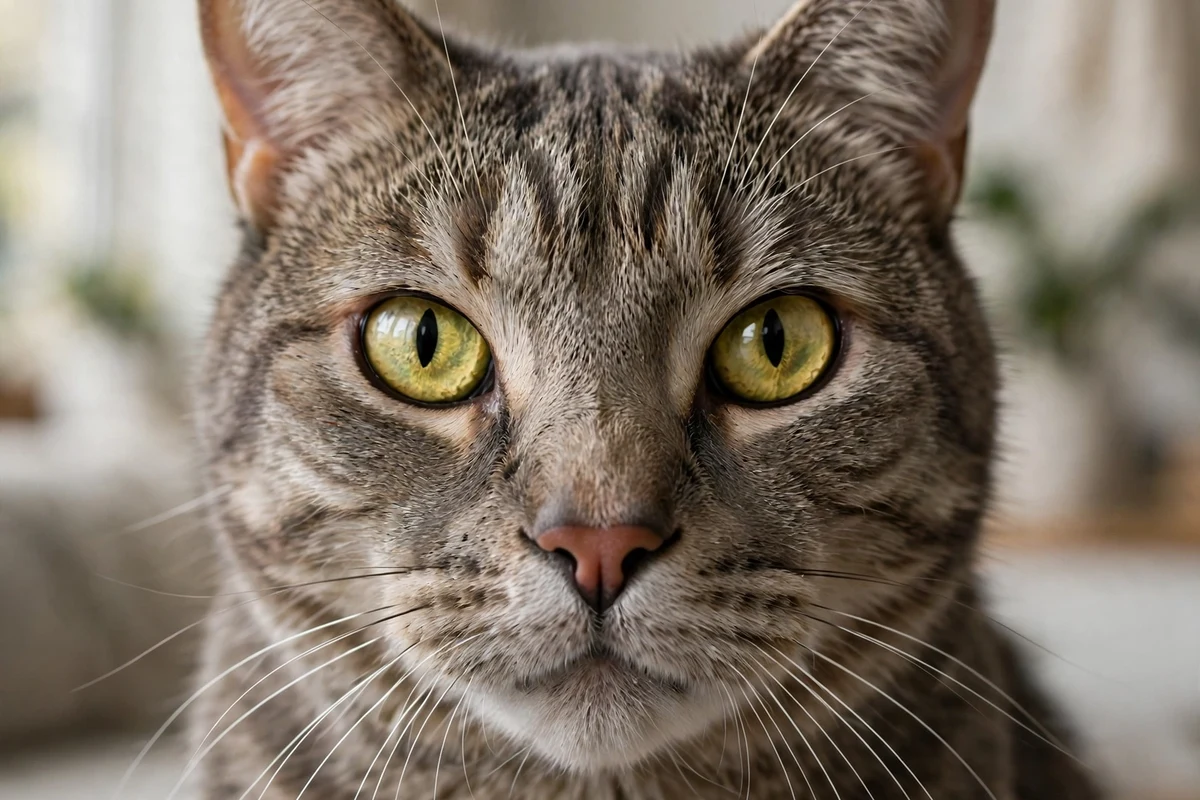
Why Does My Cat Stare at Me?
If you are asking why does my cat stare at me, the short answer is that staring is how cats talk without sound. Cats do not have a spoken request for food, play, attention, or space, so they use eyes, ears, tail, posture, and whiskers together. Read the whole body, not the eyes alone, and most stares sort themselves into a small set of meanings.
This guide gives you that whole body reading. It explains the stare types, the slow blink, the unblinking stare, staring by distance and position, staring at walls, and a safe response for each type. It does not diagnose your cat, and it does not repeat the stare back contests and hard stare advice that conflict with vet and behaviourist sources. Where a stare pairs with confusion, pain, or behaviour change, the next step is a vet visit.
The Short Answer: Staring Is How Cats Talk Without Sound
PetMD frames staring as communication in its first line: cats stare to communicate needs, emotions, or intentions, with common reasons including attention seeking, play solicitation, hunger, affection, fear, or aggression. Chewy, quoting a certified cat behaviourist and a veterinarian, makes the same point: staring is one of a cat’s primary ways of communicating with humans, observing surroundings, and expressing itself, and most of the time it is simply a natural part of how cats interact with people.
That normal base matters, because staring can feel unsettling, especially at night or without blinking. Chewy’s answer to the worry question is reassuring and specific: cat staring is completely normal and nothing to worry about in most cases, and a vacant look while lounging often means the cat feels safe and relaxed. The stares that need attention are the exceptions, and they are recognisable because the rest of the body changes with them: stiff posture, flat ears, puffed fur, dilated pupils that do not match the light, or a stare paired with confusion, pain, or frequent vocalising. The decoder below teaches you to spot that difference.
How to Read a Stare: The Whole Body Decoder
A stare on its own is ambiguous. A soft gaze with a relaxed body, a hard gaze with a stiff body, and a wide eyed gaze with a crouched body can look similar in a photo, but they mean different things in a room. Read eyes, ears, tail, posture, whiskers, and sound together, in that order, before you decide what to do.
Eyes: pupils, blink rate, and gaze hardness
Start with three eye questions. Are the pupils slit, round, or dilated for the light? Is the cat blinking, slow blinking, or holding a fixed gaze? Is the gaze soft, with half closed eyes, or hard, with wide open eyes and a fixed stare? PetMD uses those distinctions throughout its stare guide: soft blinks signal affection, dilated pupils can signal play, fear, or aggression depending on the rest of the body, and a hard, unblinking stare with stiff body language is a threat warning.
Light matters for pupils, so do not read dilated pupils alone. Pupils widen in dim light as well as in arousal. Chewy notes that wide eyes with dilated pupils and a tense body can mean hyper alertness, while MyPawWellness, read in full, adds that dilated pupils during calm observation can mean high alertness or interest, not distress, especially in dim lighting where pupils naturally widen. Pair pupil size with body tension and with light before you conclude anything.
Ears, tail, posture, and whiskers
Ears tell you direction and mood. Ears forward usually pair with curiosity or play. Ears to the side or back, the “airplane” position, pair with fear, annoyance, or a warning. PetMD’s fear stare pairs dilated pupils with a lowered head, ears pulled to the side or back, a crouched body, and raised fur. That cluster is more reliable than any single sign.
The tail often settles the meaning before the eyes do, and our guide to cat tail language shows how a flick, a lash, and a puffed tail differ. In brief: a slow swish can pair with play or curiosity, a fast lash or thump can pair with arousal or annoyance, and a puffed tail pairs with fear or threat. Posture completes the picture: a relaxed, loose body pairs with affection or curiosity, a crouch pairs with fear or hunting, and a stiff, tall, or arched body pairs with threat. Whiskers forward can pair with curiosity or hunting focus, while whiskers pulled back can pair with fear. No single sign decides. The cluster does.
Sound: silent stare versus stare plus meow
Sound changes a stare from an observation into a request. Chewy notes that if a cat adds a meow to its gaze, there is no mistaking it: the cat wants attention. PetMD notes the same pattern for food stares, where eye contact is followed by vocalising, rubbing, and walking toward the bowl or feeder. A silent stare, by contrast, is more often watching, waiting, or deciding. It may be curiosity, affection, hunting focus, or a warning, and the body decides which.
A stare plus growling or hissing is a different sound group. PetMD lists growling and hissing among the questions to ask when reading a stare, because they move the stare into the fear or aggression group at once. Do not treat a hissing stare as a request. Treat it as a warning, and use the safe response script later in this guide.
Worked examples: five stares, read start to finish
Worked example 1, soft slow blink stare: eyes half closed, slow blink, ears forward or neutral, body loose, tail still, silent or with a soft purr. Reading: affection and trust. Response: slow blink back, and approach only if the cat invites it.
Worked example 2, request stare: direct gaze, ears forward, body upright, tail still or upright, meow added, then a walk toward the bowl, door, or toy. Reading: a specific request for food, play, attention, or access. Response: check the obvious need, and meet it on a routine, not on demand every time.
Worked example 3, hunting stare: crouch, dilated pupils, ears forward, tail swishing, body low and still, then a sprint or pounce. Reading: play solicitation or hunting focus. Response: offer a wand toy, and keep hands and feet out of the target zone.
Worked example 4, fearful stare: wide eyes, dilated pupils, lowered head, ears to the side or back, body crouched, fur raised, silent or with a low sound. Reading: fear, with the cat watching the thing it worries about. Response: avert gaze, keep still, step back, and leave an escape route.
Worked example 5, hard stare: fixed, unblinking gaze, stiff body, raised fur along back and tail, ears back, possible growl or hiss. Reading: threat warning. Response: do not approach, do not stare back, avert gaze, step back, and give distance, as PetMD advises.
The 6 Stare Types
Use the decoder above to place a stare in one of these six types. Most everyday stares fall in the first three. The last two need a careful response, and the hunting stare needs a toy, not a hand.
The soft slow blink stare (affection and trust)
The slow blink is the clearest affection signal in this guide, and it has the strongest sourcing. PetMD’s slow blink guide explains that slow blinking is a form of positive emotional communication, that cats slow blink only when they feel comfortable and close with someone, and that slow blinking back can strengthen the bond. Chewy, quoting a behaviourist, describes a steady gaze paired with a slow blink as a cat showing trust and comfort, essentially saying it feels safe with you. Vetstreet explains the logic: in the animal world, direct eye contact or a hard prolonged stare is usually perceived as a threat or challenge, so a cat that looks at you, slow blinks, and looks away is signalling that it is not threatening you, and that it feels comfortable around you.
Cat slow blink meaning, in short, is trust made visible. A cat that closes its eyes near you is lowering its guard, which PetMD notes is a risk for a prey predator animal that is also hunted by larger predators. Do not rush a slow blink stare. Let the cat set the pace, slow blink back if you wish, and offer a hand to sniff only if the cat approaches or leans in. A slow blink does not always mean the cat wants physical contact, Vetstreet warns, so a finger sniff test, backing away or batting as a no, is a useful check before petting.
The request stare (food, play, attention, door)
The request stare is a direct, often unblinking gaze that has learned to work. Chewy notes that a direct, unblinking stare may be a cat asking for food, playtime, or attention, and that cats learn quickly that eye contact gets human focus. PetMD splits the request into food and attention versions: a food stare is followed by vocalising, rubbing, and walking toward the bowl or feeder, while an attention stare may be followed by a slow blink, a meow, rolling, or rubbing on nearby items.
Read the request by what happens next. A stare near the food bowl at meal time, followed by a walk to the bowl, is a food request. A stare at a closed door, followed by pawing or meowing, is an access request. A stare that follows you from room to room, followed by rubbing or rolling, is an attention request. Meet genuine needs on a routine, and do not meet every request at once, or the stare becomes the only tool that works, in the same trained pattern described for meowing. A cat that stares constantly for food in an unusual way, with begging that is new or excessive, belongs in the vet visit list, not in a routine fix alone, as Chewy notes.
The curious watch (what are you doing, and will it affect me)
The curious watch is the most common stare, and the easiest to over interpret. Chewy, quoting a behaviourist, explains that cats are naturally observant, and may stare simply because they are taking in what you are doing, and may even be trying to anticipate if what you are doing will impact them, for example walking near the treat drawer or getting ready to leave. MyPawWellness, read in full, adds the everyday version: cooking, typing, and folding laundry all get studied as if they might be relevant information later.
A curious watch is usually relaxed or alert, but not tense. Ears forward, body loose or upright, tail still, eyes open but not hard, and no sound, or a quiet chirp, are the usual cluster. The cat is not asking for anything yet. It is gathering information. You do not need to respond to a curious watch, except to notice what the cat is watching. If the watch follows a pattern, such as staring when you pick up keys, the cat has learned that keys predict leaving, and the stare is anticipation, not mystery.
The hunting stare (tracking movement before a pounce)
The hunting stare is a tracking stare, not a social stare. PetMD describes a play solicitation stare with crouching, dilated pupils, and tail swishing, followed by sprinting to swat a foot or tackling a leg with a bunny kick. Chewy describes the same hunting mode in a broader form: a cat may fixate on a bug, a toy, or even something invisible to you, tracking even the tiniest movement, as preparation for a pounce.
Distinguish hunting from request by the body: low crouch, stillness, focused eyes, and a swishing tail, followed by movement toward a target, rather than a walk toward a bowl or door. The response is a toy, not a hand. PetMD suggests grabbing an interactive toy like a cat wand for a play session when you see this stare. Keep hands and feet out of the pounce zone, and do not tease the cat with fingers during a hunting stare, because that teaches the cat that people are prey.
The fearful stare (wide eyes, crouch, ears back)
The fearful stare is a watchful stare with a tense body. PetMD lists its cluster: dilated pupils, lowered head, ears pulled to the side or back, body crouched down, and fur raised. The cat is staring to keep its eyes on the stimulus it worries about, PetMD explains, whether that is a loud noise, a quick movement, or a remembered negative experience. Chewy adds the companion warning signs for a hurt or scared stare: wide eyes, dilated pupils, a tense body, and other signs such as hiding, limping, or avoiding touch, which could mean it is time to call the vet.
Do not approach a fearful stare cat, do not try to comfort it by picking it up, and do not stare back. The safe response, from PetMD, is to avert your gaze, keep still, step back, and give space. Let the cat leave if it wants to, and work out what startled it, so you can reduce that trigger next time. If fear staring is new, frequent, or paired with hiding, limping, or avoiding touch, treat it as a vet question, not as shyness to push through.
The hard stare (threat warning, stiff body, raised fur)
The hard stare is the warning stare, and it is the one to take most seriously. PetMD describes it as a hard, unblinking stare paired with stiff body language and piloerection along the back and tail, telling the other party that if they do not back off, there will be a confrontation. The hard, unblinking gaze is a threat to the other person or animal, PetMD warns, and the other party needs to retreat and give the cat distance, otherwise the cat may attack.
Do not test a hard stare. Do not hold eye contact to see who looks away first, do not approach, and do not pick the cat up. The response script later gives the exact steps, but the principle is simple: avert gaze, keep still, step back, and leave distance. A hard stare paired with a sideways arched body is a different display from a plain stare, and our guide to the crab walk explains that posture on its own. This guide does not re-explain that posture. It only notes the pairing, so you know which guide to read next.
Why Your Cat Stares Without Blinking
The question why does my cat stare at me without blinking is one of the most searched versions of this topic, and it has a calmer answer than it first appears. Cats blink less often than people, a relaxed unblinking watch is normal, and a hard unblinking stare is a different signal. The difference is the body, not the blink count.
Cats blink less often than people
Chewy answers the unblinking question directly: cats do not blink as often as we do, so it is normal for them to maintain a steady gaze, and if the cat seems calm and relaxed, it is just their way of observing the world. That single fact reframes most unblinking stares. A steady gaze from a relaxed cat is not a challenge. It is a cat watching at its own blink rate, which is slower than yours, so the gaze feels longer and more intense than the cat intends.
Do not count blinks as a test. A cat can blink slowly, blink rarely, or hold a gaze while relaxed, and all three can be normal. Count the body instead: loose or upright and relaxed, ears forward or neutral, tail still, and no tension, points to a normal watch. Stiff, crouched, or puffed, with ears back and a fixed gaze, points to fear or threat, whether the cat blinks or not.
Relaxed unblinking watch versus hard threat stare
| Feature | Relaxed unblinking watch | Hard threat stare |
|---|---|---|
| Body | Loose, upright, or lounging | Stiff, tall, or crouched and tense |
| Ears | Forward or neutral | Back or to the side |
| Tail | Still or slow swish | Lashing, thumping, or puffed |
| Fur | Flat | Raised along back and tail |
| Sound | Silent, or soft chirp or meow | Growl, hiss, or tense silence |
| What happens next | Cat looks away, slow blinks, or walks to a request | Cat holds the stare, and may attack if approached |
Use the table as a quick check, not as a score. One feature alone does not decide. A relaxed cat in dim light can have dilated pupils, and a fearful cat can be silent. The cluster, and what happens next, decide. If you are unsure, choose the safer reading: give space, avert gaze, and let the cat decide the next step.
Staring by Distance and Position
Position changes meaning, because a cat’s distance from you is part of its message. A stare from across the room, a stare while you sleep, a stare while you pet the cat, and a stare at a wall are four different reader questions, and they need four different answers. Cat staring at owner, as a general phrase, covers all of them, but the fix depends on which one you mean.
Staring from across the room or from a shelf
Staring from a distance is usually curiosity or affection at a scale the cat feels comfortable with. MyPawWellness, read in full, puts it well: staring from across the room or from a distance is usually just curiosity or affection at a scale your cat feels more comfortable with, and some cats prefer to express interest without the vulnerability of being close by. A shelf or high perch adds a second meaning: height gives a cat a good view and a safe position, so a shelf stare is often a watch from safety, not a demand.
Do not call a distance cat to you if it is relaxed on a shelf. Let it watch. If it wants interaction, it will come closer, slow blink, or meow. If it stays at a distance for a long time, that is not rejection. It is a cat choosing the distance that feels safe, and respecting that distance builds trust faster than closing it.
Staring while you sleep
The question why does my cat stare at me while I sleep feels spooky, but the usual answers are ordinary. Chewy, in its FAQ, notes that cats sometimes stare at owners while they are asleep, usually tied to curiosity or routine, waiting for you to wake up, anticipating breakfast, or simply keeping watch. MyPawWellness, read in full, adds the timing point: cats are naturally more active around dawn and dusk, right when your sleep is lightest or you are closest to waking, so the timing lines up more than it might seem, and the rest is usually supervision, checking that everything in their territory is where it should be.
Sleep staring usually pairs with a cat settling near you for the night, and our guide to cat sleeping positions shows what that settling means. If sleep staring is new, constant, or paired with night meowing, confusion, or other changes, use the vet visit list below, because a pattern change matters more than the stare alone. If it is occasional, calm, and followed by the cat settling or waiting for breakfast, it is a normal watch, not a problem to solve.
Staring while you pet them
A stare while you pet a cat is often a check in, not a warning. MyPawWellness, read in full, describes it as a cat checking in, confirming the interaction is still good, sometimes right before deciding whether to lean in for more or redirect you elsewhere, and notes that it is not usually a negative sign unless the body tenses up alongside it. That matches the petting threshold picture: the cat is monitoring the session, and the stare is part of that monitoring.
Read a petting stare by the change, not by the stare itself. A soft gaze that stays soft, with a loose body, means the session is still good. A gaze that hardens, with ears back, a tense body, a flicking tail, or a head turn to watch your hand, means the session should end. Stop at that change, not after a bite, and end calmly. A petting stare that always ends in a bite is a threshold problem, and the petting guide for biting covers that pattern in full.
Staring at walls, corners, or apparently nothing
The question why does my cat stare at the wall has an honest answer, and it starts with uncertainty. No vet source read for this guide gives a settled explanation for wall staring, and this guide does not invent one. The plausible ordinary explanations are: tracking tiny movement you cannot see, such as an insect or a shadow; hearing something you cannot hear, such as a sound in a wall or outside; and zoning out while lounging, which Chewy describes as a vacant look that often means the cat feels safe and relaxed.
Do not jump from wall staring to a medical or supernatural claim. Wall staring on its own, in a cat that is otherwise well, eating, drinking, toileting, and behaving normally, is not a diagnosis. Wall staring paired with other changes, such as confusion, disorientation, behaviour change, pain signs, or frequent vocalising, is a different case, and belongs in the vet visit list below. The honest rule is: wall staring alone, watch and note; wall staring plus change, book a vet visit and describe the full pattern.
What to Do When Your Cat Stares at You
The safe response depends on the stare type. One response does not fit all stares, and the wrong response to a hard stare can escalate it. Use the script below in order, and stop at the step that fits the stare you see.
The safe response script, one response per stare type
Soft slow blink stare: slow blink back, wait, and approach only if the cat invites it by approaching, leaning in, or rubbing. Do not rush to pet a slow blinking cat that has not invited contact.
Request stare: check the obvious need, food, water, litter, play, attention, or access, and meet it on a routine. If the request is for food outside meal time, check the schedule before feeding, so the stare does not become a demand tool.
Curious watch: do nothing, or acknowledge calmly. Let the cat watch, and notice what it is watching, because that tells you what it has learned to anticipate.
Hunting stare: offer a wand toy at once, and move hands and feet out of the target zone. Play until a catch, then wind down calmly.
Fearful stare: avert gaze, keep still, step back, and leave an escape route. Do not talk to, look at, or pet the cat, as PetMD advises for afraid or aggressive cats. Once you are at least 5 feet away, PetMD suggests distracting with a tossed toy to the other side of the room, if that can be done without approaching the cat.
Hard stare: avert gaze, keep still, step back, and give distance. Do not approach, do not stare back, and do not pick the cat up. Wait for the cat to leave or relax before you move normally again.
A stare that always ends in licking is a combined signal, and our guide to why cats lick people explains the grooming and bonding half of it. This guide owns the stare half: what the eyes and body mean, and how to respond safely.
How to slow blink back
Slow blinking back is simple, and it works best when it is slow and unforced. Look at the cat with a soft gaze, close your eyes slowly, hold them closed for a brief moment, and open them slowly. PetMD notes that cats respond to slow blinks from humans, and that slow blinking can strengthen the bond. Chewy, quoting a behaviourist, suggests giving pets and slow blinking right back when a cat offers a steady gaze with a slow blink.
Do not force a slow blink exchange. If the cat looks away, that is a normal part of the exchange, as Vetstreet explains: a cat may slow blink and then look away, signalling that it is not threatening you. If the cat does not slow blink back, that is not rejection. It may simply not be in a slow blink mood, or it may want a different interaction. Offer a hand to sniff, and let the cat decide.
What never to do (hard stare back, approaching a tense cat, picking up a tense cat)
Never hold a hard, unblinking stare back at a cat, especially a tense or fearful cat. Chewy’s FAQ is direct: returning a soft gaze or slow blink is a way to build trust, but skip the unblinking stare, because cats may take that as a challenge. PetMD’s response rules make the same point: if a cat seems afraid or aggressive, avert gaze, keep still, and step back, and do not attempt to look at, talk to, or pet the cat.
Never approach a hard staring or tense cat to “reassure” it, and never pick up a tense, hard staring, or fearful cat. Picking up a cat that is already warning you removes its escape route, and that is when a warning becomes a bite or scratch. Never use a stare contest as a training method, and never repeat the advice from lower authority pages to stare back until the cat looks away. That advice conflicts with PetMD and Chewy, and this guide does not repeat it.
When to See a Vet (normal behaviour versus warning signs, kept strictly separate)
Keep these lists separate. Normal staring is common, and warning signs are specific. Mixing them makes normal staring look medical, and makes medical staring look like a quirk.
Normal staring that needs no action
Normal staring that needs no action includes soft slow blink stares, curious watches from across the room or a shelf, request stares at meal time or a door, hunting stares that lead to play, sleep staring that is calm and occasional, and vacant lounging stares that Chewy describes as a cat feeling safe and relaxed. These need no fix, and no vet visit, on their own. If they become constant in a new way, or pair with a change, move them to the warning list below, because change, not frequency alone, is the trigger.
Warning signs that need a vet visit
Book a vet visit if staring pairs with aggressive body language, such as stiff posture, dilated pupils, or tail flicking, if the cat seems confused or disoriented, if it begs constantly for food in an unusual way, if it shows pain signs such as hiding, crouching, limping, or avoiding touch, or if it vocalises frequently while staring. Those are Chewy’s worry flags, read in full, and PetMD adds the general rule: if staring is paired with behaviour changes or signs of illness, contact a veterinarian.
This list is deliberately reduced to the Chewy and PetMD level, as instructed. Lower authority pages list more specific neurological signs, such as circling, eye shaking, drooling, and not recognising people, but those are not repeated here as a reader checklist, because they invite self diagnosis from a general guide. If you see any of those signs, or any sudden change in staring behaviour, describe the full pattern to a vet, and let the vet decide what it means. Do not use this guide to diagnose vision loss, cognitive decline, or high blood pressure. It lists companion changes only, and directs you to a vet.
Frequently Asked Questions
Is it normal for my cat to stare at me all the time
Yes, in most cases. Chewy’s answer is that cat staring is completely normal, and that cats stare for many reasons, from affection to curiosity to seeking attention. “All the time” needs a check, though: is the staring constant in a new way, or has the cat always been watchful? MyPawWellness, read in full, makes the same distinction: a watchful personality is one thing, and a stare that lines up with a change, such as a new pet, a move, or a schedule shift, is another. If the cat is otherwise well, and the body stays relaxed, frequent staring is a personality and communication pattern, not a problem. If it is new, constant, and paired with other changes, use the vet visit list.
Should I stare back at my cat
It depends on the stare. For a soft, relaxed stare, a soft gaze or slow blink back is a good response, and Chewy describes it as a sweet way to build trust. For a hard, tense, or fearful stare, do not stare back. Avert your gaze, keep still, and step back, as PetMD advises. The rule is: slow blink back to a soft stare, look away from a hard stare. Never hold an unblinking stare back as a contest, because cats may read that as a challenge.
Why does my cat stare at me and then look away
Looking away after a stare, especially after a slow blink, is usually a non threat signal. Vetstreet explains that when cats look at each other, blink, and look away, they are conveying that they are not threatening the other cat, and the same logic applies to people: a cat that slow blinks and looks away is signalling comfort and safety, not rejection. A cat may also look away because it has finished its check, because it has decided what to do next, or because it is inviting you to approach on its terms. Let the cat set the next step, and offer a hand to sniff if it approaches.
Why does my cat stare at me while I eat
Staring while you eat is usually a food request stare, in a specific setting. PetMD notes that some cats stare intently while you are eating, in hopes of getting a tasty morsel of human food, and that food stares are often followed by vocalising and rubbing. The fix is routine, not scolding. Do not feed from your plate if you do not want the stare to continue, because every morsel teaches the stare to return at the next meal. Feed the cat on its own schedule, away from your meal if needed, and ignore the meal time stare calmly, while meeting the cat’s own meal need on time.
This guide describes behaviour patterns and general information only. It does not diagnose a cat. If staring pairs with confusion, pain, or behaviour change, contact a vet.