
Chantilly-Tiffany Cat: Breed Profile, History & Best Names
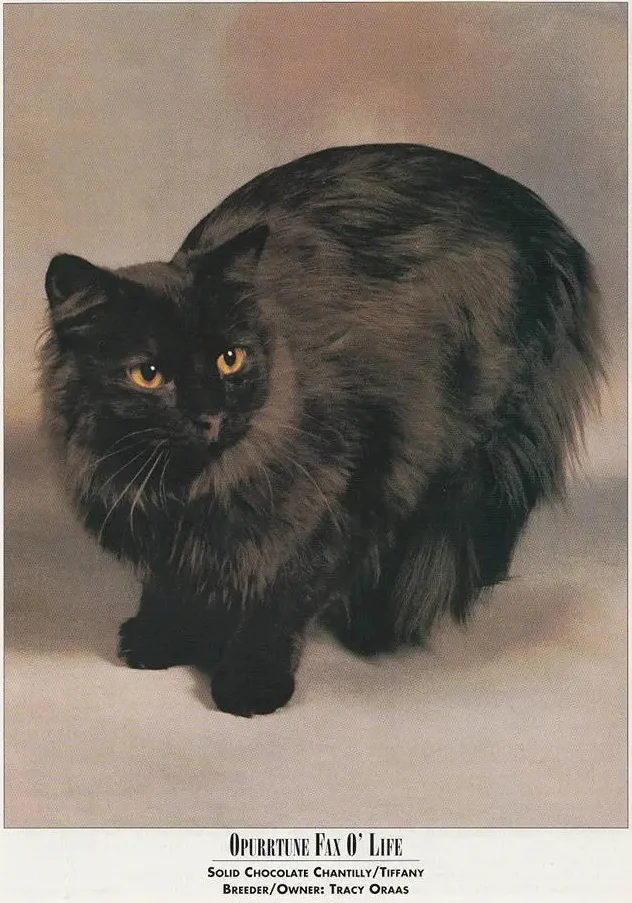
The Chantilly-Tiffany was the cat in the chocolate coat: a silky, semi-longhaired North American breed with gold eyes, a plumed tail and a voice so soft that owners described holding conversations in chirps and trills. It was gentle, devoted and always rare. It is also, honestly and completely, gone. The last known lineage ended in 2015, and there are no pedigree Chantilly-Tiffany cats left to buy, adopt or breed from anywhere in the world.
This page is the breed’s documented record rather than a buying guide: two chocolate cats of unknown ancestry bought in New York in 1967, a Burmese mix-up that haunted the breed for decades, three names in twenty-five years, and the cattery fire that began its final chapter. If you arrived here because a “Chantilly” kitten is being offered for sale, read the extinction sections carefully before you believe the label.
History: Two Chocolate Cats of Unknown Ancestry
📖 Breed History
The breed began in 1967, when Jennie Robinson of Neotype Cattery, New York, bought a pair of semi-foreign longhaired chocolate cats with golden eyes as part of an estate sale in White Plains. “Thomas” was about a year old and “Shirley” about six months; they may have shared parents but were not littermates, and their ancestry was never recorded and never known. In May 1969 Shirley produced a first litter of six kittens, every one of them chocolate and a copy of its parents.
Robinson started a breeding programme to fix those traits, and in the early 1970s the American Cat Association (ACA) registered Thomas, Shirley and many of their descendants under the breed’s first name: Foreign Longhair. When Robinson wound her programme down in the 1970s, Florida breeder Sigyn Lund of Sig Tim Hil Cattery bought some of her cats and carried the breed on. Lund was known as a Burmese breeder, the cats’ New York origin was never publicised, and the public simply assumed the chocolate longhairs were longhaired Burmese. That assumption, repeated in print, became the breed’s curse.
It was never true. Robinson herself gave the evidence: the May 1969 kittens “were dark self-colours with no points and pinkish paw pads, the opposite of traits that identify Burmese.” All the American Chantillys descended from Thomas and Shirley, none was ever bred to a Burmese, and the registries never permitted Burmese outcrossing. Yet the myth was already in the books: an informal phone interview with Lund’s cattery fed Harper’s Illustrated Handbook of Cats the suggestion that the cats were British crosses of Burmese and Himalayan, and David Taylor’s The Ultimate Cat Book (1989) described the breed as “produced from crossing Burmese cats with Longhairs.” Breed historians now treat that whole story as discounted.
The breed survived in pieces. In 1973 a longhaired, chocolate, gold-eyed cat of unknown ancestry appeared at a Canadian acreage and produced carbon-copy kittens, whose offspring Canadian breeders used, in cooperation with Robinson and Lund, to help re-establish the breed. Then, in 1988, Canadian breeder Tracy Oraas of Opurrtune Cattery answered a classified ad for “chocolate kittens” and, with Siamese and Oriental breeder Jan DeRegt, did detective work worthy of the story, down to phoning veterinarians across Florida, until they reached Robinson and Lund. Finding none of the original cats left, Oraas and DeRegt re-established the breed on registered European Angora, Havana Brown, Abyssinian, Somali and Nebelung foundation stock, the outcrosses the registries allowed. The numbers stayed tiny throughout: by 2009, only fifteen Chantillys had ever been registered in TICA’s Experimental Registry.
The Name Tangle: Chantilly-Tiffany vs Tiffanie
No breed ever collected names like this one, and the names are where most of the confusion still lives. Show judges felt “Foreign Longhair” was too general (they suggested “Mahogany”), so Lund renamed the breed Tiffany, a name she chose for its feeling of elegance and class, after a 1920s Los Angeles theatre studio. The ACA then dropped the breed for rarity, every Lund-registered cat lost its pedigree status, and the cats drifted on, often advertised, wrongly, as Burmese. In 1992 Oraas was asked to rename the revived breed to end the confusion with the British Tiffanie, created in 1981. Wishing to keep the elegance of “Tiffany,” the breeders chose Chantilly, the French town and lace famous for refinement. In 2000 TICA’s legal counsel ruled that only “Chantilly” could be used with TICA’s name. “Chantilly-Tiffany,” the hyphenated form most references use, is the compromise that stuck in popular use.
| Chantilly-Tiffany (this breed) | Tiffanie | |
|---|---|---|
| Origin | North America, from 1967 | United Kingdom, from 1981 |
| Ancestry | Two chocolate longhairs of unknown ancestry; never bred to Burmese | A living breed from the British Asian/Burmilla programme, genuinely Burmese-derived |
| Also called | Chantilly, Tiffany, Foreign Longhair | Asian Semi-Longhair, Asian Longhair |
| Status | Extinct since 2015 | Living breed, still bred today |
One more namesake completes the tangle: the “Tiffany” recognised by the New Zealand Cat Fancy is neither of these cats, but a Burmese longhair. Three cats, two spellings, one very confusing century of cat fancy paperwork, and only the British cat is still with us.
Appearance: Silky, Semi-Long and Chocolate First
The Chantilly was a moderate cat in every measurement: a semi-foreign build of medium size, neither cobby nor svelte, with females at 6 to 8 pounds and males at 8 to 10 in the breeders’ own description. Adults weighed roughly 2.5 to 5 kg in the standards, and the breed was slow to mature, reaching its full coat and full colour expression at about one to two years old.
The coat was the signature: full, silky, soft and smooth, worn semi-long with very little undercoat, finished with a plumed tail, a contrasting neck ruff and furnished ears. The head was a broad, modified wedge with gentle curves, wide cheekbones, a medium-length nose and a strong, broad, short, softly squared muzzle. The eyes, almond to oval, wide-set and slightly angled, were the second signature: yellow to gold in any shade, intensifying with age, sometimes with a green “halo” around the pupil. True green eyes were not allowed.
Chocolate was the founding and iconic colour, but the standards accepted a wider eumelanin palette: blue, cinnamon, lilac and fawn, with black included in the Canadian CCA standard though not the ACFA’s. Accepted patterns were solid, mackerel, ticked and spotted tabby. Colourpoint, classic blotched tabby and white spotting were never allowed, and solid cats could shade slightly paler toward the underside.
Temperament & Personality: Devotion in a Silky Robe
The breed’s own FAQ, written by Oraas and Robinson, calls the Chantilly “devotion in a silky chocolate (or other-coloured) robe,” and every surviving description agrees. These were gentle, easily managed cats, moderate in energy: not as placid as Persians, not as active as Orientals. A Chantilly typically formed a particular affinity for one person in the home, followed that person constantly, responded well to its name, and preferred that company to any other amusement.
The voice matched the temperament. Instead of a full meow, Chantillys conversed in quiet chirps and trills, the trait Britannica’s entry singles out as the breed’s “chirping meow.” With strangers they were friendly but conservative, taking their time; with children and other pets they integrated well. Nothing in the record describes an aloof or difficult cat, just a devoted one with a favourite human.
Care & Grooming
Care, as the breeders recorded it, was light for a longhair. The silky, little-shedding coat, short on undercoat, was not given to matting and needed only occasional combing, with attention to the modified ruff and the hindquarters. The one routine the FAQ singles out is ears: Chantilly ears seemed inclined to waxiness and were to be checked and swabbed regularly. A companion animal was part of the care plan, not an extra: this was a breed that did not thrive in endless hours of solitude, and people who worked full time were advised to keep a second pet. That is the whole historical care picture; there is no modern care guidance for this breed, because there are no modern Chantillys to give it to.
Health Notes
Honesty is the only honest approach here: no breed-specific health condition was ever documented for the Chantilly-Tiffany in the available sources. The breeders’ FAQ describes a very healthy breed “not given to any particular problems,” with one recurring quirk, a finicky digestion in some cats, which tolerated sudden food changes and high corn-content foods poorly. The same source notes that mothers were slow to wean and kittens slow to accept solids. On grooming, the sources contradict each other: some secondary profiles claim Chantillys over-groomed and pulled their own hair, while the ACFA standard and the breed’s founders held the coat was easily groomed and little-shedding precisely because of the missing undercoat. Both claims are reported because the record supports neither side conclusively.
Lifespan needs the same hedging. Secondary compilations variously report figures spanning roughly 7 to 16 years, but there is no registry dataset behind any of them, and there never will be: the breed’s health record ends where the breed ends. Treat every lifespan number attached to this breed, including the one in our Quick Facts, as a historical report, not a measured fact.
What Living With One Was Like
The picture the sources leave is of a shadow cat. A Chantilly chose its person, trailed them from room to room, answered when called and held up its end of the conversation in chirps. It was a lap-ready, undemanding companion that saved its wariness for strangers and its whole heart for the household, and it minded being left alone more than it minded almost anything else. Owners’ accounts gathered by breed historians describe exactly that cat: laid-back as an adult, devoted to the point of following its person like a dog.
The end came quietly and then all at once. By 2001 three catteries remained, in Canada and the United States; by 2003 Amorino Cattery in southern Illinois, run by Anne Davenport-Parini, was the only one operating in the US. Her chocolate tabby male, Hershey Nugget, a grandson of Oraas’s Mica, fathered at least ten kittens with two females, a solid blue and a solid lilac. In 2012 Nugget and his grandson Frosty appeared together in the “Chantilly” episode of Cats 101, filmed at Amorino. Later that year a fire destroyed the cattery and its archives; Nugget died in 2013 of the lung damage he had sustained in it. Frosty, a solid chocolate and the last known Chantilly in the US, was sent to a Nebelung breeder in Norway, where one solid lilac kitten, Acey, was born in 2013. When Frosty died, the Norwegian breeder ended the programme in 2015 and had Acey spayed. The last known lineage was over. There are no intact Chantilly cats alive, and no operating breeding programme, and any cat offered under this name today is a lookalike wearing an extinct breed’s label. If the chocolate, gold-eyed, devoted type is what you love, the living cats who carry parts of that story, including the Burmese it was so often mistaken for, are in our cat breed profiles.
Best Names for a Chantilly-Tiffany
You cannot name a Chantilly today, but you can name the chocolate longhair who reminds you of one, and these names are chosen for exactly that cat: chocolate coats, Chantilly lace and French elegance. Every meaning below comes from our name database; inspiration-only picks are described honestly, with no invented translations. Chantilly itself is recorded as a nod to sweet French whipped cream; Dentelle is French for lace; Tiffany carries the recorded meaning “manifestation of God”; and Cocoa, Mocha, Cacao, Truffle and Praline cover the chocolate shelf.
Browse the full lists of brown cat names and French cat names, or try the Name Generator →
Frequently Asked Questions
Is the Chantilly-Tiffany really extinct?
Yes. The last known lineage ended in 2015, when the Norwegian breeder who had taken in Frosty, the last known Chantilly in the United States, gave up the programme after his death and had his one kitten, Acey, spayed. No intact Chantilly cats remain and no breeding programme operates, so breed references list the Chantilly-Tiffany as extinct.
Is the Chantilly-Tiffany the same as the Tiffanie?
No. They are unrelated breeds with near-identical names. The Chantilly-Tiffany (also Chantilly, or Tiffany) was the North American breed on this page, extinct since 2015. The Tiffanie, with an “ie,” is a living British breed from the Asian/Burmilla programme, genuinely derived from Burmese lines. The shared name is a coincidence that caused decades of confusion, and it is why the American breed was renamed Chantilly in 1992.
Can I buy or adopt a Chantilly-Tiffany today?
No genuine source exists. The breed is extinct, with no intact cats and no breeding programmes since 2015, so a kitten advertised as a Chantilly-Tiffany is a lookalike, most likely a chocolate domestic longhair, whatever the listing claims. A chocolate longhair adopted from a shelter can give you the look and the devoted temperament, honestly labelled.
Was the Chantilly-Tiffany a longhaired Burmese?
No, although books said so for years. The myth grew because Florida breeder Sigyn Lund also bred Burmese, and the cats were even advertised as Burmese for a time. Founder Jennie Robinson documented that the original 1969 kittens had no points and pinkish paw pads, the opposite of Burmese traits; no Chantilly was ever bred to a Burmese, and the registries never permitted the cross.
How long did Chantilly-Tiffany cats live?
Nobody can say with confidence. Secondary breed compilations report ranges spanning roughly 7 to 16 years, but none rests on registry data, and the breed’s small, scattered population was never tracked the way living breeds are. With the breed extinct, that historical uncertainty is permanent.
What colours did the Chantilly-Tiffany come in?
Chocolate was the founding and iconic colour. The standards also accepted blue, cinnamon, lilac and fawn, plus black in the Canadian standard, in solid and in mackerel, ticked or spotted tabby patterns. Pointed colours, classic blotched tabby and white markings were never part of the breed.
By Brianna Baxter
Featured photo: Photo: Anne Helgren, CC0 1.0, via Wikimedia Commons.