
Cyprus Cat: Island Landrace, Ancient History, Temperament & Best Names
The Cyprus cat is not really a breed at all, and that is exactly what makes it interesting. It is the island’s own cat: a landrace shaped by Cyprus itself rather than by a registry standard, found everywhere from Troodos mountain villages to the walls of Limassol’s castle. Depending on who is telling the story, the same cat answers to Cypriot cat, Saint Helen cat, or Saint Nicholas cat.
What the Cyprus cat does have is the deepest backstory of any cat in our cat breed library. The oldest known evidence of a cat living closely alongside humans was dug up on this island, its most famous legend involves an empress shipping boatloads of snake-hunting cats to a monastery, and in the last two decades breeders have built a recognized breed, the Aphrodite, out of these same island cats. This page covers the landrace itself: origins, looks, and life with one.
History: The Oldest Cat Story in the World
📖 Breed History
In 2004, archaeologists at Shillourokambos, a Neolithic site in southern Cyprus, uncovered a first: a grave around 9,500 years old holding a carefully buried eight-month-old cat, interred alongside a human and decorative artifacts. The research team, led by Jean-Denis Vigne, reported that “a small pit or grave had been deliberately dug out, and the body of the cat was placed in it, then rapidly covered.” Cyprus was separated from the mainland before people lived there, so the cat, a Near Eastern wildcat, must have arrived with human help. It is still the oldest known example of a cat in close association with humans, predating Egypt’s famous cat depictions by some 4,000 years.
Here is the part the brochures leave out. The Shillourokambos cat proves that people and cats were closely associated on Cyprus 9,500 years ago; it does not prove that today’s Cyprus cats descend from it. The reference literature is blunt: there is no evidence that modern cats of any variety are descended from the ancient Cypriot wildcats, and both the World Cat Federation (WCF) and The International Cat Association (TICA) have repeated breeder descent claims uncritically. The island’s modern cats most likely developed from centuries of arrivals, often ship’s cats, breeding with little outside influence into a distinct, locally adapted population found all over the island today.
Modern genetics supports the “distinct island population” part. UC Davis geneticist Leslie A. Lyons, working with the Cyprus cat initiative and National Geographic, sampled random-bred cats from the Malcolm Cat Sanctuary for a global study. The January 2012 report concluded that “Cyprus cats are a distinct population within the Mediterranean,” about as distinct a lineage as the famous Van cats of Turkey, with little mainland admixture, and that a breed could be developed from them. Their relation to Greece’s Aegean landrace is still untested; the study had no Aegean samples.
Saint Helen’s Cats: The Monastery Legend
Ask on Cyprus where the island’s cats came from and you will hear about Saint Helen. By Byzantine legend, the Empress Helena shipped hundreds of cats from Egypt or Palestine to Cyprus in 328 AD. After a drought said to have lasted 37 years left the Akrotiri peninsula infested with venomous snakes, the cats were imported as pest control for its 4th-century monastery, Saint Nicholas of the Cats. The monastery, the story goes, kept two bells: one to call the cats in for meals, and one to send them out into the fields to hunt snakes.
It is a legend, and the sources say so plainly; nobody can now know whether shiploads of cats really arrived in the 4th century. But it is also the earliest known written record of cats on Cyprus, and the monastery is entirely real. Saint Nicholas of the Cats still stands near Akrotiri, today a nunnery whose nuns care for a cat colony that once dwindled and has since revived, a scene Giorgos Seferis put into verse in “The Cats of St. Nicholas.” The legend is why the landrace carries its other two names, Saint Helen cat and Saint Nicholas cat.
Appearance: An Island Type, Not a Show Standard
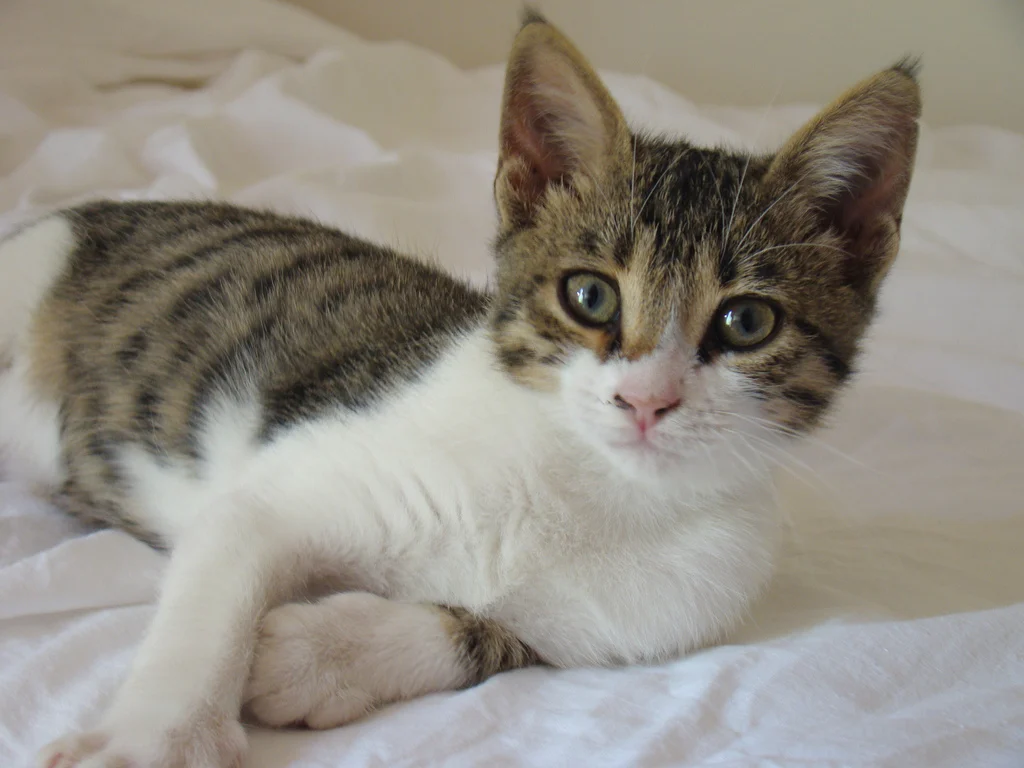
Because the Cyprus cat is a landrace, there is no written standard every Cyprus cat must match, and island cats vary. Reference descriptions agree on an athletic, energetic cat, somewhat thick-haired for a Mediterranean type, its coat running from short to semi-longhaired. The coat is seasonal, growing longer with undercoat for the cool, wet mountain winter and shedding back for the hot, dry summer (the World Cat Congress’s account), a rhythm the breed bred from them still shows.
The fuller, larger mountain type is what the breed standards were written from, and they describe it in detail. Both standards call for a long-triangular head with straight cheeks, wide-based medium-to-large ears forming an open V, and olive-shaped, obliquely set eyes of any uniform color. The body is muscular through the hips and shoulders, with hind legs slightly longer than the front legs, a leaper’s build the WCF notes is shared with another island breed, the Manx, and a medium-long, well-plumed tail. The standardized breed allows almost any color except colorpoint or mink; island cats wear the full everyday range of tabby, tortoiseshell, bicolor and solid.
Size needs the same honesty as the history. A landrace has no official weight, and Cyprus cats run from ordinary medium cats to big mountain animals. The large end is real: in the breed developed from these cats, TICA’s standard puts adult males at 15 to 18 pounds and females at 10 to 14 pounds, maturing slowly over three to five years. A typical Cyprus house cat lands in the medium-to-large range, the mountain type at its impressive end.
Temperament & Personality
Start with energy. Reference descriptions call the landrace athletic and energetic, a cat built by a working life of hunting, and that streak survives in pet cats as playfulness, curiosity and a strong hunting drive. These are not ornaments; a Cyprus cat expects a life with things in it.
Toward people, the descriptions are warm. Pet references describe Cyprus cats as affectionate, adaptable and quick to bond, and the best evidence comes from the breed developed out of them: TICA’s standard for the Aphrodite requires a gentle, non-aggressive temperament, and its overview describes those cats as affectionate, social and somewhat dog-like toward their keepers. Individual island cats naturally vary, a monastery feral is not a hand-raised house cat, but the population’s reputation is a sociable, people-oriented cat that settles readily into family life.
Care & Grooming
The short coat asks for little: a brush now and then to lift loose hair. Semi-longhaired Cyprus cats want regular brushing, and every coat wants more in spring, when the woollier winter coat comes out. That seasonal swing is the landrace’s main grooming fact; plan brushing around the calendar, not the week.
The rest is energy management. An athletic, hunting-minded cat needs vertical territory, scratching posts, interactive play, and safe outdoor access where possible; an indoor Cyprus cat needs those outlets provided deliberately, or it will invent its own, usually involving your curtains. Add the standard care routine, and watch the waistline: a population adapted to feast-and-famine island seasons gains weight readily when the hunting is done by a food bowl.
Health Notes
There is no registry health program for the Cyprus cat, because there is no registry for it, and no breed-specific inherited disease is documented for the landrace in the breed references. Structurally, this is an open island population, not a closed studbook breed, and the genetic work found a broad, distinct population rather than a bottlenecked one. Landraces developed under natural selection for local conditions tend to be hardy, and Cyprus cats carry that reputation, but hardiness is a population tendency, not a promise for any individual cat.
So the health plan is the ordinary one: vaccinations and parasite control kept current, dental checks, weight watched, annual vet visits, and extra vigilance for cats that roam (traffic, fights, infectious disease). The standardized breed’s quoted lifespan is 12 to 15 years, and a well-kept indoor Cyprus cat has every chance of matching it. These are general notes, not medical advice; your vet is the authority on your cat.
Cyprus Cat vs Aphrodite: Same Island, Different Thing
Most confusion around this cat comes from one overlap: since 2012, the standardized breed developed from the Cyprus landrace has been shown and sold internationally, as Aphrodite’s Giant in the WCF and simply Aphrodite in TICA. Every Aphrodite descends from Cyprus landrace cats, but the great majority of Cyprus cats are not Aphrodites. The differences that matter:
| Cyprus cat | Aphrodite (Aphrodite’s Giant) | |
|---|---|---|
| What it is | The island landrace itself: a natural, unregistered population | A standardized breed developed from that landrace, with breeding programs from 2006 |
| Registry status | Not recognized as a breed by any major registry | Fully recognized by the WCF (1 July 2012); Preliminary New Breed in TICA (September 2017) |
| Size | Varies, medium to large; mountain type biggest | Large by standard (TICA males 15 to 18 lb, females 10 to 14 lb); small specimens are disqualified |
| Coat | Short to semi-long, seasonal; everyday colors and patterns | Short or semi-long, soft and woolly; no colorpoint or mink; no white spots on solids |
| Breeding | Open island population; no pedigree, no standard | Closed breeding under WCC rules; no out-crossing to other breeds |
| Where you meet one | Homes, farms, streets and the monastery across Cyprus | Breeders and shows in Cyprus, Europe, Asia and the United States |
Our full Aphrodite Giant profile is now live. Short version: if the cat has a pedigree and a show standard, it is an Aphrodite; if it supervises a harbor, farm or monastery courtyard in Cyprus, it is the landrace that came first.
Living With a Cyprus Cat
In Cyprus, these cats already live every version of the feline life: house pets, farm cats, harbor cats, and the monastery colony. As a pet, expect the landrace package: an adaptable, athletic, people-bonded cat with a real hunting drive and a coat that changes with the seasons. Homes with climbing space, people around much of the day, and safe outdoor access or serious indoor enrichment suit it best. A good family cat by reputation; a poor choice if you want a quiet lap ornament.
Plenty of people meet this cat on holiday and come home determined to have one. Cyprus rescues and sanctuaries, the Malcolm Cat Sanctuary among them, regularly care for island cats, and adoptions from Cyprus to homes abroad are an established route via local rescues, with the usual pet-travel paperwork; the alternative is a pedigreed Aphrodite from a breeder. Either way, start with the setup in our new cat owner starter kit, and give a rescue cat time to claim its new territory.
Best Names for a Cyprus Cat
Names for the island’s own cat, from the Greek end of our database, meanings recorded as shown. The island’s goddess leads: Aphrodite, Greek goddess of beauty, whose mythic birthplace was the sea off Cyprus, and Adonis, the “beautiful youth loved by Aphrodite.” The monastery’s saints follow: Elena, “bright; shining light,” the international form of Helen, for Saint Helen of the legend, and Nicholas, “victory of the people,” for Saint Nicholas of the Cats; Nikos carries the same meaning in modern Greek form. Then Thalassa, “sea”; Calliope, “beautiful voice”; Daphne, “laurel”; Hermes, “messenger god”; Demeter, “goddess of agriculture and the harvest”; Athena, goddess of wisdom; and Stella, Latin for “star,” the Mediterranean classic. Browse the full Greek cat names list and our around the world cat names for more island inspiration.
Frequently Asked Questions
Is the Cyprus cat the world’s oldest cat breed?
It is not a breed at all, so it cannot hold that title, but it sits at the center of the oldest human-cat story known. The 9,500-year-old Shillourokambos burial (Vigne et al., 2004) is the oldest evidence of a cat in close association with humans. What it does not show is descent: there is no evidence today’s Cyprus cats descend from that cat, and the literature cautions that registries repeat breeder descent claims uncritically. Oldest human-cat association, yes; provably oldest breed, no.
Is a Cyprus cat the same as an Aphrodite’s Giant?
They are the same island stock at different stages. The Cyprus cat is the landrace: the natural island population, no pedigree, no standard. The Aphrodite, called Aphrodite’s Giant in the World Cat Federation, is the standardized breed developed from it, fully recognized by the WCF in 2012 and a TICA Preliminary New Breed since 2017. Every Aphrodite descends from Cyprus cats, but most Cyprus cats are landrace cats, not Aphrodites.
How big do Cyprus cats get?
There is no standard size, because there is no standard. Island cats range from ordinary medium cats to the large, big-boned mountain type the breed standards were written from. In the standardized breed, TICA puts adult males at 15 to 18 pounds and females at 10 to 14 pounds.
Did Saint Helen really send cats to Cyprus?
That is the legend, and it is labelled as one in the sources. By Byzantine tradition, the Empress Helena shipped hundreds of cats from Egypt or Palestine in 328 AD to clear venomous snakes from around the monastery of Saint Nicholas of the Cats, whose monks supposedly rang bells to feed and deploy the cats. It is the earliest written record of cats on Cyprus, but it is unverifiable, and cats have been arriving on ships ever since. The monastery is real, and its nuns still keep cats today.
Are Cyprus cats friendly?
By reputation, yes. Pet references describe them as affectionate, adaptable and quick to bond, and the breed developed from them is required by its TICA standard to be gentle and non-aggressive, with TICA describing those cats as affectionate, social and somewhat dog-like with their people. Individuals vary, so a hand-raised house cat and a monastery feral will not greet you the same way.
How long do Cyprus cats live, and are they healthy?
No breed-specific inherited disease is documented for the landrace, and its open island gene pool is why it is considered hardy, though that is a tendency, not a guarantee. Lifespan figures of 12 to 15 years are commonly quoted for the breed developed from these cats, and a well-kept indoor Cyprus cat, vaccinated, parasite-controlled and vet-checked, can reach that range.
By Brianna Baxter
Featured photo: Photo: Riannacone, CC BY-SA 3.0, via Wikimedia Commons.