
Raas Cat: Breed Guide, History, Temperament & Best Names
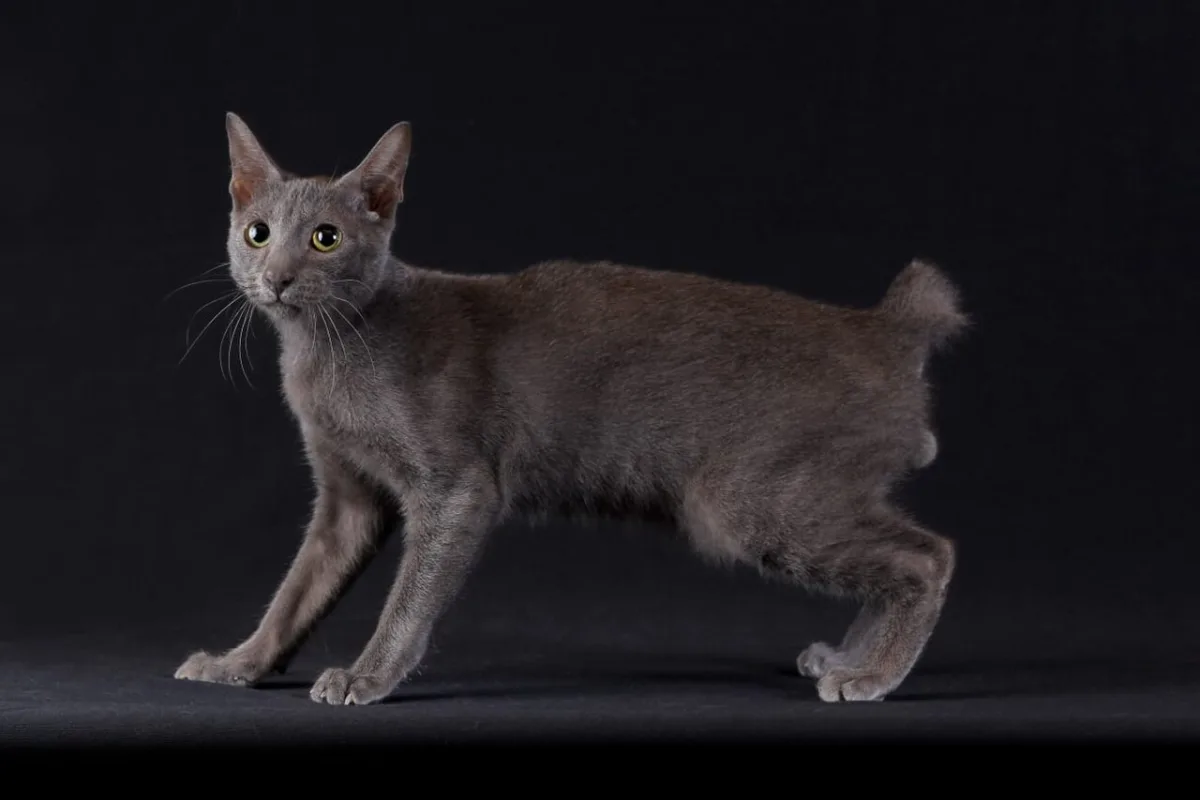
The Raas is Indonesia’s island cat: a natural landrace from Raas Island, east of Madura in East Java, where the island’s cats lived cut off from the mainland for generations. Most wear a solid blue-grey coat, those are the cats islanders call Busok, with solid black, chocolate and lilac cats alongside; the chocolate cats carry their own name, Amethyst. With its wedge-shaped head, large upright ears and naturally short, kinked tail, it looks far wilder than its domestic ancestry.
One honest note first: no major cat registry recognises the Raas as a standardised breed. Its one formal status is Provisional Class with the Feline Fanciers Federation (FFF), under the name Busok; development is supervised in Indonesia by the local club IBRA. The pure population is tiny, fewer than 100 cats, by a 2016 estimate. This page, part of our cat breed library, follows the written standard and says plainly where the record runs out.
History: A Prestige Gift from One Small Island
📖 Breed History
The Raas developed on Raas Island, some 38.9 square kilometres east of Madura in East Java’s Sumenep Regency. Cut off from mainland cats, the island population bred among itself for generations and became a distinct landrace. Traditionally the cats were prestigious gifts from local elders (kyai) to honoured guests and visiting officials, which kept ownership limited.
Local accounts describe the isolation as lasting centuries, and the islanders guarded it: residents resisted the cats being taken off the island at all, and local folklore holds that a ship attempting to carry Raas cats away would sink. Believed literally or not, it did its job, the population stayed closed and the type stayed consistent.
Isolation took a toll, and it has been documented: a study of the Madura and Raas cats by Lesley Morgan (Australian Cat Federation) and Dr Ronny Rachman Noor (Bogor Agricultural University), summarised in Messybeast’s specialist breed list, recorded a declining population and high inbreeding in what is effectively a closed colony of bobtailed blue cats. The same literature floats a hypothesis about the founding cats: Korat or Maew Boran-type stock, Thailand’s old blue cats, possibly carried to the island on trading ships long ago, a hypothesis about domestic cats, not a documented pedigree.
The modern chapter is organised conservation: development is supervised by IBRA, the Indonesian Busok Raas Association, and as of 2026 six official catteries inside Indonesia breed the cats selectively for conservation and promotion. The Feline Fanciers Federation, a Hong Kong-based registry, gives the breed Provisional Class status under the name Busok and registers its pedigrees, against a base of fewer than 100 pure cats, by the 2016 estimate.
Appearance: Solid Colours, a Wedge Head and a Kinked Bobtail
Almost everything that can be said with confidence about its looks comes from the written standard carried by the FFF and IBRA. The head is an equilateral triangle with rounded cheekbones and a smooth, slightly curved forehead. The nose is medium-length, with a gentle break of up to about 3 mm below the eye line; the muzzle is fine and wedge-shaped, chin tip aligned with nose tip. The ears are a signature: medium to large, wide at the base, well separated, pointing to roughly the 11 and 1 o’clock positions.
The eyes are lemon-shaped to oval, bright and expressive. Their colour surprises people who know the “blue” nickname: that word belongs to the coat. Accepted colours are yellow, green, turquoise and orange; blue eyes, the standard states plainly, are not accepted.
The body is medium-sized, solid and muscular, with shoulders and hips in parallel, a slim, relatively short neck, and slim, well-muscled legs, the hind pair slightly longer, giving an athletic stance. The tail is the other signature, and it is short, not full: the standard’s classes run from rumpy (no tail at all) through rumpy riser (0 to 3 cm) and stumpy (3 to 4 cm) to longy (4 to 10 cm), typically ending in a kink or bend.
The coat is short to medium, close-lying, smooth and glossy, in four accepted solids: blue (the Busok), black, chocolate (the Amethyst) and lilac, the chocolate family recessive and rare; a white belly is acceptable, and the ideal is solid and preferably blue. Patterned cats exist on the islands, bicolours, sepia, mink and pointed colourpoints, but sources attribute them to interbreeding with ordinary local cats, not to the pure type.
The Leopard Look, and What It Is Not
Search for this breed and you will quickly meet two claims: that it looks like a little leopard, and that it might be part wild cat. The first is fair comment about a wedge-faced, athletic cat; the second has no evidence behind it. No registry document or study records any Asian leopard cat ancestry for the Raas; the one origin hypothesis in the specialist literature is the Korat-type domestic stock described above.
The comparison that causes the confusion is the Bengal, worth making precisely because the two are opposites underneath. The Bengal is a documented hybrid breed, created deliberately from Asian leopard cat crosses: rosettes and spots over a full-length tail. The Raas is an unplanned island landrace wearing a solid coat over a bobtail. Similar first impression; entirely different cats on paper.
Temperament & Personality
The standard itself sketches the temperament: the Busok-Raas is described there as a very active, athletic cat with a strong attachment to its owners, and a notably loud, deep voice compared with other breeds. This is not a background-noise companion.
Breed guides and breeder accounts add that the cats are strong-willed, slow to trust strangers, and best suited to experienced owners. Read that as reported experience from a very small population rather than surveyed breed data, though it fits the history of a guarded prestige gift, never selected for instant friendliness. The safe baseline: an energetic, bonded, talkative cat that chooses its people.
Care & Grooming
The coat asks little: short to medium, close-lying and glossy, it needs no more than an occasional brush, weekly, as guides suggest. No Raas-specific care literature exists beyond that.
The care point the standard insists on is climate: the Busok-Raas is sensitive to cold weather and high humidity, and the cats are typically kept indoors, especially through cooler or wetter seasons, sensible for a breed shaped on a tropical island. Pair that indoor life with outlets for the documented energy: daily interactive play and climbing territory. Setting up for a first cat? Our new cat owner starter kit covers what to have ready before arrival day.
Health Notes
The honest health section for this breed is short, because the data does not exist. No veterinary literature documents a breed-specific disease list for the Raas, no registry runs a screening programme for it, and no lifespan figure appears in any source this page can stand behind, the 12 to 15 years printed in pet guides is repeated without a study behind it. The same applies to weight: the standard gives no figure.
What is documented is a population question, not a diagnosis. The breeding base is tiny, fewer than 100 pure cats estimated in 2016, within a closed island colony where researchers have recorded a high degree of inbreeding and declining numbers. That makes genetic diversity the breed’s open health question, and why the IBRA-supervised cattery programme matters. For an individual cat, the plan is the standard one: preventive veterinary care kept current, and prompt attention when something changes. These notes are general published information, not medical advice; your vet is the authority on your cat.
Living With a Raas Cat
Start with the plainest fact on this page: outside Indonesia, you almost certainly cannot have one. It is developed by six official catteries inside Indonesia, island tradition runs against the cats leaving at all, and the pure population is counted in dozens. There is no breeder network or waiting list abroad, and anyone overseas offering “Raas” kittens is selling something no registry can verify.
For an owner in Indonesia with access to an IBRA cattery, the cat is a characterful one: active, deeply attached, loud-voiced, slow with strangers, happiest indoors in a warm climate. It is a heritage breed in the most literal sense, a piece of one island’s history that happens to be a cat.
Best Names for a Raas Cat
Indonesian names from our name database, with meanings exactly as recorded there. Ayu records “beautiful” and Dewi “goddess”; Sari is “essence; flower” and Sekar simply “flower.” Kencana is “gold,” for the rare Amethyst cats, and Batik is “wax-resist dyeing,” after Java’s famous cloth. For the boys, Bima is recorded as “formidable (Mahabharata hero),” and Raja is “king”, a fitting nod to a cat once fit only for honoured guests. Lombok records “chili pepper” and shares its name with the island east of Bali; Timor is “east.” Komodo carries no recorded meaning in our database, an inspiration pick, for Indonesia’s island of giant lizards. Browse more in our around the world cat names collection.
Frequently Asked Questions
Is the Raas cat a recognised breed?
Not by any major registry. It does not appear as a recognised breed with the big federations (WCF, TICA, CFA, FIFe). Its documented formal status is Provisional Class with the Hong Kong-based Feline Fanciers Federation, under the name Busok, the FFF publishes its standard and registers its pedigrees, while development in Indonesia is supervised by the local club IBRA. Indonesian press reports describe WCF acknowledgement of the Busok as a native breed, and a blue Busok won a champion title at a WCF show in Jakarta in 2023, but acknowledgement and exhibition are not recognition, and WCF publishes no standard for the breed.
Is a Raas cat part wild cat?
There is no evidence that it is. The Raas is a domestic island landrace: its wedge-shaped face and athletic build give it a wild expression, which is where the leopard comparisons come from, but no registry document or study records Asian leopard cat ancestry. The only origin hypothesis in the specialist literature is domestic, Korat or Maew Boran-type blue cats, possibly brought by trading ships. The genuinely leopard-cat-descended breed is the Bengal; the Raas is not.
Why do Raas cats have such short tails?
The short tail is a natural trait of the isolated island population, and the standard is built around it: tails are classed from rumpy (no tail) through rumpy riser (0 to 3 cm) and stumpy (3 to 4 cm) to longy (4 to 10 cm), usually with a kink or bend at the tip. Short, kinked tails are common in Southeast Asian cat populations generally, and the Raas tail’s precise genetics have not been formally published.
What colours do Raas cats come in?
Four solid colours under the standard: blue, the famous Busok, plus black, chocolate, known as the Amethyst, and lilac; a white belly is acceptable, and the chocolate family is recessive and rare. Despite the “blue cat” nickname, the blue is the coat: eye colour runs yellow, green, turquoise or orange, and blue eyes are specifically not accepted in the standard. Patterned cats appear on the islands through interbreeding with local cats, outside the pure type.
How big do Raas cats get, and how long do they live?
The standard describes a medium-sized, solid, muscular cat but publishes no weight, and no study or registry documents a Raas lifespan. Pet-guide figures, weights around 8 to 16 pounds, lifespans of 12 to 15 years, are repeated without a source behind them; on the present record, both numbers are undocumented.
Can I get a Raas cat outside Indonesia?
Realistically, no. Breeding sits with six official catteries inside Indonesia working under IBRA, the pure population was estimated at fewer than 100 cats in 2016, and island tradition has long resisted the cats being removed at all. With no breeder network abroad, a “Raas” kitten offered overseas cannot be verified by any registry, regard it with scepticism.
By Brianna Baxter
Featured photo: Photo: I Putu Aditya Perdana, CC BY-SA 4.0, via Wikimedia Commons.