
Ragamuffin: Breed Guide, Temperament, Health & Best Names
Most breeds in this cat breed library were created by crossing two cats and seeing what happened. The Ragamuffin was created by a disagreement. In 1994 a group of breeders walked away from the most tightly controlled breeding program in the cat world, and because they were not allowed to take the name “Ragdoll” with them, they gave their cats a new one. The cats themselves never noticed the difference: big, plush, people-obsessed lap cats then, big, plush, people-obsessed lap cats now.
What you get is one of the largest and slowest-growing breeds in the cat fancy, a heavy-boned cat that is not fully grown until its fourth birthday, wearing a coat the CFA standard compares to rabbit fur, in literally any color a cat can be. This profile covers the split honestly, explains how a Ragamuffin actually differs from a Ragdoll, and gives the health-screening story the short breed summaries usually skip.
History: The Ragdoll Split
📖 Breed History
California, 1960s: breeder Ann Baker develops the Ragdoll, a large, docile cat named for its habit of going limp in your arms. In 1975, frustrated with the traditional cat associations, Baker trademarks the names “Ragdoll” and “Cherubim,” founds her own registry, the IRCA, and rules her breeding program with strict controls. In 1994 a group of IRCA breeders, chafing under the restrictions, break away. The trademark stays with Baker, so their Cherubim cats get a new name, Ragamuffin, suggested by founder Curt Gehm over the group’s first choice, Liebling.
The foundation of the breed is older than the name. The IRCA Cherubim cats behind the Ragamuffin had been developed from 1971 to 1994, across lines that included the IRCA Miracle Ragdolls, Ragdolls, Honey Bears and Maxamillion lines. Worth pausing on: the Ragdoll itself was founded from IRCA lines developed over just four years, 1971 to 1975. The breakaway breeders held two decades of their own breeding, the Ragamuffin’s gene pool has been the broader one ever since.
Genetic breadth was the point, not a side effect. Working first under the American Cat Fanciers Association (ACFA), the new group deliberately allowed limited outcrosses: domestic longhairs that already matched their written standard, and later Persians, to widen the gene pool and strengthen health, personality and type. A limited outcross back to IRCA Ragdolls ran until 2010 in ACFA. Outcrossing continues today under registry rules, Siberians in ACFA, longhaired Selkirk Rex in the CFA, British Longhairs in the UK’s GCCF, and only cats with at least one Ragamuffin parent and an approved outcross count as authentic Ragamuffins.
Recognition came quickly for a breed born in an argument. The United Feline Organization gave full championship status first, ACFA followed the same year, and the Cat Fanciers’ Association accepted Ragamuffins into its Miscellaneous class in February 2003, advancing them to Championship in February 2011. The breeders who left in 1994 wanted the Ragdoll’s sweetness with more breeding freedom; the registries’ paperwork says they got it.
Ragamuffin vs Ragdoll: What Actually Differs
Start with the honest summary: these are close cousins, and the shared traits are real. Both are large, slow-maturing, unusually docile cats that seek out people and often relax completely when picked up. The differences live in the standards. A Ragdoll must be a pointed cat with blue eyes, that is non-negotiable in its standard. A Ragamuffin may be any color or pattern a cat comes in, pointed included, with eyes of any solid color. Look at the face and the difference sharpens: the Ragamuffin standard asks for large, walnut-shaped eyes, rounded contours and a scooped nose under a “sweet” expression, while the Ragdoll standard calls for flatter planes and a slightly angled, almond-shaped eye. The coats differ on paper too: plush texture is required in the Ragamuffin, where the Ragdoll standard allows silky or plush.
| Trait | Ragamuffin | Ragdoll |
|---|---|---|
| Colors | Every color and pattern, with or without white | Pointed patterns only |
| Eyes | Any solid color; walnut-shaped; odd eyes occur | Blue only; almond-shaped |
| Coat texture | Plush required, compared to rabbit fur | Silky or plush |
| Face | Rounded contours, nose scoop, “sweet” expression | Flatter planes, straighter profile |
| Gene pool | Registry-approved outcrosses still used for diversity | Closed to the original foundation lines |
| Kittens | Born white; color develops as they mature | Also born white (pointed) |
For a pet home, the practical difference is choice: if your heart is set on a seal-point cat with blue eyes, both breeds can offer one, but if you want this temperament in a tortoiseshell, a tabby or a solid black, only the Ragamuffin can. Our full Ragdoll profile covers the cousin breed in the same depth.
Appearance: Big, Plush and Rabbit-Soft
A Ragamuffin is a substantial cat in every direction: rectangular body, broad chest and shoulders, heavy bone, a short strong neck, and hindquarters as broad as the shoulders. The CFA standard gives the averages, females between 8 and 13 pounds, males between 14 and 20, and many pet profiles quote males at 15 to 20 pounds and females at 10 to 15, so expect a genuinely large cat either way. The standard even expects a fatty pad on the lower abdomen; it is part of the breed’s build, not a feeding failure. And the size arrives slowly. Ragamuffins are fully mature at four years of age, which means the gangly two-year-old sharing your sofa is, by breed standards, still a teenager.
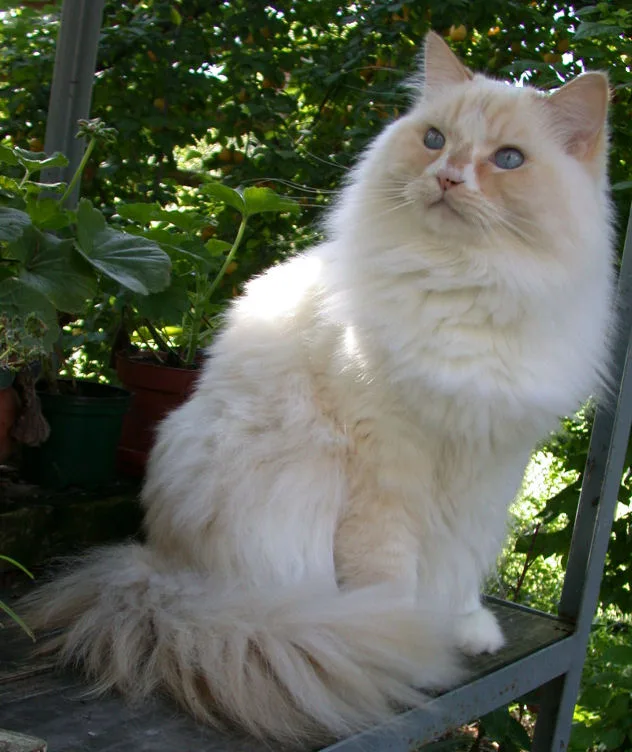
The head is a broad, modified wedge with a rounded forehead, a visible dip in the nose profile and a wide muzzle with puffy whisker pads, the equipment behind that sweet, slightly surprised expression. The coat is medium-long, soft, dense and plush, longer around the neck and the edges of the face so it forms a ruff, and usually finished with a plumed tail and tufts between the toes. The CFA’s own description reaches for the best comparison available: the coat feels like a rabbit’s. Kittens are born white and develop their color as they mature, so the kitten you meet is a rough draft of the cat you will live with. Colors run to everything, solids, tabbies, tortoiseshells, calicos, minks and points, with or without white. Pointed Ragamuffins can be registered and bred, though the CFA and GCCF do not allow them in the show ring.
Temperament & Personality: The Lap Is the Point
Every breed reference lands in the same place: this is a calm, affectionate, people-first cat. Ragamuffins follow their households from room to room, greet visitors instead of hiding from them, and settle into laps for as long as the lap is available. The Ragdoll inheritance shows when you pick one up, many go soft and floppy in your arms, though how limp an individual goes varies by cat. They are softly spoken, communicating in quiet chirps and trills rather than the full-volume commentary of an oriental breed, and they are patient: tolerant of children, generally easy with other cats and dogs, and famously willing to be carried around like a beloved stuffed animal.
The trade-off is dependence. A Ragamuffin is not a cat that chose you as staff and gets on with its own projects; it wants company as a daily requirement and does poorly left alone for long stretches. Plan on interactive play every day, not because the breed is high-energy, because it isn’t, but because play is one of the ways it bonds with you. Many learn fetch, come when called, and walk happily on a harness. That trusting, fearless nature is also why breed references advise keeping Ragamuffins indoors: a cat that assumes everyone is a friend should not be testing the theory on traffic.
Care & Grooming: The Easy Longhair
Here is the Ragamuffin’s best-kept secret: despite all that fur, the plush coat does not readily mat or clump. The CFA standard says so outright, and owners’ guidance agrees, a thorough combing once or twice a week is usually enough to lift out loose hair and keep the coat in order, working gently through the ruff, britches and tail plume with a wide-toothed comb. Increase the frequency during the spring and autumn sheds. The coat needs no trimming, and the routine doubles as the health check: run your hands over the body for lumps, and keep nails trimmed, ears checked and teeth brushed on the usual cat schedule.
Exercise and feeding need more thought than grooming. This is a moderately active cat that would rather bond than burn calories, and its standard-issue tummy pad makes visual weight checks unreliable, a Ragamuffin can look perfectly breed-typical while quietly gaining. Measure meals rather than free-feeding, schedule daily play sessions with a wand toy, and choose furniture that respects the physics: a 20-pound cat needs a sturdy, wide-platformed tree, not a wobbling tower. Ask your vet to judge body condition by feel at check-ups; on this breed, your eyes will lie to you kindly.
Health Notes
The Ragamuffin’s outcross history was designed to protect its health, and breed references describe a generally healthy cat with a life expectancy of 12 to 16 years. Two inherited conditions deserve honest space here, because the breed’s own ancestry carries them and both are testable. Hypertrophic cardiomyopathy (HCM), a thickening of the heart muscle, is the first: Ragamuffins can carry a genetic mutation linked to HCM, the same family of risk found in their Ragdoll cousins, and cats with two copies face a higher risk of severe disease. Reputable breeders DNA-test their breeding cats for the mutation and screen hearts by ultrasound, but a clear DNA result does not rule out every form of HCM, so periodic vet checks still matter. The second is polycystic kidney disease (PKD): Ragamuffins can inherit the PKD1 mutation through their Persian-line outcrosses, causing fluid-filled cysts in the kidneys that can appear before a cat’s first birthday and damage kidney function over time. A DNA test exists, and responsible breeders use it.
For anyone choosing a kitten, the ask is short: request the parents’ HCM and PKD test results, and expect paperwork rather than reassurance. For owners, the everyday risks are the ordinary ones, amplified by size and serenity, weight gain above all. None of this is a reason to avoid the breed; it is a breed whose breeders built genetic diversity on purpose, and screened kittens from tested parents are the system working as designed. This section is general breed information, not medical advice for an individual cat.
Living With a Ragamuffin
Picture the daily routine honestly. Your cat will supervise breakfast, relocate to whichever room the household gathers in, claim the best lap by evening and sleep somewhere within arm’s reach of a person. Ragamuffins suit families with children, multi-pet homes, and anyone who works from home and wants a colleague. They suit apartment living well, the energy budget is modest, as long as the company budget is not. A household that is out for ten hours a day should either add a second pet or look at a more independent breed from this breed library; a lonely Ragamuffin is a contradiction in terms. Bringing one home? Our new-cat starter kit walks through the first-week setup, and slow, structured introductions handle the rest, this is a breed that wants to like everybody, including the dog.
Best Names for a Ragamuffin
Teddy is the obvious place to start: our name database records it as “gift of God,” a short form of Theodore, and for a cat that is essentially a teddy bear with a heartbeat it needs no further argument. The rest of our shortlist is inspiration-only in the database, described honestly, with no invented translations. Velvet, from “soft black velvet,” was made for that plush coat. Marshmallow, “soft white marshmallow,” suits the white-born kittens and the pale adults. Muffin is “the small cake; soft and sweet,” Mochi a “Japanese rice cake; soft and squishy,” and Pudding “soft and wobbly like pudding”, a run of names for a cat with no sharp edges. Bear, “the big cuddly animal; teddy-like,” fits the males pushing 20 pounds. Honey is “sweet and golden,” Biscuit “the baked treat; golden and warm,” Mellow “suits a relaxed easygoing cat,” Winnie comes via “Winnie the Pooh,” and Snuggles is recorded simply as “for a kitten that loves snuggling,” which is the breed description in six words. Every description above comes from our name database. Browse the fluffy cat names and cute cat names lists for more, or run the full database through the generator.
Frequently Asked Questions
What is the difference between a Ragamuffin and a Ragdoll?
The Ragamuffin began as IRCA Cherubim stock that split from Ann Baker’s Ragdoll program in 1994, so the breeds are close cousins with the same docile temperament. The visible differences: a Ragdoll must be pointed with blue eyes, while a Ragamuffin can be any color or pattern with eyes of any solid color; the Ragamuffin face is rounder with walnut-shaped eyes and a scooped nose; and the Ragamuffin standard requires a plush, rabbit-like coat and still uses approved outcrosses to keep its gene pool wide.
How big do Ragamuffins get?
They are one of the larger breeds. The CFA standard averages females at 8 to 13 pounds and males at 14 to 20 pounds, and the size arrives slowly, a Ragamuffin is not fully mature until about four years old. Heavy bone and a thick coat make them feel even more substantial than the scale says.
Do Ragamuffins need a lot of grooming?
Surprisingly little for a longhaired cat. The plush coat does not readily mat or clump, so a thorough combing once or twice a week is usually enough, with extra sessions during the spring and autumn sheds. They do shed moderately, the deal is a big, soft coat with a small maintenance bill.
Are Ragamuffins good with children and other pets?
Yes, patience with children and an easy manner with other cats and dogs are signature breed traits, and they are a large part of why families choose Ragamuffins. They are sociable rather than shy, often greeting visitors at the door. Sensible supervision still applies, as with any cat and small children.
How long do Ragamuffins live, and are they healthy?
Typically 12 to 16 years. The breed is generally healthy, helped by its deliberately wide gene pool, but two testable conditions come with its ancestry: an HCM-linked mutation from the Ragdoll side and the PKD1 mutation from Persian-line outcrosses. Responsible breeders DNA-test for both; ask to see the parents’ results, and keep up routine vet checks, since a clear DNA test does not exclude every form of heart disease.
Are Ragamuffin kittens really born white?
Yes. Ragamuffin kittens are born white and develop their color and pattern as they mature, like their pointed ancestors, a seal tabby adult may have started life as a small white kitten. Because the breed matures so slowly, the coat, color and size you see at eight weeks are only the first draft of the adult cat.
By Brianna Baxter
Featured photo: Photo: Iris Preyler-Hamertinger, CC BY-SA 3.0, via Wikimedia Commons.