
Scottish
When people say scottish cat, they often mean one thing: a cat with folded ears. That is only half the family. The Scottish breed group includes folded ear cats and straight ear cats, in short coats and long coats, and all four types can be born in the same litter. This article covers the whole family, so you can tell which member you are looking at and which one fits your home.
For folded ears in full, including the health detail and the welfare debate, read the Scottish Fold profile. This family article summarises the fold health issue honestly in its own section below and links to that profile for detail. Most of the space here goes to what the group shares and to the straight eared cats, who rarely get a dedicated article of their own.
What “Scottish cat” means here
One litter, two ear types
The defining idea of the Scottish group is the litter split. The fold comes from an incomplete dominant gene, giving approximately half folded and half straight kittens in a litter. All Fold kittens are born with straight ears, and folding, where it happens, begins between 18 and 24 days according to TICA, and at about 3 to 4 weeks according to other sources. That means no one can tell at birth which kittens will fold. The ear type reveals itself in the first month, while body, coat, and temperament stay shared across the litter.
This is why using “scottish cat” as a synonym for Fold alone causes confusion. A straight eared kitten from the same litter is not a failed Fold. It is a full member of the group with its own breed standing in the registries that recognise it.
The four members of the Scottish breed group
TICA defines the Scottish Breed Group as four breeds: Fold shorthair, Fold longhair, Straight shorthair, and Straight longhair. All four can be born in the same litter and are identical except for ear carriage. The longhair versions are sometimes called Highland Fold and Highland Straight in informal use, a name that refers to coat length, not to a separate breed origin.
The table below states the group plainly, so the four members do not blur into one another.
Scottish Fold Shorthair: folded ears, dense plush short coat. Scottish Fold Longhair: folded ears, dense plush medium to long coat. Scottish Straight Shorthair: upright ears with rounded tips, dense plush short coat. Scottish Straight Longhair: upright ears with rounded tips, dense plush medium to long coat. All four share the round head, round eyes, sturdy body, and calm temperament described below.
Not the Scottish wildcat
A short warning, because the keyword pulls a different animal into search results: the Scottish wildcat is a wild animal of the Scottish Highlands, with a thick blunt ringed tail and solitary habits, and hybridisation with domestic cats is its main threat. It is not a pet breed and it is not part of this breed group. If a page about the wildcat appears when you search for a scottish cat, it is about conservation, not about choosing a pet. This article is about the domestic breed group only.
History from Susie to today
A barn cat in Scotland in 1961
The first Fold was Susie, a solid white longhaired barn cat found in Scotland in 1961 by shepherd William Ross, and every Fold today traces back to her line. In the first three years of the breeding programme, 76 kittens were produced, 42 with folded ears and 34 with straight ears. That early count already shows the litter split at work: from the very start, the programme produced straight eared cats alongside folded ones, in roughly the proportions the incomplete dominant gene predicts.
How the breed was built from British and American Shorthair crosses
William Ross developed the breed with Pat Turner and later crosses to Persians, American Shorthairs, Exotic Shorthairs, and Burmese, and in TICA’s account also British Shorthairs. British Shorthairs were one of the crosses used to build the round Scottish look, and they give the same teddy bear shape with normal ears. American Shorthairs were also used in the early Scottish breeding programme, as the TICA introduction records. Exotic Shorthairs appear in the early cross list too, which helps explain the round face and dense coat. Those crosses explain why a Scottish cat looks round and sturdy rather than slim: the roundness was bred in deliberately, from round breeds.
Why some registries recognise the group and others do not
Registry recognition is split, and this guide states the split plainly instead of repeating one registry’s line as fact. Scottish Folds are not recognised by FIFe and GCCF, while CFA and TICA do recognise the Fold. VCA records that in 1977 a British geneticist reported that one third of kittens from folded eared pairings developed osteodystrophy, after which British breeding halted, and that CFA gave championship status in 1978. The GCCF non acceptance story and the CFA acceptance story are therefore two sides of the same history: the same health finding that ended British breeding did not stop American recognition. For Straights, registry positions also need checking kitten by kitten, because sources disagree on which registries list Straights and under what name, so a breeder’s papers should name the registry and the exact breed label rather than relying on a general claim.
Appearance
The round head, round eyes, and sturdy body they all share
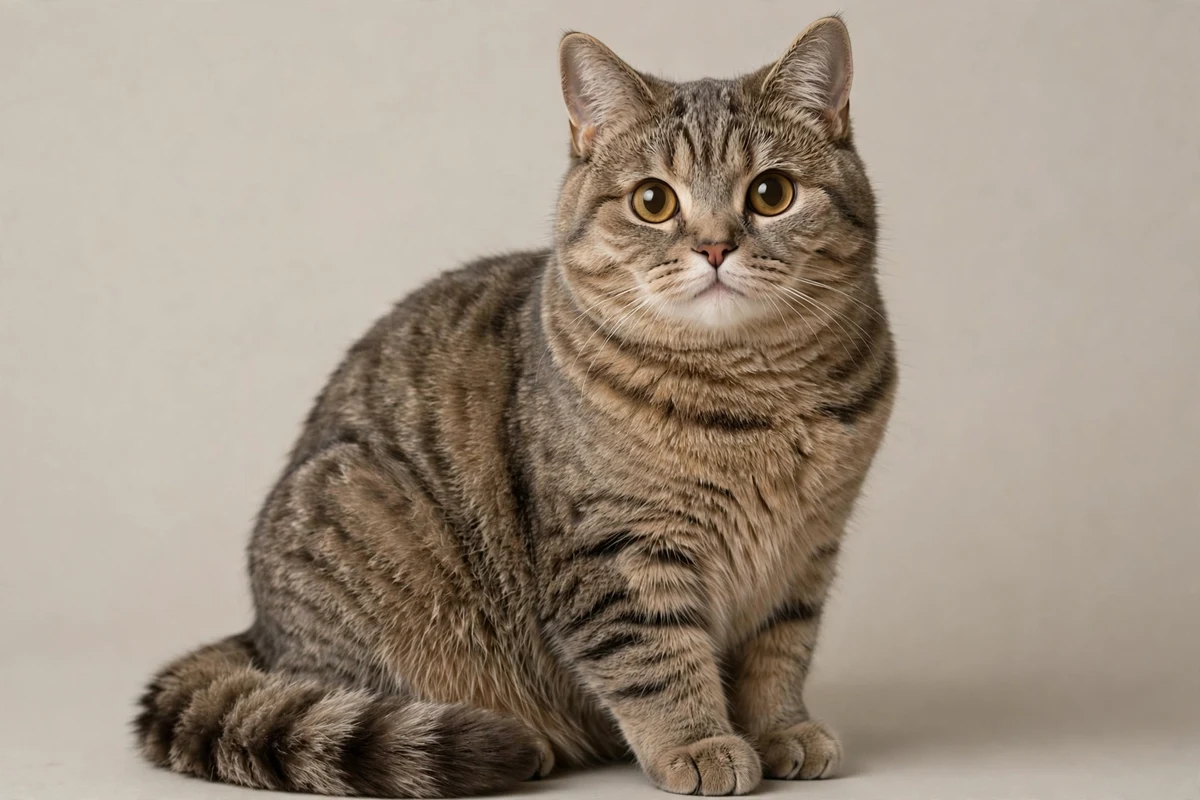
Every member of the Scottish group shares the same outline: a round head with full cheeks, large round wide set eyes, a short muzzle, and a sweet, open expression. The body is medium, round and sturdy, well padded, on medium length legs, with a medium to long tail that should be flexible and proportioned to the body. Reported weight for the group is 6 to 13 pounds overall, with males 9 to 13 pounds and females 6 to 9 pounds. The look is soft and teddy bear like without being exaggerated, and the roundness is the first thing to look for when comparing a Scottish cat with a slimmer breed.
Folded ears: single, double, and triple folds
Folded ears fold forward and downward, lying close to the head so the head looks even rounder. Folds are described as single, double, or triple, according to how tightly the ear folds. A triple fold lies flattest and gives the classic owl like look that made the Fold famous. Folded ears are the only feature that separates a Fold from a Straight littermate; body, coat, eyes, and temperament are shared. The Fold profile linked above covers folded ear care and the welfare debate in full.
Straight ears: upright, medium, with rounded tips
Straight ears are upright, medium in size, with rounded tips, set wide apart on the round head. They give the cat an alert, open expression that is quite different from the owl look of a Fold, even though the rest of the cat is the same. A Scottish Straight is easy to mistake for a British Shorthair at a glance, and the comparison is fair, since British Shorthairs helped build the look. The difference is in the details: the Scottish Straight carries the group history, the group temperament, and the longhair option in the same litter system, and its papers should name it as a Scottish Straight rather than as a British Shorthair.
Coats and colours, short and long
The coat is dense and plush in both lengths, in almost every colour and pattern, including solid, tabby, bicolour, tortoiseshell, calico, and pointed in TICA’s account. VCA notes pointed colours as an exception for Folds, so this guide flags that registry difference rather than smoothing it over: ask which registry a kitten is registered with if pointed colour matters to you. Tabby patterns include classic, mackerel, and spotted forms, and eye colour often coordinates with coat colour, with copper, gold, green, and blue eyes all appearing across the group. The longhair coat is dense and plush rather than fine and silky, which is why its grooming needs differ from a longhair breed built on a silk coat.
Temperament and daily life
Calm, loyal, and close without being clingy
Scottish cat temperament is described by TICA as intelligent, inquisitive, loyal, laid back and quiet, following people from room to room, often preferring four feet on the floor to being carried. That last detail matters: these are close cats, not lap cats in the carried sense. They like to be near their people, on the floor beside a chair or on a sofa cushion nearby, rather than held for long periods. The voice is quiet and soft, which makes the group a good fit for homes that want company without constant talking.
One claim this guide does not repeat is that Straights are more active and playful than Folds because of the fold gene affecting brain structure. TICA says the group shares personality across ear types, and no source in this set supports that brain claim. Treat ear type as an ear difference, not a personality difference.
The Buddha sit and other group habits
The famous Buddha sit, sitting upright with legs stretched out in front like a person, is reported across the group and is often photographed in Folds, but it is a group habit rather than a Fold only trick. Scottish cats also lie flat on their backs, stretch out fully, and sleep in odd, relaxed positions that show how comfortable they are in the home. These postures are part of the breed’s charm and a useful sign that a cat feels safe: a tense cat does not sit upright with its belly exposed.
Children, dogs, and other cats
Scottish cats are reported as good with children and, after proper introduction, with other pets. Their calm, laid back nature and quiet voice make them forgiving of gentle children, and their people following habit means they tend to join family life rather than hide from it. As with any breed, introductions should be gradual, with separate spaces at first and supervised meetings, especially with dogs. A Scottish cat that can retreat to a high perch or a quiet room will settle faster than one forced into immediate contact.
The ear gene and health, stated honestly
This section is a summary. The Fold profile carries the full health detail and the welfare debate, and readers who want folded ears should read it before deciding. What follows is enough to make an honest choice between ear types.
What the fold gene does beyond the ears
The fold gene affects cartilage beyond the ears. For Folds, osteochondrodysplasia linked to the fold gene is reported, with joint stiffness, tail stiffness, and mobility change as signs to watch. Welfare sources in this set frame the issue strongly: because the trait and the disease share one gene, every Fold carries osteochondrodysplasia to some degree. Other sources in the same set have called the Fold a healthy breed, and this guide does not repeat that line uncritically, because it conflicts with the welfare evidence. The honest summary is that folded ears come with a cartilage cost, and the severity varies between individual cats.
Why Fold to Fold breeding is avoided
Responsible breeders pair Fold with Straight rather than Fold with Fold. The reason follows from the gene: two copies of the fold gene raise the risk and severity of joint disease, while a Fold to Straight pairing keeps the fold trait in about half the litter without doubling the gene dose. The 1977 report that one third of kittens from folded eared pairings developed osteodystrophy is the historical basis for this rule, and it remains the standard practice described across the sources.
What is different for straight eared cats
For Straights, the fold related joint condition is not carried in the same way, because Straights do not carry the active fold trait. That makes the Straight the lower risk choice for joint disease within this group, and it is the main health reason some buyers choose a Straight over a Fold while keeping the same look and temperament. It does not make Straights free of all health risk, and the next section covers what still needs screening.
Ordinary screening still worth asking about
Polycystic kidney disease and hypertrophic cardiomyopathy are reported in the group, and Catpedia lists progressive retinal atrophy and hypertrophic cardiomyopathy as conditions to watch for Straights. Ask breeders about screening for kidney and heart conditions, and ask a vet about a screening plan for any Scottish kitten, folded or straight. Ear checks also belong in ordinary care, more so for folded ears, which can trap wax, but straight ears still benefit from a regular look.
Care by coat length
Shorthair grooming
Weekly brushing suits the dense plush shorthair coat, removing loose hair and keeping the coat even. The shorthair does not need daily grooming, and a weekly session also gives the owner a chance to check ears, teeth, nails, and body condition in one pass.
Longhair grooming
Longhair grooming runs two to four times a week depending on source, with a comb or slicker brush worked through the dense coat to prevent tangles, especially around the neck ruff and the tail. The longhair coat is plush rather than silky, so it mats differently from a silk coated breed: tangles form where the coat is thickest, and regular combing through those areas matters more than a quick surface brush.
Weight, play, and ear checks
Measured portions matter for this group, because the round, well padded body can gain weight without the change being obvious under a plush coat. Play should be daily but calm: interactive toys, gentle fetch, and climbing perches suit a laid back cat better than high intensity exercise sessions. Ear checks are part of the weekly routine, with folded ears checked more carefully for wax build up, and nail trimming and dental care completing the ordinary routine.
Is a Scottish cat right for your home
Choose the Fold profile if you want folded ears
Choose a Fold if the owl like look is what you love, and you have read the full health section in the Scottish Fold profile and are comfortable with the cartilage risk and the vet screening it implies. A Fold suits a calm home that can watch for joint stiffness and keep vet visits regular.
Choose a Straight if you want the same look without the fold gene
Choose a Straight if you want the round head, the calm temperament, and the plush coat without the fold gene and its joint risk. A scottish cat of the Straight type gives you the family look and the family personality with a lower joint risk profile, while still needing ordinary kidney and heart screening. Either choice suits a home that wants a quiet, loyal, people following cat that prefers four feet on the floor to being carried. Compare the Scottish group with other round, calm breeds in the full breed hub before deciding.
Frequently asked questions
Are Scottish Straights a real breed or just Fold kittens
Scottish Straights are a real breed group member, not leftover kittens. TICA defines the Scottish Breed Group as four breeds, and the Straight shorthair and Straight longhair are two of them, born in the same litters as Folds and identical except for ear carriage. The Straight has its own breed standing in the registries that recognise it.
Can you tell at birth which kittens will fold
No. All Fold kittens are born with straight ears, and folding begins between 18 and 24 days according to TICA, or at about 3 to 4 weeks according to other sources. A breeder cannot honestly promise a folded ear kitten at birth, and any promise to do so should be treated with caution.
Are Scottish cats good with children
Yes, with the usual care. Scottish cats are calm, loyal, and quiet voiced, and they tend to do well with gentle children who respect the cat’s preference for staying on the floor rather than being carried. Supervised introductions and a retreat space help any new cat settle with children.
How long do Scottish cats live
Scottish cat lifespan figures differ by source, so this guide presents the broad span rather than one figure. Basepaws and Pets Best give 11 to 15 years for Folds, and Catpedia gives 12 to 16 years for Straights. This article uses 11 to 16 years as the broad reported span across the group and notes the source split. Lifespan in any individual cat depends on genetics, weight, and veterinary care across its life.