
Thai Cat: Breed Guide, Temperament, Health & Best Names
The Thai is the original Siamese, deliberately kept. Everything the world first fell for in the cats of Siam is here: the pale body with dark points, the sapphire-blue eyes, the voice that holds a conversation. What is missing is the exaggeration. Where the modern show Siamese was refined into long lines and sharp angles, the Thai kept the moderate build and rounded cheeks of the cats in the early photographs, and it is now recognised as a breed in its own right for doing exactly that.
That makes the Thai the cat for people who love the classic Siamese look and personality but not the extreme modern type. In Thailand this is still the Wichien Maat, the native pointed cat described in centuries-old poems. In the West it answers to Thai, Old-Style Siamese, Traditional Siamese or Classic Siamese, and to a nickname it never asked for: applehead.
History: The Siamese Split
📖 Breed History
The Thai descends from the Wichien Maat, the pointed cat of Thailand, cherished there for at least 700 years and described in the Tamra Maew, the Cat-Book Poems of the Ayutthaya era. The Thai shares its homeland with a whole family of native cats, including the Sam Sawet, another ancient Thai breed. The breed’s Thai name is often translated as "moon diamond". In its homeland this cat was never lost; it is the Western branch of the family that wandered away from the original, and then had to find its way back. The deep history is shared with the Siamese, and our Siamese breed profile tells the royal-court story in full.
Pointed cats reached Britain and America in the late 1800s and were exhibited as Siamese, after Siam, the old name for Thailand. Western breeders then set about improving the import: deeper blue eyes first, then steadily longer heads, finer bones and slimmer bodies. By the 1950s the show-ring Siamese was a far more elongated, angular cat than the one that had arrived seventy years earlier.
Not everyone followed. From the 1950s onward, some breeders kept breeding the moderate, early-1900s type, but by the 1980s that cat could no longer win against the extreme one, and preservation clubs formed in Europe and North America to protect it. Europe moved first on paper: in 1990 the World Cat Federation recognised the old type as a separate breed with full championship status and gave it the name Thai, to set it apart from the show-style Siamese.
North America caught up through TICA: Preliminary New Breed status in 2007, Advanced New Breed in 2009, and championship status from 2010, made permanent in 2013. FIFe added the Thai to its preliminary recognised breeds in 2015. Since 2001, breeders have also imported native pointed cats directly from Thailand to widen the gene pool, and TICA registers documented Thailand imports as Thais. The CFA, meanwhile, still recognises no separate Thai breed; in that registry, cats of this type are registered as Siamese.
Thai vs Modern Siamese
The fastest way to understand the Thai is to stand it next to its famous relative. The two share common ancestry, the point colouration gene and the outgoing personality. They differ in type: the conformation of the body and head.
| Thai | Modern Siamese | |
|---|---|---|
| Head | Modified wedge with rounded cheeks and a long, flat forehead; softly wedge-shaped muzzle | Long, fine, tapering wedge; angular, with straight lines running nose to ear tips |
| Body | Moderately long and substantial, medium bone; lithe, like a small panther | Svelte and tubular; fine-boned and very slim |
| Ears | Medium to large, broad at the base with slightly rounded tips, set fairly high | Strikingly large and wide-set, continuing the lines of the wedge |
| Eyes | Large, intense blue; upper lid almond-shaped, lower lid rounded | Almond-shaped and slanted; always blue |
| Coat | Short, silky single coat, lying close; always pointed | Short, fine and glossy, lying close; always pointed |
| Temperament | Vocal, social, intensely people-bonded | Vocal, social, intensely people-bonded. The split was about looks, not personality |
| Registry status | A breed of its own in TICA, WCF and FIFe; not recognised separately by the CFA | Championship breed in every major registry |
One honest nuance: "Thai" is a registry name, not a guarantee of a look. A cat described as an applehead or traditional Siamese is not automatically a registered Thai; the registered breed follows the TICA and WCF standards, and both describe a modified wedge head rather than a round apple. For the modern side of the family, see our Siamese profile.
Appearance: The Classic Look, Kept
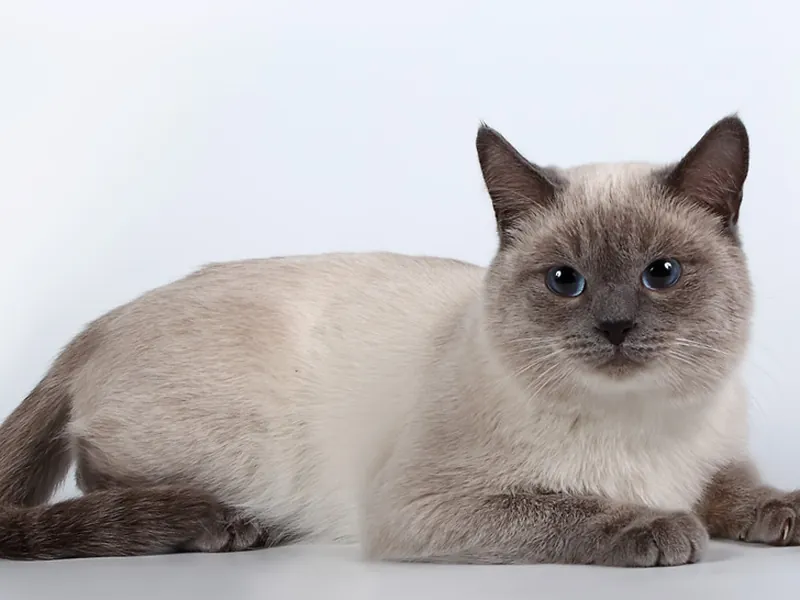
The trademark is the head. The forehead is long and flat, the cheeks are full and rounded, and from those rounded cheeks a distinctly wedge-shaped muzzle projects, ending in a soft, spade-shaped tip rather than a point. The profile runs nearly straight, with no more than a slight dip at eye level. It is a head with curves where the modern Siamese has angles, though breeders will tell you the standard is a modified wedge: applehead is a nickname, not the blueprint.
The body is foreign type without the extremes: moderately long, lithe and graceful, with medium bone and firm muscle, carried on medium legs. The tail is long, roughly the length of the torso, and tapers gently. The ears are broad at the base and set relatively high on the head. The eyes are large and always blue, and the WCF standard asks for them as intense and dark as possible.
The coat is a tropical cat’s coat: short, silky and close-lying, a single coat with little to no undercoat, soft rather than slick or plush. Colour is always pointed, a pale off-white to warm fawn body set against darker ears, mask, legs and tail, and the registries accept all pointed colours without white, from the classic seal, chocolate, blue and lilac to red, cream, cinnamon and tabby points. Kittens are born pale and develop their points as they grow; the temperature-sensitive genetics behind that trick is a great story, and it is told on the Siamese page.
Temperament & Personality: The Original Companion
TICA’s own breed introduction puts it plainly: living with a Thai is like living with a small child. Thais are highly intelligent, curious, active and people-loving, with what the registry calls a great sense of humour. They greet you at the door and start chatting. They follow you from room to room in order to help, communicate with taps of the paw, and regard your shoulder as a legitimate seat. This is the personality that made the early Siamese famous, preserved along with the look.
They are great talkers, though owners often describe the delivery as conversational rather than strident: chatty, not necessarily loud. The catch is the emotional contract. A Thai needs a response and daily attention, and one that feels ignored will act out. Physically the breed is low-maintenance; emotionally it is anything but. Give a Thai your time, and the friendship deepens for years.
Care & Grooming
Grooming genuinely is minimal. The short single coat asks for no routine beyond an occasional brush or a rub-down with a damp hand to lift loose hairs; TICA notes that Thais are essentially self-cleaning. Add the standard basics: nail trims, dental care, sensible feeding and regular veterinary check-ups.
The real care budget is time and company. Plan daily interactive play for a bright, athletic cat, and think twice about a Thai for a home that stands empty all day; a second cat is a common and sensible arrangement for this sociable breed. Keep Thais indoors or supervised outdoors. And remember the tropical coat: in cold weather a Thai will claim the warmest spot in the house, which is usually you.
Health Notes
The Thai is generally a healthy, long-lived breed, helped by a preservation programme that treats genetic diversity as a goal in itself: outcrosses to moderate-type Siamese and documented imports from Thailand keep the gene pool wide. Fifteen years is a common benchmark for the family, lifespans into the late teens are widely reported for Thais, and some reach their early twenties. Treat those numbers as the shape of the breed’s reputation rather than a promise for any individual cat.
There is no long list of conditions proven to be specific to the Thai, and that honesty matters. The watch-points vets discuss come from the wider Siamese family the Thai shares blood with: amyloidosis, a protein-deposition disease of the liver and kidneys documented in Siamese lines; hereditary retinal degeneration, for which DNA testing exists and responsible breeders screen; feline asthma; and hypertrophic cardiomyopathy, a heart condition reported across the family. None of these is a reason to avoid the breed. They are reasons to ask a breeder what screening the parents had, and to keep up routine vet care. These are general, widely published family notes, not medical advice; your vet is the authority on your cat.
Living With a Thai
A Thai suits a household that wants to be involved with its cat: people who are home for a good part of the day, families with respectful children, and multi-pet homes where a devoted, supervisory companion is welcome. Expect help with cooking, working and bathing, whether you requested it or not; Purina’s breed guide warns that you may have to fish a Thai out of the bath. Expect conversation at hours of the cat’s choosing. If this is your first cat, our new cat owner starter kit covers the essentials before the supervisor arrives.
What a Thai does not suit is being decoration. This is the original companion cat, and it intends to companion.
Best Names for a Thai
Names that fit the cat that kept the classic look: genuine Thai names from our database, and jewel-and-moon picks honouring the Wichien Maat itself. Every meaning below comes from our name database; nothing here is invented.
Two deserve a word. The breed’s own Thai name is often translated as "moon diamond", and our database holds both halves: Chandra, recorded as Sanskrit for "moon", and Ploy, Thai for "gem; precious stone". Malee ("jasmine flower") and Kamala ("lotus") keep the Thai garden theme, Nok ("bird") suits the household chatterbox, and Mongkut ("crown") remembers the royal courts of Siam. You will find more on our Siamese cat names list, browse cat names from around the world, or dig through the gemstone cat names.
Frequently Asked Questions
Is a Thai cat just an old-style Siamese?
Essentially, yes, and by design. The Thai is the registered preservation of the original Siamese type: the moderate cat of the late 1800s and early 1900s, before show breeding stretched the breed into its modern form. The registries needed a distinct name so the old type could have its own standard and show classes, and they settled on Thai, the name Europe had used since 1990. Old-Style Siamese remains the descriptive name many breeders and owners use, especially in North America, and in Thailand the same cat is simply the Wichien Maat.
What is the difference between a Thai and a Siamese?
Ancestry, no; shape, yes. Both descend from Thailand’s pointed cats and share the pointed coat, blue eyes and talkative, people-obsessed personality. The difference is type: the Thai is moderate, with rounded cheeks, a modified-wedge head and a substantial body, while the modern Siamese is the extreme version, all long lines and angles. Our Siamese breed profile covers the modern breed in full.
Are Thai cats as vocal as Siamese?
They are famous talkers from the same vocal family, and a Thai will greet you at the door with a running commentary. Many owners and breed guides describe the Thai delivery as a little softer than the modern Siamese at full volume; Purina calls the breed talkative in a "less demanding or strident way" than other foreign types. But a quiet breed this is not. Talk back, and you have a conversation partner for life.
How long do Thai cats live?
They are known for longevity. Fifteen years is a common benchmark for the wider family, Thai lifespans into the late teens are widely reported, and some cats reach their early twenties. Sound breeding, a lean weight, indoor living and routine veterinary care stack the odds in your cat’s favour.
Do Thai cats need a lot of grooming?
No. The short, silky single coat is one of the easiest in the cat world: an occasional brush or rub-down is plenty, and the breed largely grooms itself. Budget your effort for play and company instead; that is where a Thai spends it.
Is the Thai recognised as a breed everywhere?
Not quite, and the patchwork is part of the breed’s story. The WCF granted the Thai full championship status in 1990; TICA followed with championship status in 2010, made permanent in 2013; and FIFe lists the Thai among its preliminary recognised breeds, added in 2015. The CFA still recognises no separate Thai breed: there, cats of this type are registered as Siamese, as they long continued to be in Britain too.
By Brianna Baxter
Featured photo: Photo: Talar, CC BY-SA 3.0, via Wikimedia Commons.