
York Chocolate Cat: The Chocolate Farm Cat That Nearly Vanished
The York Chocolate is, or was, America’s chocolate cat: a semi-longhair in solid chocolate or pale lilac that appeared by chance on a New York goat farm in 1983 and was bred into a recognised breed from a single kitten named Brownie. It won championship status in smaller registries and WCF recognition, yet it never caught on, and today nobody can say for certain whether any unaltered York Chocolate is still alive.
One honest note first: almost everything documented about this breed comes from a handful of sources, the registry standards (WCF and CCA), Sarah Hartwell’s breed history at Messybeast, and French registry records. This page, part of our cat breed library, sticks to that record, including where the record runs out.
History: One Chocolate Kitten on a Goat Farm
📖 Breed History
In 1983, on Janet Chiefari’s goat dairy farm in Grafton, New York, a black-and-white longhaired farm cat named Blacky produced a litter by a solid black longhair, Smokey. One kitten was unlike any farm cat before her: a solid chocolate-brown longhair. Chiefari named her Brownie, and Brownie became the foundation of a breed.
Noticing Brownie’s build matched the farm’s other longhairs, Chiefari began breeding deliberately. Brownie was mated to Minky, a black longhair who was both her son and her half-brother. On 5 June 1985 they produced Teddy Bear, a green-eyed solid chocolate male, and Cocoa, a chocolate-and-white female. Brownie was then mated back to Teddy Bear, and the five kittens born on 31 December 1988 completed a foundation of eleven chocolate cats. Chocolate-to-chocolate matings produced only chocolate kittens until 1990, when the first lilac, called lavender in the early American standard, and described as a rich, warm cocoa, appeared.
The name is literal: “York” for New York State, “Chocolate” for the colour. In Italy the breed found admirers as Il Gatto Cioccolato, “the chocolate cat”, and an International York Chocolate Federation (IYCF) was founded there in 2003, though it went dormant within a year or two.
The registry story is one of small wins. The Cat Fanciers’ Federation (CFF) accepted it as an experimental breed in March 1990 and awarded championship status shortly afterwards (the breed federation dates it to March 1991). The Canadian Cat Association (CCA) granted championship status in March 1995 and published a standard. The American Cat Fanciers Association registered it only as a “New Breed or Colour”. The one major recognition came in August 2002, when the World Cat Federation (WCF) recognised the breed, under the shorter name “York”. FIFe, TICA and CFA never recognised it at all.
Appearance: Solid Chocolate, Plumed Tail
Most of what can be said with confidence about the York Chocolate’s looks comes from the WCF standard. The body is medium to large and elongated, with substantial bone and firm muscle, a sturdy farm-cat frame, the shoulders and rib cage no broader than the hips. The legs are long and slender, the hind legs set slightly higher than the front, and the oval paws carry tufts between the toes.
The tail is a signature: medium to long, broad at the base, tapering slightly to a rounded tip and fully furnished with flowing hair, a true plume. The head is a modified wedge that looks small against the body, with a slightly rounded forehead, a long straight nose with a slight indentation at eye level, and an elongated, well-defined muzzle that can look almost square thanks to pronounced whisker pads. The ears are large, broad at the base, moderately pointed and tilted slightly forward, with inner tufts.
The eyes are medium-sized ovals, set at a slight slant toward the nose. The WCF standard allows golden, hazelnut and green, preferring pure, deep shades, some pet guides also list blue or odd eyes, but the standard does not.
The coat is semi-long, fine and glossy, with a soft, silky texture and a well-developed undercoat that is not woolly; it lies shorter on the shoulders and lengthens toward the back, with a slight frill at the neck. Two colours, each with or without white: solid chocolate and solid lilac (lavender). A solid cat must be evenly coloured to the roots, with no shading, rusting or tabby markings, though kittens may show ghost markings that fade by ten months, and kittens are born a lighter cocoa, the colour deepening to full depth at around 12 to 18 months. A white locket or belly patch on a solid cat is a fault. On size, the standards give mature males at roughly 10 to 16 pounds and females at 6 to 10 pounds.
Temperament & Personality: The Devoted Farm Cat
The CCA standard sums the breed up in its own words: bright and intelligent, energetic and playful, with an easy-going personality. The breed federation’s description adds devotion, York Chocolates were said to love their owners passionately, mellow lap cats as happy curled up on a person as chasing a toy.
Breed guides round out the picture: a people-oriented cat that follows its household from room to room, communicates more by purring than by meowing, and keeps the farm cat’s hunting instinct, an efficient mouser. Catster’s profile notes a shy streak with strangers, and guides disagree about independence. All of this was written about a very small population, so read it as reported character, not a guarantee.
Care & Grooming
For a semi-longhair, the York Chocolate was considered low-maintenance: the breed standard describes silky fur that needs little grooming and sheds minimally, and because the undercoat is developed but not woolly, it mats far less than many long coats. A weekly comb-through to lift loose hair is the standard advice.
Everything else is ordinary cat care: a cat descended from hunting farm stock needs play that uses the instinct, and any surviving York Chocolate should be kept indoors or in a secured garden. Setting up for a first cat? Our new cat owner starter kit covers what to have ready.
Health Notes
The honest health section for this breed is short. No veterinary literature and no registry source documents a breed-specific disease list for the York Chocolate: it was a naturally occurring breed built from random-bred farm cats, its numbers always too small for a health study or screening programme, and no registry records an inherited condition for it. The health plan for such a cat is the standard one, routine preventive veterinary care.
Lifespan is likewise undocumented. Pet guides print estimates that contradict each other, 13 to 15 years in some, up to 20 in others, and none traces to a study, so this page lists lifespan as not documented rather than repeating a number we cannot stand behind. One old claim deserves a direct answer: the breed federation’s early FAQ repeated owners’ remarks that the cats seemed easy for allergy sufferers to live with. That is anecdote, not evidence; no cat breed is hypoallergenic.
York Chocolate Today: A Breed That May Be Gone
The documented numbers were always tiny. In 2005 there were around 60 York Chocolates in existence. French registry (LOOF) records show just ten kittens born in France between 2005 and 2010. The WCF’s Best Cat database holds no York records at all, meaning none have been shown at WCF shows since the 2010s. In 2016 the last remaining known breeder, Debbie Reber, ended her breeding programme.
The paper trail has gone quiet, too: the CCA standard has been labelled “dormant” since 2020, the CFF lists the breed’s name but publishes no standard or status, and the Italian IYCF has been dormant since about 2004.
So is it extinct? As of 2026, Wikipedia’s assessment is that it is unknown whether any unaltered York Chocolate cats are still alive, and that if the breed exists at all it must be in critically small numbers. Some websites declare it flatly extinct, but no registry keeps a live census, and unregistered chocolate longhairs descended from the lines could exist as pets, so “likely extinct, or nearly so” is as far as the record honestly goes. Treat any kitten offered for sale under this name with care, and ask for a pedigree.
Names for a York Chocolate Cat
A chocolate cat invites chocolate names, Brownie, Teddy and Cocoa were the breed’s own foundation cats. More sweet shades fill our brown cat names list; browse the full cat name library or try the cat name generator.
Shortlist: Chocolate Names for a York Chocolate
Tap a name to copy it.
York Chocolate Cat FAQs
Is the York Chocolate cat extinct?
Possibly, it is not proven either way. The documented population was about 60 cats in 2005; the last known breeder ended her programme in 2016; no York has appeared in the WCF’s show records since the 2010s. Wikipedia’s 2026 assessment is that the breed is either extinct or in critically low numbers, and that it is unknown whether any unaltered York Chocolates remain alive.
Is the York Chocolate recognised?
Partly, and mostly historically. The World Cat Federation recognised it in August 2002 (as “York”), the only major international registry to do so; FIFe, TICA and CFA never recognised it. The Canadian Cat Association gave championship status in 1995, but its standard has been labelled dormant since 2020, and the Cat Fanciers’ Federation, which gave championship status in the early 1990s, no longer publishes a standard for it.
What colours does the York Chocolate come in?
Two: solid chocolate and its dilute, solid lilac, called lavender in the early American standard, each also recognised with white as a bicolour. Kittens are born a lighter cocoa shade and the colour deepens, reaching full depth at about 12 to 18 months.
How big is a York Chocolate cat?
Medium to large, with a sturdy, elongated farm-cat build. The breed standards put mature males at roughly 10 to 16 pounds and females at 6 to 10 pounds, with long legs, oval tufted paws and a long, plumed tail.
What is a York Chocolate’s temperament like?
By the standard’s own description: bright, intelligent, energetic and playful, with an easy-going personality. Breed accounts add devotion to their owners, a lap-cat streak, a tendency to communicate by purring rather than meowing, and a farm cat’s strong hunting instinct. Those descriptions come from a very small population, so treat them as reported character.
Is the York Chocolate the same as the Havana Brown or the Chantilly-Tiffany?
No, three separate creations. The Havana Brown is an English breed built in the 1950s from Siamese crossed with black domestic cats. The Chantilly-Tiffany is another American chocolate longhair, of unknown origins, developed independently. The York Chocolate came from neither: ordinary New York farm cats, selectively bred from one chocolate kitten.
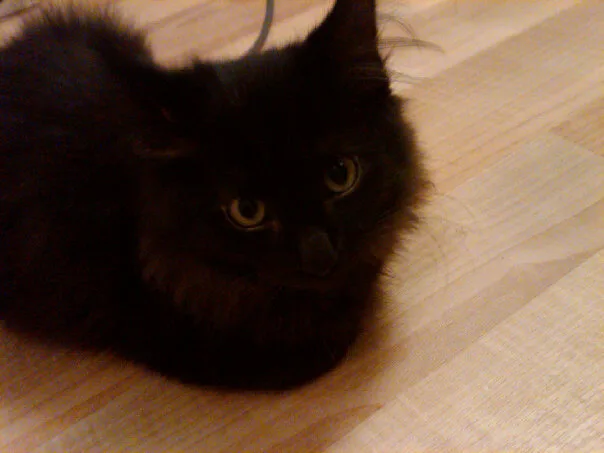
Featured photo: Photo: Xprettybrneyesx, CC BY 3.0, via Wikimedia Commons.
Sources: the WCF breed standard for the York (2010), the Canadian Cat Association breed standard (1995; labelled dormant 2020), Sarah Hartwell’s York Chocolate breed history (Messybeast), the International York Chocolate Federation breed FAQ, and LOOF registry records.