
Should You Dress Up Your Cat for Halloween?
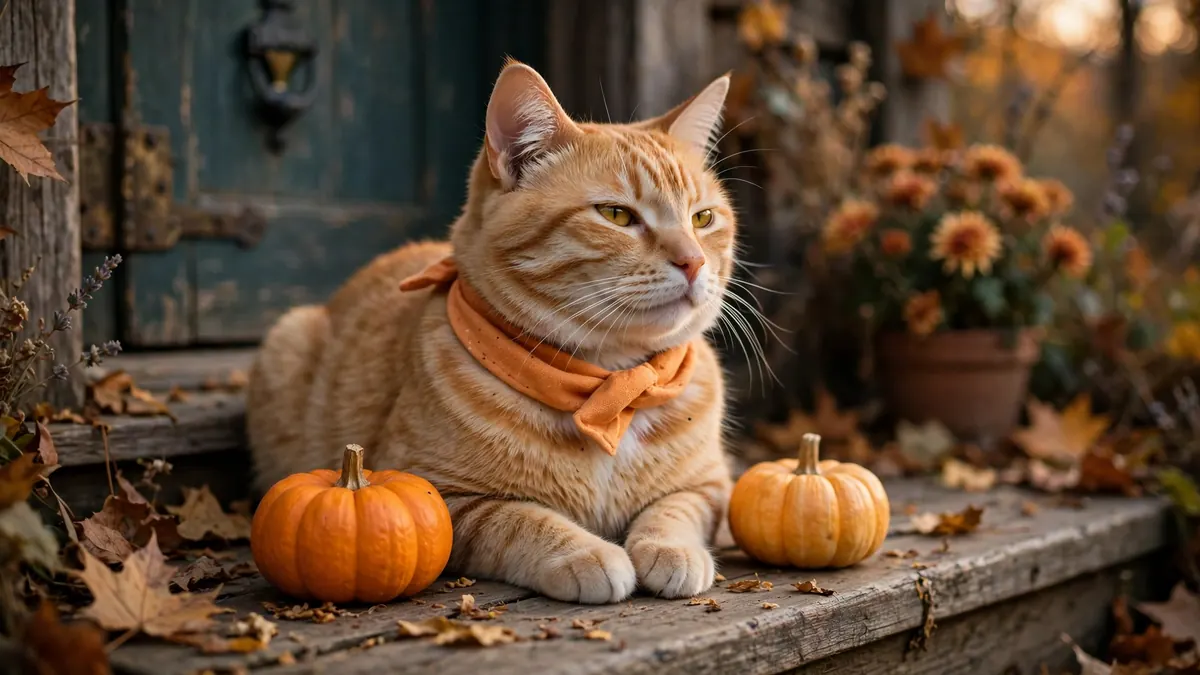
Every October, the same photos flood social media: cats in witch hats, cats in pumpkin suits, cats dressed as tiny superheroes. Some of those cats look fine. Many are telling their owners, in unmistakable cat language, that they are not fine at all, but the owners miss it, because a stressed cat often sits very still for the camera.
So, should you dress up your cat for Halloween? This guide gives the honest answer first, then the conditions under which a costume can be fair to the cat, the stress signals that mean “take it off now,” the safety rules a costume must pass, and the ways to include your cat in the fun that don’t involve clothes at all.
The Short Answer
For most cats: no. The RSPCA’s guidance is blunt, “avoid dressing cats up; most cats will not tolerate nor enjoy wearing any costume”, and Cats Protection simply says to skip costumes altogether, because being confined in clothing is very stressful for cats. The ASPCA is a little softer but points the same way: don’t put a cat in a costume unless you know she loves it. A small minority of cats, usually ones already used to a harness or clothing, will tolerate a simple, safe costume for a few supervised minutes: a quick photo, then off. If in any doubt, the welfare organisations’ advice is unanimous: give it a miss, and use a bandana, a photo backdrop or a Halloween toy instead.
Key Takeaways
- The default answer is no. Most cats find costumes stressful, and welfare charities advise against them for cats in particular.
- A cat that “freezes” in a costume is not posing. Stillness is one of the clearest feline stress signs, the costume comes off, not the camera out.
- If your cat is one of the tolerant few, the costume still has to pass strict rules: nothing over the face or head, no small or dangling parts, full movement, and never, ever, left on unsupervised.
- Trial it days before, not on the night. A failed trial is your answer; Halloween evening, doorbell ringing, is the worst time for a first attempt.
- The best feline “costumes” aren’t costumes. A festive collar, a decorated box, a themed backdrop photo or a new Halloween toy includes your cat without dressing her.
Why Most Cats Hate Costumes
Start with the position of the welfare organisations, stated the way they state it. The RSPCA says most cats will not tolerate or enjoy any costume and advises owners to avoid dressing cats up. Cats Protection tells owners to skip costumes because confinement in clothing is very stressful for cats, and because a cat trying to fight her way out of an outfit can injure herself in the struggle. The veterinary team at Purdue University “strongly encourages” owners to forgo pet costumes entirely, noting that animals not used to clothing find it uncomfortable, unpleasant and stressful. Even the ASPCA, the most permissive of the group, recommends against a costume unless you know your pet loves wearing one.
There are real reasons behind the consensus. A costume covers the tools a cat uses to read the world and to communicate: her ears, her tail, her whiskers, the line of her body. The RSPCA points out that animals signal how they feel through ear, eye, tail and body positions; cover those up and the cat feels more anxious while her owner loses the ability to read her. Fabric against the coat is an unfamiliar, inescapable sensation, a body costume can trap heat, the RSPCA warns body costumes can cause overheating, and anything restricting movement, sight, hearing or breathing turns a photo opportunity into a genuine welfare problem.
None of this makes you a bad owner for having bought the little pumpkin suit. It does mean the burden of proof is on the costume, not on the cat.
The Stress Signs That Mean “Take It Off Now”
If you trial a costume on your cat, her body language is the whole experiment. Any one of these signs ends the session immediately, not after one more photo:
- Freezing or going limp. The RSPCA lists ‘freezing’, difficulty moving normally, up to complete stillness, as a sign of discomfort. Vets make the same point: a cat who goes rigid or flops still in a costume is showing stress, not cooperation, the most misread sign of all.
- Ears rotating sideways or flattening back.
- Crouching low, hunching, or pressing the tail tight against the body.
- Struggling to get out of the costume, wriggling, rolling, pawing or biting at it. The RSPCA: a pet trying to remove the clothing is uncomfortable, and it comes off immediately.
- Lip licking, showing the white of the eye (“whale eye”), or panting. Panting in a cat is never casual.
- Retreating, hiding, or leaning away from you, the cat is voting with her feet.
- Vocalising, growling, hissing or insistent meowing, or swatting. These are escalations; the earlier, quieter signs were the warnings.
Reading cats is a skill worth having beyond Halloween, our guide to your cat’s tail and body language walks through the common signals. And note what is not on the list: a cat sitting still, staring at the camera. That is very often the freeze, not a pose.
If Your Cat Is One of the Tolerant Ones
A small number of cats don’t mind wearing things. They tend to share a profile: introduced to clothing or a harness young, happy in a harness, generally unflappable. If that is your cat, a costume can be fair, under all of these conditions:
- She passed a calm trial in advance (see the trial steps below) with none of the stress signs above.
- The session is measured in minutes. The RSPCA’s rule for even the calmest pet: supervised closely at all times, worn for short periods only. A few photos, then off, a tolerant cat does not need to wear a costume for an evening.
- She stays at home, in a calm moment. Not while trick-or-treaters are cycling through the door, and never taken out trick-or-treating.
- She can walk away. No holding her in place for the camera. If she leaves, the photoshoot is over.
- You are watching her the whole time. Every major source, ASPCA, RSPCA, university vets, gives the same instruction: never leave a costumed pet unattended. A costume that is fine under supervision can tangle, twist or catch the moment nobody is looking.
The Costume Safety Rules
Whatever the costume, it has to pass every rule on this list. One failure is enough to send it back.
- Nothing covering the face or head. The ASPCA recommends avoiding costumes with a headpiece altogether. A costume must never cover the nose or mouth (breathing, eating, drinking), obscure the eyes, or enclose the head, and anything over the ears or pressing on the whiskers dulls the senses the cat navigates by.
- Full movement, always. The ASPCA’s test: the costume must not limit movement, sight or the ability to breathe or meow. She must be able to walk, jump down, turn, and use the litter tray normally.
- No small, dangling or chewable parts. Buttons, bells, sequins and glued-on decorations can be chewed off and swallowed, a choking risk, and swallowed pieces can block the intestines. Texas A&M’s veterinary school singles out ribbons and bows as especially dangerous for cats: swallowed ribbon becomes a “linear foreign body” that can saw through the gut and needs emergency surgery.
- No elastic or rubber bands, especially around the neck. Rubber bands and tight straps can cut off circulation and hide under fur where you won’t notice. Wide, soft, quick-release fastenings are the only acceptable kind.
- Fit in the narrow middle. Too tight means overheating and distress; too loose means tripping, caught claws and snagging on furniture, a trapped, panicking cat. If it doesn’t fit properly, it doesn’t go on.
- No paints, dyes or glitter on the fur. Cats groom. Anything applied to the coat will be licked off and swallowed, quite apart from the stress of applying it. The colour goes on the backdrop, not the cat.
- Non-toxic materials, aired out first. If a costume smells strongly of chemicals out of the packaging, air it fully before it goes anywhere near your cat.
- Distance from flames. A costumed cat near a candlelit jack-o’-lantern is a burn and fire risk, the ASPCA warns that pets easily knock pumpkins over and that curious kittens are at particular risk of singed fur and burns. Battery-powered candles remove the problem; a dressed cat and an open flame should never share a room.
How to Trial a Costume Before Halloween
The ASPCA’s advice is to try any costume on before the big night, and the trial is a process, not a single fitting. Vet-reviewed guidance from Petco lays out the shape of it:
- Days ahead, just let her meet it. Leave the costume where she can sniff and investigate it. Resting it near her bedding lets it pick up familiar smells instead of shop smells.
- First wear: a minute or two, with a reward. Put it on calmly, give a favourite treat for calm behaviour, then take it off. Short and boring is the goal.
- Build up only if she stays relaxed. A few minutes longer next time, only if there were no stress signs at all. End on a good note, before she has had enough, so the costume predicts treats rather than misery.
- On the day: photos, then off. Even a cat who aced every trial wears the costume briefly. Minutes are plenty.
- A failed trial is a result, not a challenge. If she freezes, flattens her ears or fights to get out at any stage, you have your answer: no. Do not re-run the experiment on Halloween night, when the house is loud and the door won’t stop ringing.
Safer Ways to Include Your Cat in Halloween
The photo, the fun and the feeling of including her are all available without a costume.
- A festive collar or bandana. This is the ASPCA’s own suggested alternative. It only works for a cat who already wears a collar happily, choose a lightweight bandana or a Halloween collar with a quick-release (breakaway) buckle, trial it like a costume, and take it off at the first sign of objection. A cat who doesn’t wear collars is not a candidate.
- Dress the scene, not the cat. A pumpkin, some autumn leaves and a themed backdrop behind an un-costumed cat reads perfectly “Halloween” in a photo, and the cat is free to leave whenever she likes.
- A decorated cardboard box. Purdue’s veterinary team suggests this one: a box decorated in Halloween colours becomes both a toy and a photo set that the cat chooses to enter.
- A Halloween toy or blanket. Cats Protection’s alternatives: a safe Halloween-themed toy to play with, or a cosy spooky blanket to snooze on. Festive for you, genuinely enjoyable for her.
- Celebrate the season on paper instead. Naming a new autumn kitten? Our list of Halloween cat names, Spooky, Pumpkin, Salem and 150 more, marks the season with zero stress.
Disclosure: this article contains affiliate links. If you buy through one of them, we may earn a commission at no extra cost to you, as explained on our affiliate disclosure page. Nothing here is sponsored, and the welfare advice above does not change because a product is linked.
One More Thing: Halloween Night Itself
Even the rare cat who tolerates a costume shouldn’t be wearing one while the doorbell cycles all evening. Costumed strangers, noise and a constantly opening front door are stressful and create an escape risk; the ASPCA advises keeping all but the most social pets in a separate room during peak trick-or-treating, with ID and microchip details up to date in case a spooked cat slips out. Keep the candy bowl away from that room too, chocolate is genuinely toxic to cats, as our guide to cats and chocolate explains. Our full holiday safety guide covers the whole season, Halloween candy, Christmas tinsel, New Year fireworks, in one place. And if this is your cat’s first Halloween in your home, the seasonal section of our new cat owner starter kit is worth ten minutes before the decorations go up.
Frequently Asked Questions
Is it cruel to dress up a cat for Halloween?
It depends on the cat and on how it’s done. Forcing a stressed cat into a costume for a photo is unfair, the RSPCA advises avoiding dressing cats up, since most won’t tolerate or enjoy it, and Cats Protection calls clothing confinement very stressful for cats. A genuinely tolerant cat in a safe costume for a few supervised minutes is a different situation. The line is the cat’s reaction, and she draws it.
How long can a cat wear a Halloween costume?
Minutes, not hours, and supervised the entire time. The RSPCA’s rule for any pet in a costume is close supervision at all times and short periods only. For a cat who passed a proper trial, think of a short photo session: costume on, a few pictures, costume off, treat given.
My cat freezes and sits still in her costume. Does that mean she’s okay with it?
Almost certainly not. Freezing is a recognised stress sign, the RSPCA lists it as difficulty moving normally and a marker of discomfort, and vets warn that a cat who goes rigid or still in a costume is showing stress, not posing for you. A still, staring cat in a costume is usually a cat waiting for it to be over. Take it off.
Are cat hats and ear headbands a safer compromise?
Not really. Headpieces are the part the ASPCA specifically recommends avoiding, and anything that covers the ears, presses on whiskers or can slip over the eyes fails the basic safety rules. Most cats object to headgear even more than to body costumes. If you want a touch of Halloween, a festive collar or bandana, on a cat who already wears one happily, is the safer compromise.
My cat wears a harness and a winter sweater happily. Can she wear a costume?
She is the best candidate there is, a cat already relaxed in clothing is the exception the welfare guidance allows for. The same rules still apply: no headpiece, no small or dangling parts, full movement, minutes only, supervised throughout, and off at the first stress sign. A sweater habit doesn’t make an elaborate costume safe; it just means a simple one might be tolerated.
What is the safest “costume” for a cat?
Honestly, none, and that’s a complete answer, not a dodge. The closest things are a lightweight festive bandana or breakaway collar on a collar-happy cat, a themed photo backdrop with the cat sitting in front of it undressed, or a decorated box she can climb into by choice. All three give you the photo; only one asks anything of the cat, and even that one she can refuse.
Halloween belongs to people; your cat’s part in it should be the parts she would choose herself, a new toy, a warm blanket, a quiet room away from the doorbell, and maybe a photograph she wandered into. Dress up the house, dress up yourself, and let the cat attend as the one creature who never needs a costume.