
Siamese Cats: The Talkative Blue-Eyed Royals of Thailand
Nobody owns a Siamese. You enter into a long-term discussion with one. This is the most vocal breed in the cat world: a sleek, blue-eyed philosopher who comments on your cooking, argues with your schedule, and greets you at the door with a full report on everything you missed. A Siamese does not meow so much as converse, with a famously low, raspy voice that has strong opinions about dinner being three minutes late.
Behind the chatter is one of the oldest and most refined breeds in existence, straight out of the royal courts of Siam. Lithe, elegant, and intensely bonded to its people, the Siamese is the cat for someone who wants a companion with presence, personality, and absolutely no off switch.
History
📖 Breed History
The Siamese descends from the Wichianmat landrace cats of Thailand, prized in the royal court of Siam for centuries. The breed is one of the first distinctly recognized domestic cat breeds anywhere. The first Siamese were exported to the United States in 1878 and to Britain in 1884, the first documented US arrival was a cat named Siam, presented to President Rutherford B. Hayes by the American consul in Bangkok (CFA), the first dedicated breed club was founded in Britain in 1902, and the Cat Fanciers' Association recognized the breed in 1906. In the 1950s, breeders refined the breed toward the modern extreme: a longer, more angular, wedge-headed cat. The older, rounder style split off officially from the 1980s onward and is now recognized separately as the Thai. The Siamese became foundation stock for several other breeds: crossed with Persians it produced the Himalayan, the longhaired version is the Balinese, and Siamese genes run through the Oriental, Colourpoint Shorthair, Cornish Rex, Sphynx, and Peterbald. Siamese blood also flows in the Havana Brown, the solid chocolate breed created from chocolate and seal point Siamese crosses. The most deliberate of those crosses is the Tonkinese, created from Siamese and Burmese stock to blend both parents into a single aqua-eyed cat. Siam also gave the world the Khao Manee, the pure-white white gem of the same Tamra Maew manuscripts. Thailand’s other ancient breed is the Korat, the silver-blue good luck cat of the same Cat-Book Poems.
Appearance
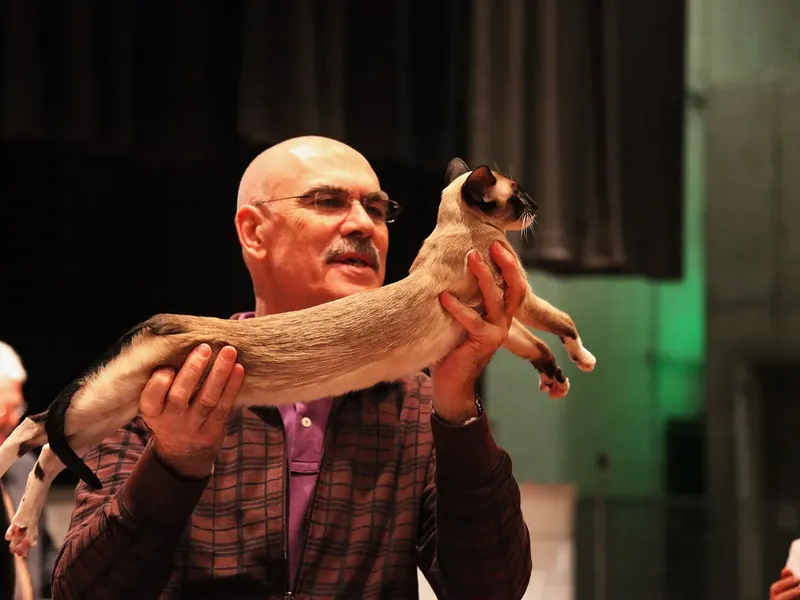
The modern Siamese is a study in long lines. The body is medium-sized, svelte, and tubular: fine bones wrapped in firm muscle, long slim legs, a long neck, and a long thin tail tapering to a fine point. The head is a long tapering wedge, with the triangle running from the tip of the nose to the tips of the ears, and the ears themselves are strikingly large, pointed, and wide at the base. The eyes are almond-shaped and slanted, and always blue. The coat is short, fine, and glossy, lying close to the body.
Then there is the colorpoint magic, which is genuine science. The pointed pattern comes from a temperature-sensitive form of albinism: the enzyme that makes pigment only works in the cooler parts of the body, so the ears, face, legs, and tail darken while the warm torso stays pale. Kittens are born white or cream and develop their points over the first months, and adults slowly darken with age. Classic point colors are seal, chocolate, blue, and lilac, with red, cream, lynx, and tortie points recognized in other registries.
Temperament & Personality
Social, vocal, intelligent, affectionate: again, the sheet nails it, but you have to live it to believe it. A Siamese bonds intensely with its people, often picking one favorite human and supervising them full-time. It insists on joining everything: your lap, your desk, your shower, your phone calls. It plays fetch, learns tricks, and holds forth on every topic in a famously wide range of cries. Owners describe the voice as low and raspy, and the delivery as relentless. A bored Siamese is a destructive Siamese, because this is one of the cleverest breeds alive, CFA notes the Siamese is often considered the most intelligent of cats, and it needs a job. Give it company, play, and conversation, and you get the most devoted companion in the cat world.
Care & Grooming
Grooming is nearly effortless: the short, close-lying coat with no heavy undercoat needs only an occasional wipe or quick brush. CFA's grooming tip is disarmingly simple: wet your hands and stroke the coat until your hands are dry, gently removing the dead hair. The real care budget is time. Siamese cats need daily interactive play, mental stimulation, and, above all, companionship: they do poorly left alone for long hours and do best in homes where someone is around, or with another cat for company. Keep them indoors; their curiosity and confidence are a bad combination with traffic. Puzzle feeders, tall scratching posts, and rotating toys keep the clever brain busy. They are fine-boned but muscular, so feed for a lean, athletic condition and keep up with routine veterinary care. If your Siamese narrates your life, our funny cat names might have the perfect credit line.
Health Notes
Siamese are generally a healthy, long-lived breed. The historical crossed eyes and kinked tails of early imports were long ago bred out and are considered faults today. The breed-specific conditions to be aware of are progressive retinal atrophy (PRA), which can cause blindness and is detectable by genetic testing; amyloidosis, which can damage the liver (CFA advises asking whether there is any history of it in a kitten's lines); and asthma, with coughing, wheezing, and breathing difficulty. Siamese can also be prone to pica, especially wool-sucking, which can cause life-threatening intestinal blockages (PetMD). The Siamese's wedge-shaped head also brings a higher risk of periodontal disease, so brush your cat's teeth with a cat-safe toothpaste (Purina, PetMD). As with any purebred, responsible breeding and routine veterinary care matter most: choose breeders who raise kittens in the home and test their lines, keep your cat at a lean weight, and discuss age-appropriate screening with your vet. A well-bred Siamese is a sturdy, energetic companion often living well into its teens (PetMD).
Best Names for a Siamese
Thai royalty, sapphire eyes, and that famous voice: eighteen names with real meanings for the most talkative cat alive.
Frequently Asked Questions
Why are Siamese cats so vocal?
It is the breed's signature trait. Siamese were selectively bred for sociability, and their famously wide range of low, raspy cries is how they run their household commentary. They talk to bond, demand, complain, and celebrate.
Are Siamese kittens really born white?
Yes. The colorpoint pattern comes from temperature-sensitive albinism: pigment only develops in the cooler extremities. Kittens are born white or cream, and the points darken over the first months of life.
Do Siamese cats get along with other pets?
Generally well. They are social and often thrive with another cat or a cat-friendly dog, especially since they hate being left alone. Proper introductions still apply.
Are Siamese cats hard to care for?
Grooming is easy, but the breed is high-maintenance in attention. They need daily play, mental stimulation, and lots of companionship. A lonely, bored Siamese will invent trouble.
What is the difference between a Siamese and a Thai cat?
The Thai is the older, rounder, traditional-style Siamese, recognized as a separate breed from the 1980s onward. The modern Siamese is longer, leaner, and more angular with the extreme wedge head.
Do Siamese cats stay blue-eyed?
Yes. Blue almond-shaped eyes are a defining breed trait, though the exact shade varies from pale sky to deep violet-blue.
What breeds make up a Siamese cat?
None, the Siamese is a naturally occurring landrace, the Wichianmat of Thailand, not a mix of two pedigree breeds. It is one of the parent breeds other breeds were made from, not the other way round (see the History section above).
Are Siamese cats hypoallergenic?
No. There is no such thing as a truly hypoallergenic cat: the main allergen is in saliva and skin glands, not fur. A Siamese's short coat sheds less than some breeds', which can help, but it will still trigger susceptible people (PetMD).
By Brianna Baxter
Featured photo: Photo: Pieter Lanser, CC BY 2.0, via Wikimedia Commons.
The Siamese founded a whole family: cross it with an American Shorthair and you get the Snowshoe, while its own traditional form is preserved as the Thai cat. For the classic head-to-head, see Siamese vs Burmese.