
Nebelung Cat: Breed Profile, Temperament & Best Names
Some cats are named for places. The Nebelung is named for weather. Nebelung means “creature of the mist”, from the German Nebel, mist or fog, and one look explains it: a semi-long blue coat frosted with silver at the tips of the guard hairs, so the cat seems to stand in its own private fog, wide-set green eyes shining through. It is one of the cat world’s most beautiful silhouettes, and one of the rarest.
Under the coat is a particular kind of companion. The Nebelung bonds the way its cousin the Russian Blue does, deeply, selectively, often to one or two people, but everything runs quieter and slower: a soft voice, gentle manners, a devotion to routine, and a long, patient courtship before a stranger is trusted. It chooses you once, then follows you from room to room for years.
Below: the breed’s creation in 1980s Denver, how the shimmer coat works, why routine matters, the honest health picture, a side-by-side with the Russian Blue, and names drawn from mist, silver and German.
History
📖 Breed History
The Nebelung was created in Denver, Colorado in the 1980s by breeder Cora Cobb of Nebelheim Cattery. Its foundation cats were two longhaired blue kittens, Siegfried (born 1984) and Brunhilde (born 1985), born to Elsa, a black domestic shorthair, and a blue domestic longhair father. Cobb built the programme with Russian Blues as the outcross, aiming to recreate the longhaired blue cats of 19th-century Russia.
The names were a programme in themselves. Siegfried and Brunhilde are the hero and heroine of the Nibelungenlied, the medieval German saga Wagner turned into the Ring cycle, Cobb was a Wagner admirer, and Nebelung itself plays on Nebel (mist) with an ear toward Nibelung. The kittens looked like long-coated Russian Blues, and the first breed standard, drafted with TICA geneticist Dr Solveig Pflueger, was essentially the Russian Blue standard plus the coat; the pair’s first kittens arrived in 1986.
Russian Blue breeders in TICA objected to that framing, so the standard was revised to describe a distinct new breed, one recreating the type of the blue-grey cats imported from Russia in the late 19th and early 20th centuries. Longhaired blues had been shown as far back as the first Crystal Palace cat shows of 1871, then faded from view as the cat fancy contracted. TICA granted the Nebelung New Breed status in 1987 and full championship in 1997. It now also holds recognition with the ACFA, the WCF, LOOF and the ACF, with preliminary status at the GCCF; the CFA still does not recognise it.
The story took an unexpected turn in the early 1990s, when longhaired kittens began appearing in Russian Blue litters in Russia itself, proof that the recessive longhair gene had been riding along in the Russian Blue population all along. In 1993, Dutch breeder Letty van den Broeck imported a Russian Blue male, Timofeus, from Russia; semi-longhaired, he was the first known longhaired Russian Blue stud in Western Europe. Cobb later brought a Moscow-bred Nebelung male into her own lines, and the American, Russian and European branches of the breed merged. Our Russian Blue profile covers the parent breed in full.
Appearance: Silver-Blue, Seen Through Mist
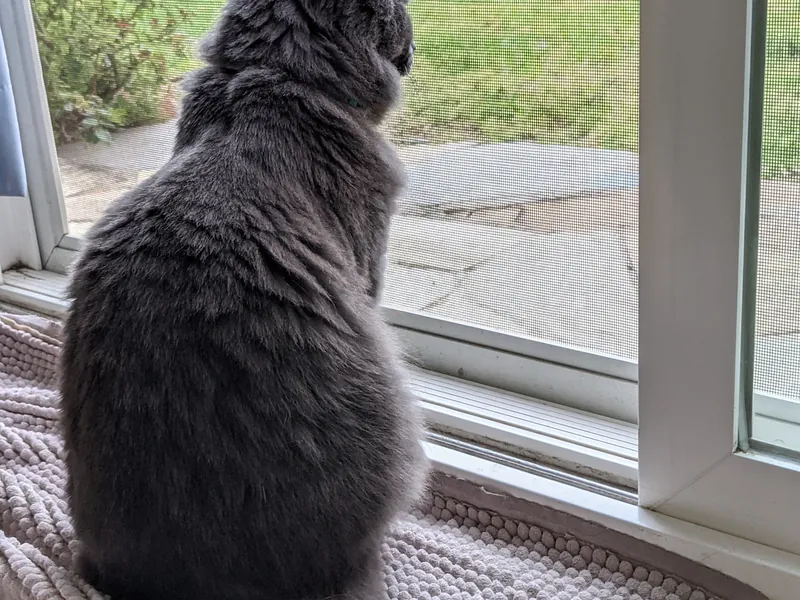
The shimmer is structural. A Nebelung’s coat is a true double coat: a fine, soft undercoat beneath longer guard hairs, every hair an even medium blue, sound to the roots, and the guard hairs are tipped with silver. Those pale tips catch the light over the blue beneath and produce the breed’s signature luminous haze, the mist made visible. TICA describes a silky-soft coat with a luminous, misty aura, and the effect is most obvious when the cat moves.
The coat is dressed unevenly, like a cat in formal wear: longest over the tail, which carries a full, thick plume; feathering behind the ears; britches, “pantaloons”, on the hind legs; and, on males, a distinct ruff around the neck. It is a seasonal coat, denser in winter, lighter in summer, and a slow one: the full adult coat takes about two years. The nose leather and paw pads are a soft mauve-grey to pinkish-lavender.
Beneath it, the body is long, sturdy and well-muscled, a medium-sized cat of semi-foreign type, typically 3.5 to 5 kg (8 to 11 lb) for females and 4.5 to 6.5 kg (10 to 14 lb) for males. The head is a modified wedge with high cheekbones, a straight profile that forms a distinctive angle at the brow, prominent whisker pads and a strong chin in line with the nose tip. The ears are large, pointed, and set to continue the lines of the wedge. The eyes are wide-set, oval to almond-shaped, and worth the wait: kittens start out yellow or yellow-green, and the vivid adult green develops only slowly.
Temperament & Personality
TICA’s own summary of the breed: devoted to their owners and family members, highly intelligent, active, affectionate and good-natured, and shy with strangers and young children, preferring the company of their own family to that of visiting strangers. All of it is true at once; the balance between them is the breed.
A Nebelung typically chooses one or two people and attaches completely: claiming the chosen lap, following from room to room, supervising the household from a nearby perch. The courtship runs the other way at first. Kittens and new arrivals need time to adjust to a home, and TICA advises letting the cat make its own advances to its new family. Push a Nebelung for affection before it is ready and it will quietly withdraw; wait, and the devotion, when it comes, is total.
Routine is this breed’s love language. Predictable feeding times, familiar furniture, a stable household rhythm, Nebelungs relax into pattern, and are unsettled by upheaval, whether that is a houseful of guests, a rearranged room or a changed work schedule. Their voice is soft and used sparingly. Play is real but dignified: intelligent rather than frantic, with a kittenish streak that survives well into adulthood, and many learn household routines, and games like fetch, quickly, on their own terms.
Care & Grooming
The coat is the main job, and it is a genuine one: for a medium-length coat it is dense, and TICA is blunt that regular combing is a must to prevent tangles and mats. A thorough comb-through two or three times a week keeps the coat open and the silver tipping gleaming; step it up when the heavier winter coat comes in, and again when it sheds out. Work gently through the ruff, the britches and behind the ears, where the finest hair tangles first.
Beyond the comb: wipe any discharge from the corners of the eyes with a soft, damp cloth, a tip taken straight from TICA’s care notes, keep nails trimmed, check the ears, and stay on top of dental care. Bathing is rarely needed; the coat is silky rather than oily, and most Nebelungs would rather you spent the time on a play session.
Care for a Nebelung is as much about atmosphere as grooming. Offer a tall perch or cat tree, a quiet hiding nook for guest days, daily interactive play, and introductions, to people, pets and changes, made gradually. Early, gentle socialisation matters a great deal: a well-socialised kitten grows into a cat that copes with visitors instead of one that lives under the bed.
Health
The Nebelung is considered an overall healthy breed, that is TICA’s assessment, and it is known for its longevity: reaching eighteen years of age is not uncommon, and breed references commonly put the lifespan at 15 to 18 years, a remarkable record for a breed created within living memory.
The honest caveat is youth: a breed founded in the 1980s from a small base has no established list of breed-specific genetic conditions, none are widely documented, but also less long-term data than older breeds. The small gene pool is itself the thing to manage, which is why reputable breeders make use of the permitted Russian Blue outcross and health-test their breeding cats. Ask any breeder what they test for and how they keep their lines diverse; the good ones welcome the question.
The practical watch-point is the waistline. Nebelungs have a reputation as fussy eaters who, once they find a food they love, will happily eat too much of it, and an indoor, routine-loving cat gains weight quietly. Measured portions and daily play are the real preventive medicine here. These are general breed notes, not medical advice, your vet is the authority on your cat.
Living With a Nebelung
The Nebelung suits calm, stable households: single people, couples, seniors, and families with older, respectful children who understand this cat offers affection on its own schedule. It makes a good apartment cat, moderate energy, a quiet voice, contentment indoors, provided its people are actually home; this is not a cat that thrives on being ignored. First-time owners preparing for any cat can start with our new cat owner starter kit.
Be honest about the mismatches before you fall for the coat. A Nebelung in a loud, chaotic, ever-changing household will spend much of its life stressed, and one whose people travel constantly will feel every absence. Finding one takes patience, too: the breed is genuinely rare, waiting lists are normal, and breeders are far fewer than the internet’s photo supply suggests. For the right home, though, few cats repay patience like this one, a silver-blue shadow that chose you.
Nebelung vs Russian Blue
Every Nebelung owner gets the question: isn’t it just a long-haired Russian Blue? Closely related, yes; the Nebelung was quite deliberately modelled on the Russian Blue, and the Russian Blue remains its permitted outcross. The same breed, no, say TICA and the other registries that recognise both. What separates them is smaller than the shared DNA and bigger than the coat.
| Nebelung | Russian Blue | |
|---|---|---|
| Coat | Semi-long double coat; silver-tipped guard hairs; plumed tail, neck ruff, britches | Short, dense, plush double coat; silver-tipped; stands away from the body |
| Grooming | Combing two or three times a week, tangles and mats are the risk | A weekly brush is enough |
| Build | Long, sturdy, semi-foreign body; 3.5 to 6.5 kg (8 to 14 lb) | Long, fine-boned and graceful; a dancer’s frame |
| Temperament | Devoted to one or two people, quiet, gentle, wedded to routine, shy with visitors | Devoted to one or two people, quiet, gentle, wedded to routine, shy with visitors |
| Registry view | Standalone breed: TICA championship since 1997; also ACFA, WCF, LOOF, ACF; GCCF preliminary; Russian Blue a permitted outcross | An old, natural breed recognised by all the major registries, including the CFA, which does not recognise the Nebelung |
Think of it as one personality in two coats. If the short coat, or easier availability, tempts you, our full Russian Blue profile compares in depth.
Best Names for a Nebelung
A cat named for mist wants names with weather in them, fog, silver, and a little German, in honour of Cora Cobb’s Wagner-inspired foundation cats. Meanings below come from our name database; descriptive picks are described honestly, with no invented translations. For more shades of grey, browse our grey cat names, or try the cat name generator.
Nebel, “mist, fog” (German); the word inside the breed’s own name, and the most literal name a Nebelung can wear. Misty, a descriptive pick, filed in our database under “soft morning mist”; exactly what the coat looks like at dawn. Mist, the shorter, quieter form; a descriptive name for a cat who appears and vanishes. Siegfried, the foundation sire’s own name, borrowed by Cora Cobb from the hero of Wagner’s Ring; grand, and earned. Elsa, “God is my oath” (Germanic, a short form of Elizabeth); also the name of Siegfried and Brunhilde’s mother, the black shorthair who started it all. Greta, “pearl” (German); for the pale sheen laid over the blue. Otto, “wealth, fortune” (Germanic); neat, round and quietly comic on a dignified cat. Fritz, “peaceful ruler” (Germanic); peaceful is this breed’s whole programme. Sterling, a descriptive pick, for sterling silver and the silver-tipped guard hairs. Silver, descriptive; sometimes the obvious name is right. Slate, a descriptive pick, for the blue-grey stone the coat most resembles in flat light. Luna, “moon” (Latin); for the moonlit colour of the coat at night.
Frequently Asked Questions
What is a Nebelung cat?
The Nebelung is a rare pedigree breed created in Denver, Colorado in the 1980s by breeder Cora Cobb, from two longhaired blue foundation cats, Siegfried and Brunhilde, with Russian Blues used as an outcross. It is a medium-sized cat with a semi-long, silver-tipped blue coat, wide-set green eyes and a plumed tail, known for a quiet, devoted, routine-loving temperament. TICA championship breed since 1997.
Is a Nebelung just a long-haired Russian Blue?
It is closely related, and sometimes nicknamed the long-haired Russian Blue, but the registries that recognise both treat that as incorrect. The Nebelung has its own breed standard and championship status with TICA (and recognition from the ACFA, WCF, LOOF and ACF), modelled on the Russian Blue type plus the semi-long coat; the Russian Blue is a permitted outcross, not the same breed. The confusion is understandable: longhaired kittens appearing in Russian Blue litters in 1990s Russia proved the longhair gene exists naturally in Russian Blue lines.
Are Nebelungs good family cats?
Yes, for the right family. With their own people they are affectionate, playful and deeply devoted, but TICA notes they can be shy with strangers and young children, and kittens need time to adjust to a new home. They suit calm households and older, respectful children far better than loud, unpredictable ones, and they reward patience with an unusually close bond.
How long do Nebelung cats live?
Typically 15 to 18 years. The breed is known for longevity, TICA notes that reaching eighteen is not uncommon. Indoor living, measured portions (Nebelungs gain weight quietly) and routine vet care give one the best chance of reaching the top of that range.
How much grooming does a Nebelung need?
More than its short-haired cousin. The medium-length double coat is dense, and TICA says regular combing is a must to prevent tangles and mats, two or three comb-throughs a week is a sensible rhythm, with extra sessions when the heavier winter coat comes in or sheds out. The full adult coat is slow to mature, about two years.
How rare is the Nebelung?
Genuinely rare. Few breeders work with the breed, concentrated today in Europe and Russia, and registration figures are tiny, a few dozen kittens a year even in France, where it is comparatively established, and TICA has recently listed no Nebelung breeders at all. Expect a search and a waiting list rather than an available kitten, and be wary of any “Nebelung” offered without a pedigree, a lookalike is not the breed.
By Brianna Baxter
Featured photo: Photo: Mds08011, CC BY 4.0, via Wikimedia Commons.